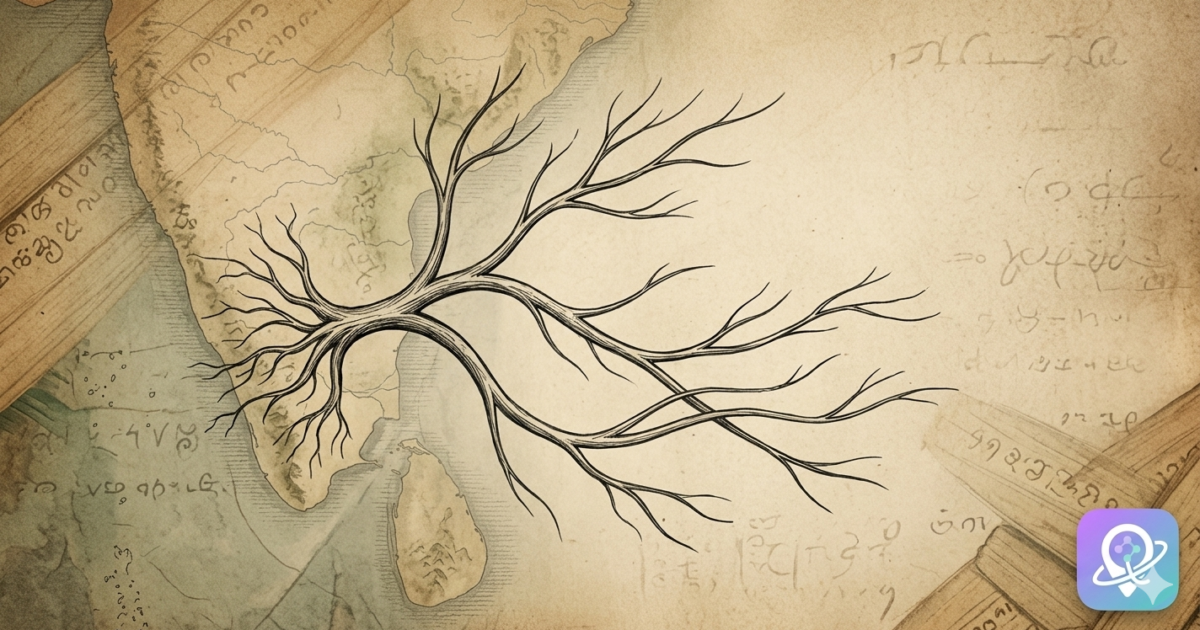
Tamil, Telugu, Kannada, and Malayalam — the four literary Dravidian languages — all descend from a reconstructed ancestor called Proto-Dravidian, spoken roughly 4,500 years ago somewhere in the southern or central Indian subcontinent. Tamil and Malayalam split last (~8th–9th century CE); Telugu and Kannada split earlier from a South-Central Dravidian branch; Brahui in Pakistan represents a much older northern offshoot. The four modern languages share 40–60% of core vocabulary (numbers, body parts, kinship terms) through regular sound correspondences — evidence of a common ancestor as concrete as any European Romance language family.
Tracing the Proto-Dravidian Roots
Linguists generally agree that Proto-Dravidian originated in the Indian subcontinent, though its precise geographical cradle is still debated. Estimates for its divergence range from 4,500 to 3,500 years ago, placing its existence roughly contemporaneous with or even predating the earliest attested Indo-Aryan languages in India. Evidence for Proto-Dravidian is reconstructed through the comparative method, analyzing systematic sound correspondences and grammatical patterns across its descendant languages. This process allows scholars to hypothesize the features of the unattested parent language, much like reconstructing Proto-Indo-European. Key shared features include a distinction between short and long vowels, a series of retroflex consonants, and a consistent agglutinative grammatical structure where suffixes are added to root words to convey meaning, rather than relying heavily on prepositions or word order as in many Indo-European languages.
Divergence and Early Literary Traditions
The split from Proto-Dravidian likely began with Proto-South Dravidian, which eventually branched into Tamil, Malayalam, Kannada, and Tulu, among others. Proto-South Central Dravidian led to Telugu and Gondi. Over time, geographical separation, political dynamics, and interactions with other language families (especially Sanskrit and later Persian and English) influenced their development.
Tamil: The Oldest Documented Literary Tradition
Tamil boasts the longest continuous literary tradition among the Dravidian languages, with its earliest known texts, such as the Tolkāppiyam (a grammatical treatise) and the Sangam literature, dating back to at least the 3rd century BCE and possibly earlier. This ancient corpus provides a rich window into early Tamil society, poetry, and philosophy. Its relative isolation from significant Indo-Aryan influence in its early stages preserved many archaic features of Proto-Dravidian, leading to its common perception as the most conservative of the major Dravidian languages. Modern Tamil continues to thrive, with a vibrant literary and cinematic culture.
Kannada: A Rich History of Inscriptions and Literature
Kannada’s literary history begins with inscriptions from the 5th century CE, with the first full-length literary work, the Kavirajamarga, appearing in the 9th century CE. This period saw the rise of significant Jain and Veerashaiva literary works, deeply influencing Kannada culture and thought. Geographically situated at a crossroads, Kannada has historically absorbed influences from both Tamil and Sanskrit, developing a distinct literary style that is both ancient and innovative. Its classical status was recognized by the Indian government in 2008.
Telugu: The "Italian of the East"
Telugu, often called the "Italian of the East" for its mellifluous sound, shows evidence of literary activity from the 6th century CE in inscriptions, but its classical literary period truly begins with Nannayya’s translation of the Mahabharata in the 11th century. Telugu literature flourished under various dynasties, notably the Kakatiyas and the Vijayanagara Empire, producing a wealth of poetry, drama, and prose. While sharing a common Dravidian base, Telugu has a significant historical influence from Sanskrit, particularly in its vocabulary and literary conventions, which gives it a unique character among its Dravidian siblings.
Malayalam: A Distinct Identity from Tamil
Malayalam emerged as a distinct language from Proto-Tamil-Malayalam around the 9th to 12th centuries CE. Prior to this, the language spoken in the region of present-day Kerala was an ancient dialect of Tamil. Over time, significant influence from Sanskrit, particularly through the Nambudiri Brahmins, led to the development of a unique phonology and vocabulary, setting it apart from Tamil. The Ramacharitam, from the 12th century, is considered one of the earliest literary works in Malayalam. Its linguistic journey showcases a fascinating case study of language divergence and the role of cultural contact in shaping identity.
Shared Heritage, Individual Pride
The shared ancestry of Tamil, Telugu, Kannada, and Malayalam is a testament to a deep historical connection among the people of South India. While each language and its speakers rightly take immense pride in their unique literary achievements, cultural expressions, and historical narratives, this pride does not diminish the recognition of their common linguistic roots. Instead, it enriches the understanding of a diverse yet interconnected heritage, fostering a sense of shared identity within the broader Dravidian linguistic family. The ongoing scholarship in Dravidian linguistics continues to uncover fascinating details about these ancient languages, reinforcing their significance in the global linguistic landscape.