TamizhConnect Blog
23 Jan 2026 · TamizhConnect
Chola Ancestry: Unraveling Myths, Uncovering History
Tamil genealogy article
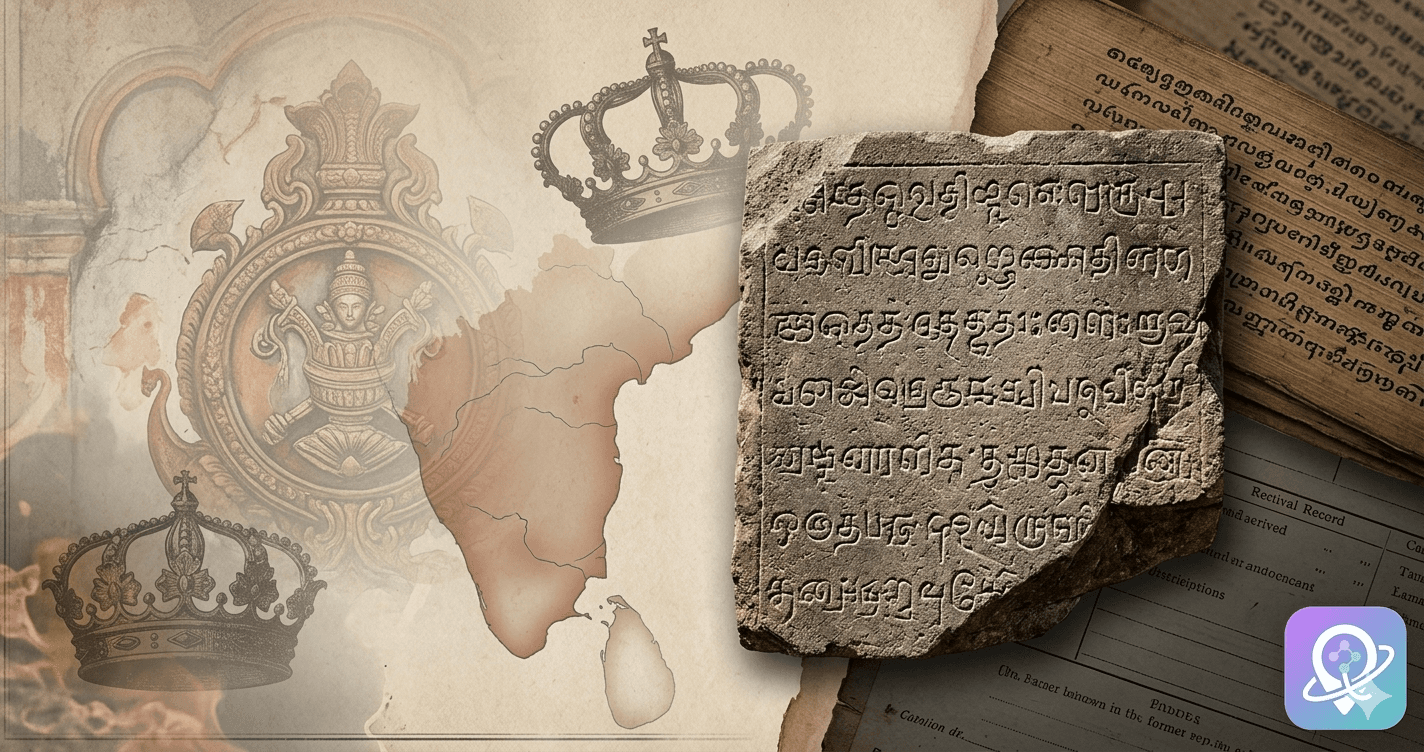
Explore the fascinating layers of Chola origin stories, distinguishing between legendary genealogies in inscriptions and historical evidence from Sangam literature. We'll examine how and why these narratives evolved over time.
Document Digitisation
Turn documents into verified Tamil lineage.
Choose the depth you need. One-time service, results stay in your account.
The Cholas ruled parts of Tamil Nadu and South India across roughly 1,300 years — Sangam-era Cholas from c. 300 BCE, Imperial Cholas c. 850–1279 CE — making them one of the longest continuous royal lineages documented anywhere. Most present-day Chola ancestry claims blur two distinct groups: the Sangam-era Cholas (mentioned in early Tamil literature as rulers of the Cauvery delta, genealogically unverifiable beyond named kings) and the Imperial Cholas (with inscription-based genealogies carved into stone across 400+ temples, traceable line-by-line). Knowing which era your claimed ancestry points to determines whether it can be evidence-based at all.
From the earliest mentions in Sangam literature to the grand imperial inscriptions, the Cholas crafted and embraced narratives that not only chronicled their achievements but also legitimized their rule and connected them to a venerable past. This post aims to navigate these layers, separating the historically verifiable from the legendary.
The Echoes of Sangam: Early Chola Mentions
Our earliest reliable glimpses of the Cholas come from the rich tapestry of Sangam literature, dating roughly from the 3rd century BCE to the 3rd century CE. Here, we meet figures like Karikalan and Killi Valavan, celebrated in poems for their martial prowess, patronage of arts, and administrative acumen. These texts, while often eulogistic, depict the Cholas as one of the three major ruling houses (alongside the Cheras and Pandyas) of ancient Tamilakam. They are portrayed as indigenous rulers, deeply rooted in the Tamil land and its cultural traditions.
Crucially, Sangam literature does not dwell on elaborate, pan-Indian mythical genealogies for the Cholas. Their legitimacy is derived from their actions, their victories, and their connection to the Tamil soil. The names of these early kings, like Karikalan ("the man with burnt leg") or Perunarkilli, are distinctly Tamil, reflecting local linguistic and cultural contexts. This period provides a foundational, historically grounded understanding of the Cholas before later narratives began to reshape their origins.
The Imperial Era: Crafting a Grand Narrative
Centuries after the Sangam period, the Cholas re-emerged from relative obscurity around the 9th century CE, establishing the formidable Imperial Chola dynasty. As they expanded their empire, their inscriptions—found on temple walls, copper plates, and stone monuments—became more than just records of donations or victories. They transformed into powerful instruments of political and cultural legitimation.
It is in these imperial inscriptions that we encounter the elaborate, mythical genealogies that often connect the Cholas to ancient, pan-Indian traditions. Kings like Rajaraja Chola I and Rajendra Chola I, while undoubtedly Tamil in their immediate lineage and cultural identity, embraced and promoted narratives that linked them to the Solar Dynasty (Suryavamsa), a lineage traditionally associated with North Indian Kshatriya dynasties like the Ikshvakus of Ayodhya. These genealogies would trace Chola origins back to mythical figures like Sibi, Manu, and even the sun god Surya himself.
Why this shift? The answer lies in the political and cultural landscape of imperial India. Connecting to the Solar Dynasty was a common strategy employed by various powerful dynasties across the subcontinent to elevate their status, claim ancient legitimacy, and align themselves with a prestigious, pan-Indian Kshatriya identity. It was a way to assert their position not just as powerful regional rulers, but as part of a grander, sacred order. This was not unique to the Cholas; many South Indian dynasties, including the Pallavas and Pandyas, also adopted similar mythical origins over time.
Sanskritization and Cultural Synthesis
The adoption of these pan-Indian mythical genealogies also reflects a broader process of cultural synthesis, sometimes termed 'Sanskritization.' While the Cholas remained fiercely proud of their Tamil heritage and promoted Tamil language and literature extensively, they also patronized Sanskrit scholars and incorporated elements of pan-Indian religious and cultural traditions. This was a strategic move to integrate their empire into a larger Indian cultural sphere and to appeal to diverse populations within their vast territories.
It's important to understand that these genealogical claims, while not historically verifiable in the modern sense, served a crucial socio-political function in their time. They were not meant to be literal historical records but rather symbolic assertions of power, prestige, and divine sanction. The kings who commissioned these inscriptions were not fabricating history in a deceptive way; they were participating in a well-understood cultural practice of constructing a glorious past to reinforce present authority.
Separating the Strands
For the modern inquirer, distinguishing between these layers is crucial. When we speak of Chola history, we rely on verifiable evidence: archaeological findings, coin hoards, and the vast body of inscriptions that detail their administrative structures, military campaigns, and cultural achievements. These tell us about the Cholas as they were – a powerful, innovative, and deeply Tamil empire.
When we encounter the mythical genealogies, we are looking at cultural artifacts that reveal how the Cholas perceived themselves and how they wished to be perceived. They offer insights into the political rhetoric, religious beliefs, and cultural aspirations of the time. While they don't provide a direct historical lineage, they are invaluable for understanding the ideology of the Chola state.
Ultimately, the Chola legacy is rich enough to accommodate both historical fact and legendary flourish. Their true power wasn't solely in a mythical lineage but in their profound impact on South Indian civilization, an impact still felt today in the grandeur of their temples and the echoes of their administration. Understanding the interplay between myth and history allows us to appreciate the Cholas not just as rulers, but as sophisticated architects of their own enduring narrative.
Share this article
TamizhConnect
TamizhConnect helps Tamil families worldwide trace their ancestry using voter records, indenture archives, and origin village matching. Our research team combines genealogy expertise with digitised Tamil Nadu datasets to help you discover your roots.
Ready to start your Tamil family tree?
TamizhConnect helps you discover relatives, trace your origin village, and keep your family history alive for the next generation.
Create your free TamizhConnect accountGo to my family treeDocument Digitisation
Have old documents? Upload them and we'll verify, trace, and add them to your tree.
Was this article helpful?
Get new articles in your inbox
Tamil genealogy tips, research guides, and new feature updates.
You might also like
Unearthing Tamil Nadu Ancestry: A Comprehensive Guide (English)
Tracing Tamil Nadu ancestry requires navigating a rich tapestry of ancient history, diverse migrations, and a unique record-keeping landscape. This guide explores the distinct challenges and rewarding paths for uncovering your roots.
18 Apr 2026
Understanding Your Roots: The Ancient Tamil Kingdoms (English)
Explore the historical significance and cultural impact of the Chola, Chera, and Pandya kingdoms to understand the broader context of your Tamil ancestry.
13 Apr 2026
Tracing Tamil Ancestry: Beyond Religious Narratives (English)
Uncover how modern research, from archaeology to genetics, sheds light on Tamil origins, moving beyond traditional religious accounts to explore a richer, evidence-based history.
20 Feb 2026
Tracing Roots: The Enduring Legacy of Ancient Tamil Kingdoms (English)
Explore the historical significance and lasting cultural impact of the Chola, Chera, and Pandya dynasties, providing context for your Tamil ancestry.
21 Jan 2026
தமிழ் மூதாதையர் ஆய்வு நூலகம் (Tamil)
TamizhConnect-க்கு தேவையான தமிழ் வம்சாவளி முறைகள், பதிவுகள், இனவியல் மற்றும் பாரம்பரியச் சரிபார்ப்புக்கான அனைத்து ஆழமான வழிகாட்டிகளும் ஒரே இடத்தில்.
02T21:31:39.751Z Sep 2026
Tamil ancestry research: Complete guide for genealogical methods (English)
All our deep-dive guides on Tamil genealogical methods, records, ethnography, and heritage validation for TamizhConnect.
02T21:31:39.750Z Sep 2026
Related by topic
Understanding Tamil Naming Conventions: Beyond 'Last Names' (English)
Tamil naming conventions traditionally do not feature fixed, inherited 'last names' in the Western sense, instead relying on a system of patronymics, village names, or caste indicators.
26 Apr 2026
Beyond 'Madras': Unpacking South Indian Ancestry in the Diaspora (English)
The colonial term 'Madras' often obscured the distinct linguistic and regional identities of South Indian indentured laborers. Learn how descendants can trace their specific Tamil, Telugu, or Malayalam heritage.
21 Apr 2026
More from TamizhConnect
Tamil Elder Interview Kit: Ready-to-Use Questions & Prompts (English)
A ready-to-copy interview kit for capturing Tamil family history from elders — grouped by topic, sequenced from easy to sensitive, with recording tips and follow-ups that unlock the stories behind the names.
21 Aug 2026
The Tamils of Dharavi: A Hundred Years from Tirunelveli to Mumbai (English)
From the droughts of Tirunelveli to the tanneries and textile mills of Mumbai, the Tamil community of Dharavi has built one of the largest Tamil cities outside Tamil Nadu. With redevelopment underway, here's how families can preserve their migration story for the next generation.
15 May 2026
Core topics
What is Tamil, really? Language, identity, and where it comes from
A clear, human explanation of what Tamil is-language, identity, people, and history-plus how to talk about it without stereotypes.
4 Feb 2026
What Defines Tamil Identity Beyond Borders and Sub-Groups? (English)
Tamil identity is primarily defined by shared language and cultural heritage, rather than by geographic borders or internal sub-group affiliations. This core identity persists across the diaspora and within Tamil Nadu.
17 Apr 2026
Continue reading
Tracing Tamil Ancestry in Sri Lanka's Complex Tapestry (English)
22 Jan 2026
Batticaloa – Lagoon, border violence and shared Tamil-Muslim memory: A complete guide to tracing your roots (English)
13 Jan 2026
மட்டக்களப்பு – ஏரி, எல்லை வன்முறை மற்றும் பகிரப்பட்ட தமிழ்-முஸ்லிம் நினைவு: உங்கள் மூதாதையரைக் கண்டறிவதற்கான முழுமையான வழிகாட்டி (Tamil)
13 Jan 2026
கொடிவழி / குடும்ப மரம் (kodivazhi Maram) – தமிழ்நாடு உறவுப் பெயர்கள் + Family Tree எழுதும் practical format (Tamil)
28 Dec 2025