TamizhConnect Blog
21 Jan 2026 · TamizhConnect
Tracing Roots: The Enduring Legacy of Ancient Tamil Kingdoms
Tamil genealogy article
Explore the historical significance and lasting cultural impact of the Chola, Chera, and Pandya dynasties, providing context for your Tamil ancestry.
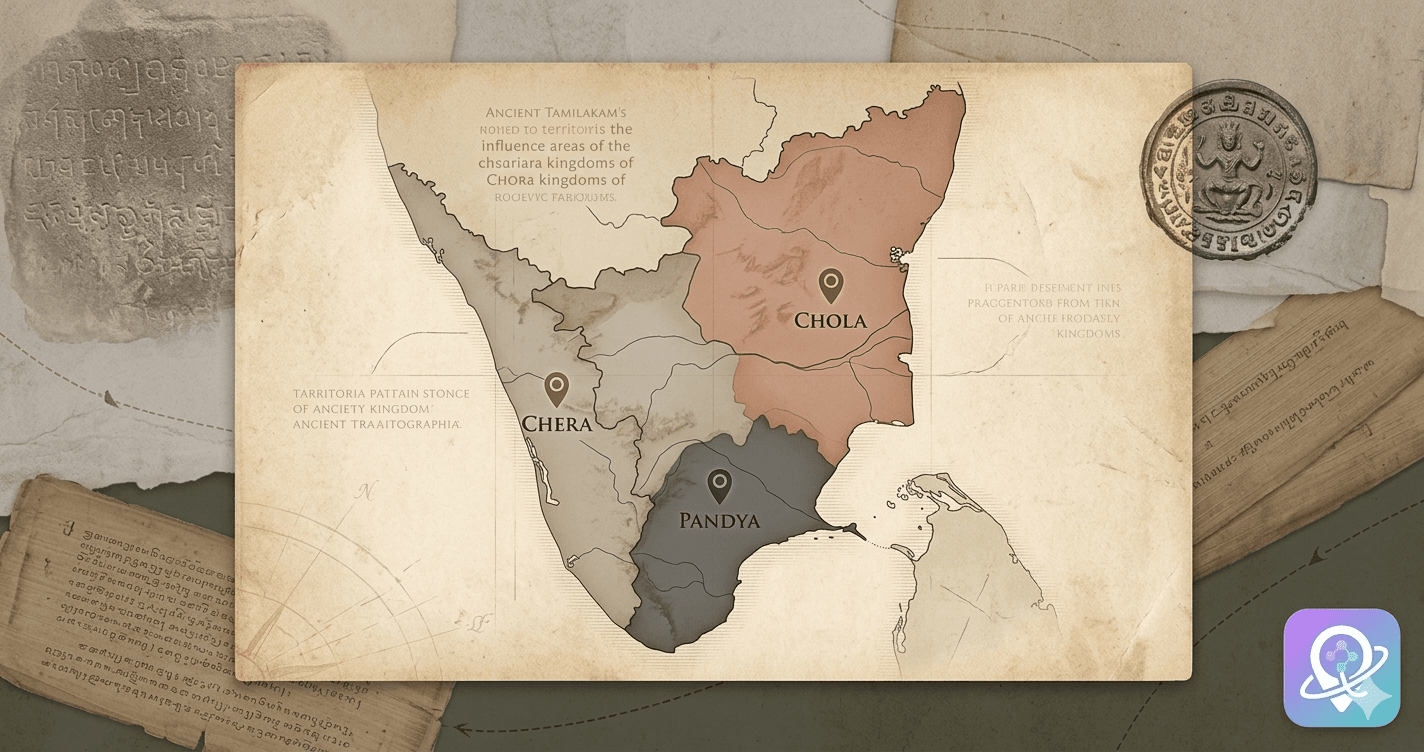
The three "Crowned Kings" of ancient Tamilakam — Cholas (Cauvery delta), Cheras (present-day Kerala and northwest Tamil Nadu), and Pandyas (Madurai and the south) — are documented continuously from Sangam literature (c. 300 BCE – 300 CE) through medieval stone inscriptions, giving Tamil history its deepest datable royal lineage. Direct royal-descent claims for present-day families are exceedingly rare (the lines were narrow). The practical value of the kingdoms for ancestry research is contextual: knowing which kingdom controlled a given district at a given century tells you which temple networks, land-grant systems, and script traditions produced the records your family may appear in.
The Cholas: Masters of Empire and Art
The Chola dynasty, perhaps the most renowned of the three, rose to prominence in the 9th century CE, eventually establishing a vast maritime empire that stretched across Southeast Asia. Their heartland was the fertile Kaveri delta, with capitals shifting over time from Uraiyur to Thanjavur and Gangaikonda Cholapuram. The Cholas were exceptional patrons of art and architecture, responsible for some of the most magnificent Dravidian temples, including the Brihadeeswarar Temple in Thanjavur, a UNESCO World Heritage site. These temples were not merely places of worship but also centers of community life, administration, and economic activity. Their bronze sculptures, particularly the Nataraja series, are celebrated globally for their artistic sophistication and spiritual depth. For those with ancestral ties to the Kaveri region or coastal Tamil Nadu, the Chola era represents a period of immense cultural flourishing and international connection, influencing surnames, village names, and local customs.
The Cholas' naval prowess allowed them to control key trade routes across the Bay of Bengal, establishing cultural and economic ties with Sri Lanka, the Maldives, and Southeast Asian kingdoms like Srivijaya (modern-day Indonesia and Malaysia). This extensive network meant that people from Chola territories might have traveled, settled, or engaged in commerce far beyond the subcontinent, a factor worth considering for diaspora communities. Their sophisticated administrative system, including land surveys and local self-governance, laid foundations that continued to influence regional structures for centuries.
The Pandyas: Patrons of Literature and Pearl Trade
Operating primarily from the southern parts of Tamil Nadu, with Madurai as their iconic capital, the Pandya dynasty boasts an even longer, though often less continuously documented, history, with mentions in ancient Sangam literature dating back to the 3rd century BCE. The Pandyas were celebrated patrons of Tamil literature and the arts, and the city of Madurai, under their rule, became a renowned center for poets and scholars. The legendary Tamil Sangams (academies) are associated with Pandya patronage, fostering the development of classical Tamil poetry and grammar. The Silappadikaram and Manimekalai, two of the five great Tamil epics, vividly depict Pandya society and culture.
Economically, the Pandyas were famous for their pearl fisheries in the Gulf of Mannar, particularly around Korkai and later Thoothukudi. Their pearls were highly prized in ancient Rome, Greece, and China, making them significant players in international trade. The enduring cultural legacy of the Pandyas is evident in the Meenakshi Amman Temple in Madurai, a sprawling architectural marvel that stands as a testament to their devotion and artistic vision. Families tracing roots to southern Tamil Nadu, especially around Madurai, Tirunelveli, and Thoothukudi, will find the Pandya influence deeply embedded in local traditions, festivals, and even dialectal variations.
The Cheras: Guardians of the Western Ghats and Spice Trade
While often overshadowed by their eastern counterparts, the Chera dynasty held sway over the western regions of Tamilakam, primarily modern-day Kerala and parts of Kongu Nadu (western Tamil Nadu). Their capitals included Karur (Vanji) and Muziris (Pattanam), a crucial port city on the Malabar Coast. The Cheras were pivotal in the lucrative spice trade, particularly black pepper, which brought Roman and other foreign merchants to their shores. Roman coins unearthed in Kerala and Tamil Nadu attest to the vibrant trade relations fostered by the Cheras.
The Cheras were also known for their martial prowess and their unique cultural identity, which, while sharing commonalities with the rest of Tamilakam, also developed distinct characteristics that laid the groundwork for modern Malayalam culture. Their contributions to Sangam literature are significant, with many Chera kings and poets featured in anthologies like the Pathitrupathu, which exclusively praises Chera rulers. For those with ancestry in western Tamil Nadu or Kerala, understanding the Chera kingdom is vital. Their legacy is seen in specific agricultural practices, trade routes through mountain passes, and the early cultural exchanges that shaped the region's unique identity.
Interconnected Legacies and Modern Relevance
The history of the Cholas, Cheras, and Pandyas is not one of isolated entities but of constant interaction, rivalry, and occasional alliances. Their territories often overlapped, and their influence waxed and waned, creating a dynamic historical tapestry. This constant interplay meant that cultural practices, religious beliefs, and even populations moved across their respective domains. For individuals researching their ancestry, understanding these ancient kingdoms provides a crucial framework for interpreting historical migration patterns, regional cultural variations, and the deep-seated pride in Tamil identity. While direct genealogical records from these ancient periods are scarce, the study of these kingdoms enriches the narrative of one's Tamil heritage, connecting individual stories to a grand and enduring civilization.
Share this article
TamizhConnect
TamizhConnect helps Tamil families worldwide trace their ancestry using voter records, indenture archives, and origin village matching. Our research team combines genealogy expertise with digitised Tamil Nadu datasets to help you discover your roots.
Ready to start your Tamil family tree?
TamizhConnect helps you discover relatives, trace your origin village, and keep your family history alive for the next generation.
Create your free TamizhConnect accountGo to my family treeDocument Digitisation
Have old documents? Upload them and we'll verify, trace, and add them to your tree.
Was this article helpful?
Get new articles in your inbox
Tamil genealogy tips, research guides, and new feature updates.
You might also like
Unearthing Tamil Nadu Ancestry: A Comprehensive Guide (English)
Tracing Tamil Nadu ancestry requires navigating a rich tapestry of ancient history, diverse migrations, and a unique record-keeping landscape. This guide explores the distinct challenges and rewarding paths for uncovering your roots.
18 Apr 2026
Understanding Your Roots: The Ancient Tamil Kingdoms (English)
Explore the historical significance and cultural impact of the Chola, Chera, and Pandya kingdoms to understand the broader context of your Tamil ancestry.
13 Apr 2026
Tracing Tamil Ancestry: Beyond Religious Narratives (English)
Uncover how modern research, from archaeology to genetics, sheds light on Tamil origins, moving beyond traditional religious accounts to explore a richer, evidence-based history.
20 Feb 2026
Chola Ancestry: Unraveling Myths, Uncovering History (English)
Explore the fascinating layers of Chola origin stories, distinguishing between legendary genealogies in inscriptions and historical evidence from Sangam literature. We'll examine how and why these narratives evolved over time.
23 Jan 2026
தமிழ் மூதாதையர் ஆய்வு நூலகம் (Tamil)
TamizhConnect-க்கு தேவையான தமிழ் வம்சாவளி முறைகள், பதிவுகள், இனவியல் மற்றும் பாரம்பரியச் சரிபார்ப்புக்கான அனைத்து ஆழமான வழிகாட்டிகளும் ஒரே இடத்தில்.
02T21:31:39.751Z Sep 2026
Tamil ancestry research: Complete guide for genealogical methods (English)
All our deep-dive guides on Tamil genealogical methods, records, ethnography, and heritage validation for TamizhConnect.
02T21:31:39.750Z Sep 2026
Related by topic
Understanding Tamil Naming Conventions: Beyond 'Last Names' (English)
Tamil naming conventions traditionally do not feature fixed, inherited 'last names' in the Western sense, instead relying on a system of patronymics, village names, or caste indicators.
26 Apr 2026
Beyond 'Madras': Unpacking South Indian Ancestry in the Diaspora (English)
The colonial term 'Madras' often obscured the distinct linguistic and regional identities of South Indian indentured laborers. Learn how descendants can trace their specific Tamil, Telugu, or Malayalam heritage.
21 Apr 2026
More from TamizhConnect
Tamil Elder Interview Kit: Ready-to-Use Questions & Prompts (English)
A ready-to-copy interview kit for capturing Tamil family history from elders — grouped by topic, sequenced from easy to sensitive, with recording tips and follow-ups that unlock the stories behind the names.
21 Aug 2026
The Tamils of Dharavi: A Hundred Years from Tirunelveli to Mumbai (English)
From the droughts of Tirunelveli to the tanneries and textile mills of Mumbai, the Tamil community of Dharavi has built one of the largest Tamil cities outside Tamil Nadu. With redevelopment underway, here's how families can preserve their migration story for the next generation.
15 May 2026
Core topics
What is Tamil, really? Language, identity, and where it comes from
A clear, human explanation of what Tamil is-language, identity, people, and history-plus how to talk about it without stereotypes.
4 Feb 2026
What Defines Tamil Identity Beyond Borders and Sub-Groups? (English)
Tamil identity is primarily defined by shared language and cultural heritage, rather than by geographic borders or internal sub-group affiliations. This core identity persists across the diaspora and within Tamil Nadu.
17 Apr 2026
Continue reading
Batticaloa – Lagoon, border violence and shared Tamil-Muslim memory: A complete guide to tracing your roots (English)
13 Jan 2026
மட்டக்களப்பு – ஏரி, எல்லை வன்முறை மற்றும் பகிரப்பட்ட தமிழ்-முஸ்லிம் நினைவு: உங்கள் மூதாதையரைக் கண்டறிவதற்கான முழுமையான வழிகாட்டி (Tamil)
13 Jan 2026
கொடிவழி / குடும்ப மரம் (kodivazhi Maram) – தமிழ்நாடு உறவுப் பெயர்கள் + Family Tree எழுதும் practical format (Tamil)
28 Dec 2025
கொடிவழி / குடும்ப மரம் (kodivazhi Maram) – மலேசிய தமிழ் உறவுப் பெயர்கள் + பெயர்/ஆவண format-க்கு ஏற்ற family tree guide (Tamil)
28 Dec 2025