TamizhConnect Blog
13 Apr 2026 · TamizhConnect
Understanding Your Roots: The Ancient Tamil Kingdoms
Tamil genealogy article
Explore the historical significance and cultural impact of the Chola, Chera, and Pandya kingdoms to understand the broader context of your Tamil ancestry.
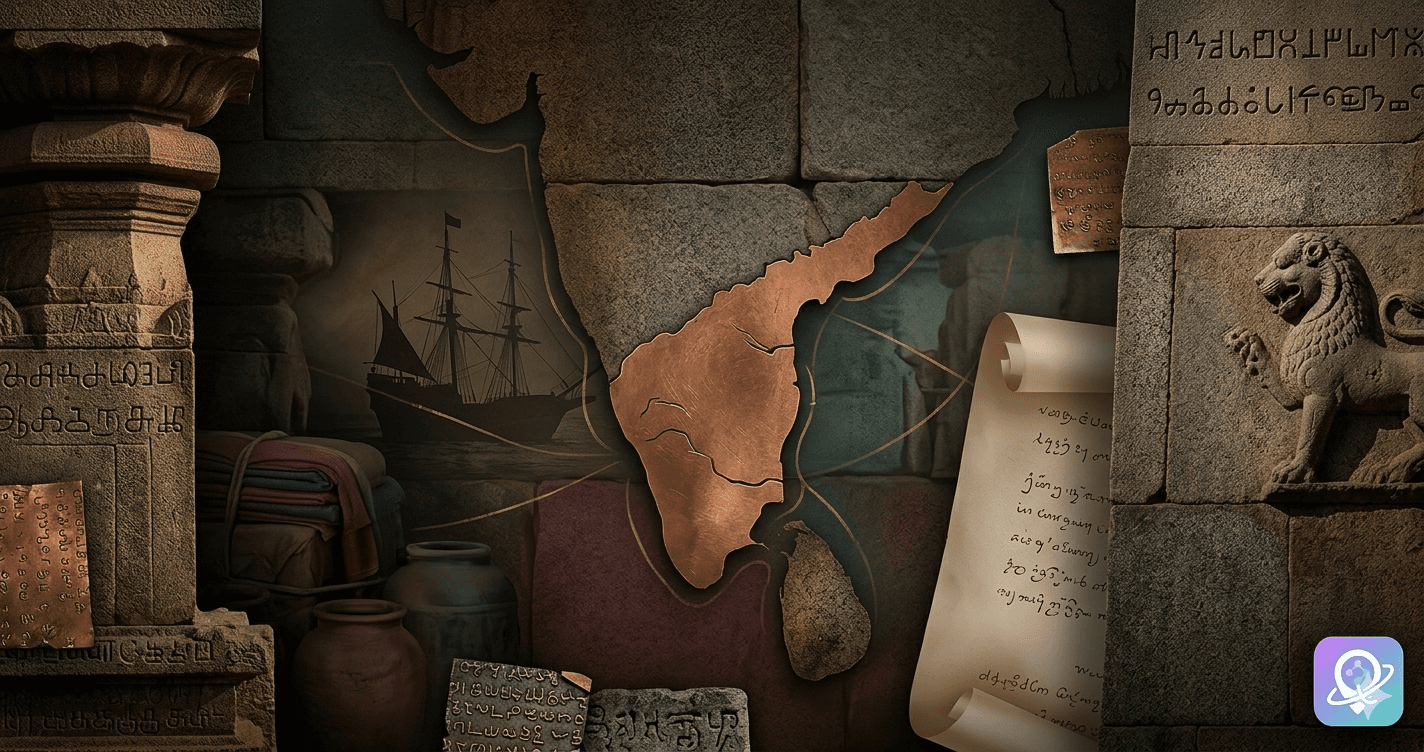
The three ancient Tamil kingdoms — Chera (present-day central and northern Kerala + northwest Tamil Nadu), Chola (Cauvery delta and later pan-peninsular), and Pandya (Madurai region and southern Tamil Nadu) — are documented continuously from Sangam literature (c. 300 BCE – 300 CE) through medieval stone inscriptions, giving Tamil history its deepest datable lineage. Direct royal-descent claims for present-day families are extremely rare (royal lines were narrow). The practical value of these kingdoms for ancestry research is contextual: knowing which kingdom controlled a given district at a given century tells you which temple networks, land-grant systems, and script traditions produced the records your family may appear in.
The Cheras: Masters of the Western Ghats and Maritime Trade
The Chera kingdom, often associated with present-day Kerala and parts of western Tamil Nadu, flourished as a significant power from the Sangam period (roughly 3rd century BCE to 3rd century CE) through the medieval era. Their strategic location along the Malabar Coast granted them unparalleled access to lucrative maritime trade routes connecting India with the Roman Empire, the Middle East, and Southeast Asia. Spices, especially pepper, timber, and precious stones were key exports, bringing immense wealth and cultural exchange to the Chera heartland. Ports like Muziris (Pattanam) were bustling cosmopolitan centers, attracting merchants and travelers from distant lands.
Chera rulers were known for their patronage of Tamil literature and the arts, and their military prowess, often engaging in conflicts with their Chola and Pandya neighbors. While their early history is somewhat obscured by the later rise of other powers, the Cheras re-emerged with prominence in the 9th century as the Kulasekharas of Mahodayapuram (Kodungallur), leaving behind a rich legacy of temple architecture and inscriptions that detail their administration and societal structure. For individuals tracing ancestry to regions in Kerala or the western Tamil Nadu plains, the Chera influence is a significant historical backdrop.
The Cholas: An Empire of Temples and Overseas Reach
Perhaps the most widely recognized of the three, the Chola dynasty (primarily 9th to 13th centuries CE, with earlier Sangam roots) built an empire that stretched across South India and extended its influence far into Southeast Asia. Their capital, Thanjavur, became a center of art, architecture, and learning, epitomized by the magnificent Brihadeeswarar Temple, a UNESCO World Heritage site and a testament to Chola engineering and artistic genius. The Cholas were master builders, constructing not only grand temples but also sophisticated irrigation systems that transformed the Cauvery delta into a fertile agricultural heartland.
The Chola navy was formidable, allowing rulers like Rajaraja Chola I and his son Rajendra Chola I to launch successful naval expeditions against Sri Lanka, the Maldives, and even distant Srivijaya (modern-day Indonesia and Malaysia). These campaigns were driven by a desire to control trade routes and assert regional dominance, leading to significant cultural exchange and the spread of Tamil influence abroad. The Chola period is often considered a golden age of Tamil culture, marked by advancements in literature, sculpture, bronze casting, and administration. Ancestors from the Cauvery delta, northern Tamil Nadu, and even parts of Sri Lanka often find their historical context deeply intertwined with the Chola legacy.
The Pandyas: Patrons of Sangam Literature and Southern Dominance
Ruling from their capital in Madurai, the Pandyas boast an even longer continuous history than the Cholas, with their presence documented from the Sangam period through the 16th century, albeit with periods of decline and resurgence. The Pandya kingdom was a vital center for Tamil literature and learning, famously hosting the Tamil Sangams (academies) that are credited with compiling vast collections of classical Tamil poetry and grammar. Madurai itself was celebrated in Sangam literature as a vibrant city, a hub of commerce, and a seat of cultural refinement.
The Pandyas controlled the southernmost tip of the Indian subcontinent, including crucial pearl fisheries in the Gulf of Mannar, which contributed significantly to their wealth and attracted traders from across the ancient world. Like their rivals, they were active in maritime trade and maintained diplomatic ties with various empires. While their empire did not achieve the same overseas territorial expansion as the Cholas, the Pandyas were formidable regional players, frequently clashing with the Cholas and Cheras for supremacy. Their lasting impact is seen in the rich literary tradition they fostered and the numerous rock-cut temples and structural temples, particularly in the Tirunelveli and Madurai regions, that bear their architectural stamp. For families with roots in southern Tamil Nadu, the Pandya heritage offers a profound connection to ancient Tamil identity.
Intertwined Legacies and Lasting Influence
While each kingdom possessed distinct characteristics, their histories were often intertwined through alliances, rivalries, and cultural exchange. The shifting boundaries and periods of dominance mean that many regions experienced the influence of more than one dynasty over time. This dynamic interplay contributed to a rich and diverse Tamil heritage, shaping language, art, religion, and social structures across the Tamil-speaking world. Understanding these ancient kingdoms provides a deeper appreciation for the historical tapestry from which your own Tamil lineage emerges, offering context to migration patterns, cultural practices, and the enduring spirit of the Tamil people.
Share this article
TamizhConnect
TamizhConnect helps Tamil families worldwide trace their ancestry using voter records, indenture archives, and origin village matching. Our research team combines genealogy expertise with digitised Tamil Nadu datasets to help you discover your roots.
Ready to start your Tamil family tree?
TamizhConnect helps you discover relatives, trace your origin village, and keep your family history alive for the next generation.
Create your free TamizhConnect accountGo to my family treeDocument Digitisation
Have old documents? Upload them and we'll verify, trace, and add them to your tree.
Was this article helpful?
Get new articles in your inbox
Tamil genealogy tips, research guides, and new feature updates.
You might also like
Unearthing Tamil Nadu Ancestry: A Comprehensive Guide (English)
Tracing Tamil Nadu ancestry requires navigating a rich tapestry of ancient history, diverse migrations, and a unique record-keeping landscape. This guide explores the distinct challenges and rewarding paths for uncovering your roots.
18 Apr 2026
Tracing Your Lineage: What Genealogy Means in Tamil Culture (English)
Genealogy, or 'வம்சாவளி' (vamsāvaḷi) in Tamil, is the study of family history and ancestral lines, deeply rooted in Tamil cultural identity.
25 Mar 2026
Tracing Tamil Ancestry in Sri Lanka's Complex Tapestry (English)
Uncover the unique challenges and surprising opportunities for researching Tamil family history in Sri Lanka, navigating centuries of records and recent conflicts.
18 Mar 2026
Crafting Your Tamil Family History: Narrative Paths to Explore (English)
Uncover various narrative structures for your Tamil family history, from chronological journeys to thematic explorations, and find the perfect fit for your unique story.
27 Feb 2026
தமிழ் மூதாதையர் ஆய்வு நூலகம் (Tamil)
TamizhConnect-க்கு தேவையான தமிழ் வம்சாவளி முறைகள், பதிவுகள், இனவியல் மற்றும் பாரம்பரியச் சரிபார்ப்புக்கான அனைத்து ஆழமான வழிகாட்டிகளும் ஒரே இடத்தில்.
02T21:31:40.701Z Sep 2026
Tamil ancestry research: Complete guide for genealogical methods (English)
All our deep-dive guides on Tamil genealogical methods, records, ethnography, and heritage validation for TamizhConnect.
02T21:31:40.700Z Sep 2026
Related by topic
Tracing Tamil Ancestry: Beyond Religious Narratives (English)
Uncover how modern research, from archaeology to genetics, sheds light on Tamil origins, moving beyond traditional religious accounts to explore a richer, evidence-based history.
20 Feb 2026
Tracing Brahmin Ancestry Between Tamil Nadu and Sri Lanka (English)
Explore the historical ties and migratory patterns of Brahmin communities connecting Tamil Nadu and Sri Lanka, and learn how to trace this unique heritage.
3 Feb 2026
More from TamizhConnect
Tamil Elder Interview Kit: Ready-to-Use Questions & Prompts (English)
A ready-to-copy interview kit for capturing Tamil family history from elders — grouped by topic, sequenced from easy to sensitive, with recording tips and follow-ups that unlock the stories behind the names.
21 Aug 2026
The Tamils of Dharavi: A Hundred Years from Tirunelveli to Mumbai (English)
From the droughts of Tirunelveli to the tanneries and textile mills of Mumbai, the Tamil community of Dharavi has built one of the largest Tamil cities outside Tamil Nadu. With redevelopment underway, here's how families can preserve their migration story for the next generation.
15 May 2026
Core topics
What is Tamil, really? Language, identity, and where it comes from
A clear, human explanation of what Tamil is-language, identity, people, and history-plus how to talk about it without stereotypes.
4 Feb 2026
What Defines Tamil Identity Beyond Borders and Sub-Groups? (English)
Tamil identity is primarily defined by shared language and cultural heritage, rather than by geographic borders or internal sub-group affiliations. This core identity persists across the diaspora and within Tamil Nadu.
17 Apr 2026