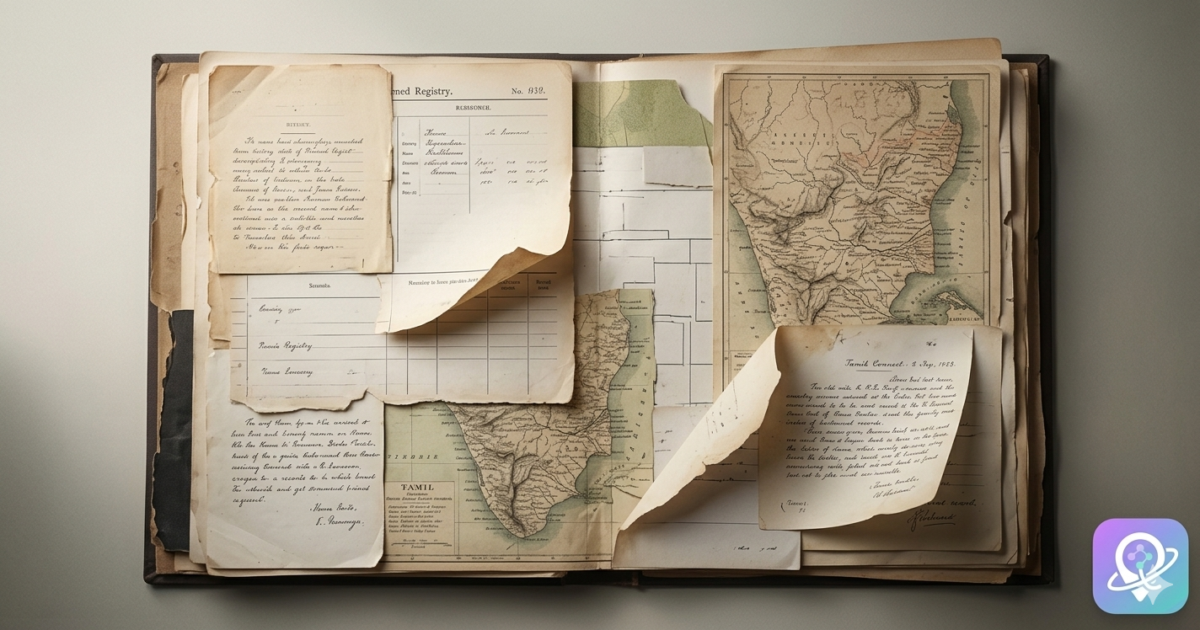
Tamil ancestry research, when pursued as evidence-based genealogy rather than cultural identity, draws on three scientific methods: archaeology (Keeladi and related sites suggesting urban Tamil culture by c. 600 BCE), historical linguistics (Proto-Dravidian reconstruction placing the language family’s deep origin in the Indian subcontinent, not imported), and population genetics (the ASI/ANI mixing model described in related posts). These methods complement rather than replace religious and literary origin narratives — descent from Agastya, links to the submerged Kumari Kandam, lineage claims in temple inscriptions. Each type of evidence serves a different purpose: religious narratives anchor identity and belonging; scientific methods provide dateable, falsifiable claims. Understanding the distinction helps decide which kind of claim belongs in which kind of conversation.
The Nature of Religious Origin Stories
Religious origin stories, whether from Abrahamic traditions or indigenous spiritual systems, serve crucial cultural and theological purposes. They often explain the creation of the world, humanity, and specific communities, providing moral frameworks and a sense of shared destiny. For instance, some traditions trace lineage back to figures like Adam or Noah, or to divine progenitors. These accounts are fundamental to faith and identity, offering spiritual truths and a sense of belonging that transcends empirical proof. They are not intended to be historical documents in the modern scientific sense, but rather profound expressions of a community’s understanding of its place in the cosmos and its relationship with the divine. When it comes to Tamil heritage, various traditional narratives, often embedded in ancient literature and folklore, speak to the deep antiquity and unique journey of the Tamil people, sometimes linking them to ancient sages or legendary landmasses.
Archaeological Insights into Tamil Origins
Archaeology provides tangible evidence of human presence and activity over vast stretches of time. For Tamil ancestry, archaeological findings have been instrumental in pushing back the documented timeline of organized human settlements and cultural practices in Tamil Nadu. Sites like Adichanallur, Keezhadi, and Porunthal have unearthed a wealth of artifacts, including pottery with graffiti marks that hint at an early form of writing, iron implements, and sophisticated urban planning. These discoveries point to a thriving, complex civilization in the Tamil region dating back well over 2,000 years, and potentially much earlier. The findings at Keezhadi, in particular, have generated significant interest, with carbon dating suggesting an urban settlement flourishing as early as the 6th century BCE, challenging previous assumptions about the timeline of urbanization in South India. While archaeology doesn’t trace individual family lines, it paints a broad picture of continuous human habitation, cultural development, and technological advancements that form the bedrock of Tamil heritage.
Linguistic Evidence: The Dravidian Family
Linguistics offers another powerful tool for understanding deep historical connections. Tamil belongs to the Dravidian language family, a group of languages predominantly spoken in South India and parts of Sri Lanka, as well as by diaspora communities worldwide. The study of Dravidian languages, their origins, and their relationships to other language families provides clues about ancient migrations and interactions. Scholars generally agree that the Dravidian languages have an ancient independent origin in the Indian subcontinent, distinct from the Indo-Aryan languages that arrived later. The presence of Dravidian loanwords in ancient Sanskrit texts further underscores the deep historical interaction between these linguistic groups. While linguistics can’t pinpoint a single ancestral ‘prophet,’ it can trace the evolution and divergence of language families, suggesting a long and continuous linguistic history for Tamil speakers that predates many documented historical periods.
Genetic Studies: Unraveling Population Histories
In recent decades, genetic research has added a fascinating dimension to understanding human ancestry. By analyzing DNA, scientists can trace genetic markers across populations, revealing patterns of migration, intermixing, and deep ancestral connections. Studies on the genetic makeup of South Indian populations, including Tamils, have shown a complex tapestry of ancient lineages. These studies often indicate a deep genetic continuity in the region, with contributions from ancient populations that migrated into the subcontinent millennia ago, as well as subsequent interactions. For instance, genetic research points to early migrations out of Africa, with subsequent waves of movement and mixing within the Indian subcontinent. While specific studies on Tamil populations are ongoing and complex, the general consensus suggests that the genetic heritage of Tamils is a rich blend of ancient indigenous lineages and contributions from various migrations over tens of thousands of years. It’s crucial to understand that genetics deals with populations and their broad movements, not with individual religious figures or specific ancestral ‘prophets’ in the traditional sense.
Bridging Narratives: Science and Heritage
It’s important to recognize that scientific approaches to ancestry and religious narratives are not necessarily in conflict; rather, they operate on different planes of understanding. Religious stories provide spiritual meaning and cultural identity, while scientific inquiry seeks empirical evidence to reconstruct historical and biological timelines. For those curious about their Tamil ancestry, engaging with both perspectives can offer a richer, more nuanced appreciation of their heritage. Understanding the archaeological record provides a tangible connection to ancient civilizations, linguistic studies reveal the deep roots of their mother tongue, and genetic research offers insights into the biological tapestry of their lineage. Together, these scientific disciplines illuminate a history that is long, complex, and deeply embedded in the land, offering a complementary lens to the profound cultural and spiritual narratives that have sustained the Tamil people for millennia.