TamizhConnect Blog
18 Feb 2026 · TamizhConnect
Tracing Tamil Ancestry in the Caribbean Diaspora
Tamil genealogy article
Uncover the complex history of Tamil indentured laborers in the Caribbean, the challenges of tracing their heritage through colonial records, and how Tamil culture endures.
Document Digitisation
Turn documents into verified Tamil lineage.
Choose the depth you need. One-time service, results stay in your account.
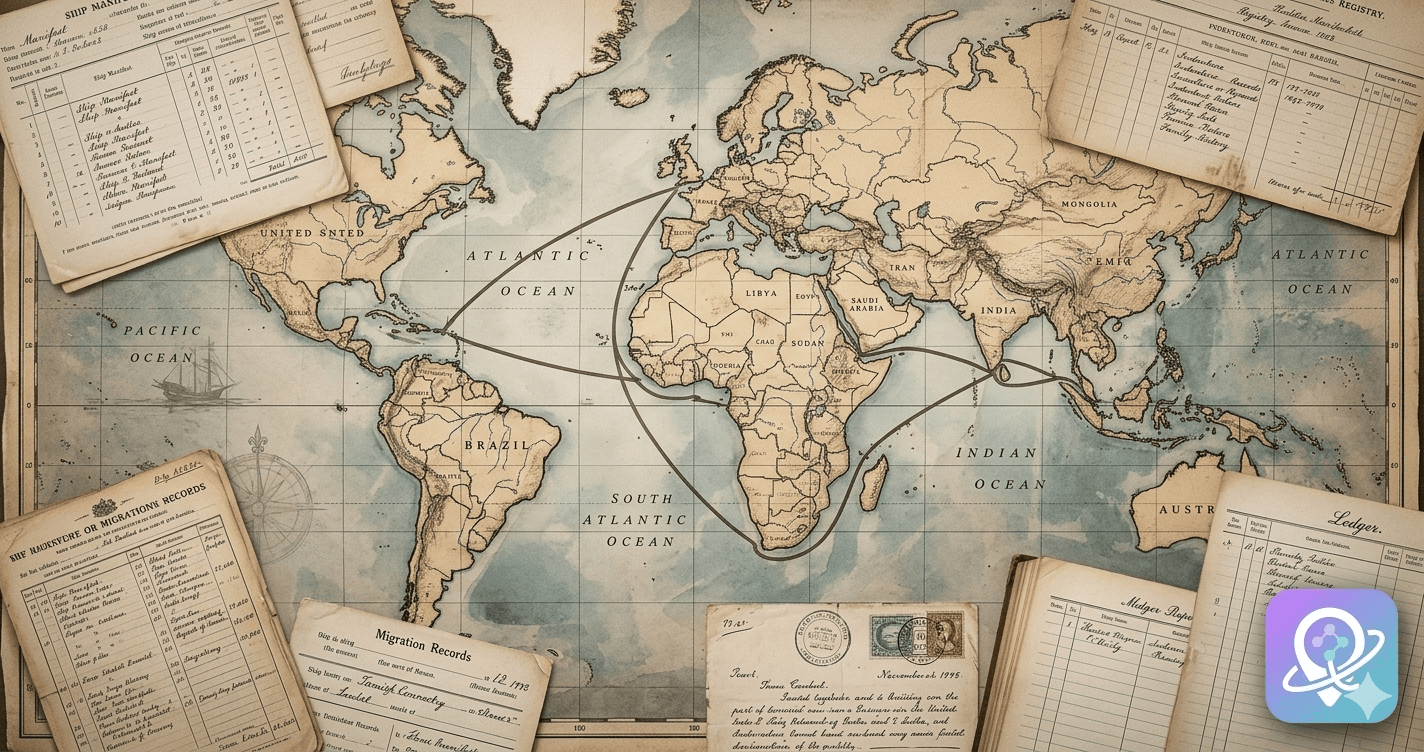
Tamil ancestry in the Caribbean traces almost entirely to the indentured labour period of 1845–1917, when roughly 100,000 South Indians — Tamils a significant but minority share, outnumbered by Bhojpuri speakers from the Hindi belt — were shipped to Trinidad, Guyana, Suriname, Jamaica, Grenada, Martinique, and Guadeloupe to work British, Dutch, and French sugar plantations. Records for the Tamil share are thinner than for the Bhojpuri majority because the primary recruiting port, Madras, maintained less detailed emigration paperwork than Calcutta. The best surviving sources are ship manifests, plantation employment rolls, and post-1945 return-passage records — none comprehensive, all usable with cross-referencing.
The Indentured Labor System and Tamil Recruitment
The indentured labor system emerged in the mid-19th century as a replacement for enslaved African labor following emancipation. British colonial powers, facing labor shortages in their Caribbean sugar colonies, turned to India to recruit workers under contract. Recruitment agents, known as arkatis in North India and kanganis in the South, often used deceptive tactics, promising prosperity and easy work to villagers facing famine, economic hardship, or social pressures. While many recruits came from the Gangetic plains, a substantial proportion, particularly those destined for Trinidad, British Guiana (now Guyana), and Suriname, were from the Madras Presidency, which encompassed much of present-day Tamil Nadu, Andhra Pradesh, Kerala, and parts of Karnataka.
Tamil laborers typically embarked from the port of Madras (Chennai), though some may have been processed through Pondicherry, a French enclave, or even Calcutta (Kolkata) if they had migrated north. The ships, often overcrowded and unsanitary, undertook journeys that could last several months, resulting in high mortality rates. Upon arrival, laborers were assigned to plantations and bound by contracts that dictated their wages, living conditions, and term of service, usually five years, after which they could re-indenture or, less commonly, opt for repatriation. The conditions were often harsh, resembling a new form of servitude, yet many persevered, eventually establishing families and communities that laid the foundation for today's Indo-Caribbean populations.
Challenges in Tracing Tamil Heritage
Tracing specific Tamil ancestry through colonial records presents significant challenges. The primary records for indentured laborers are the Emigration Passes or Registers, maintained at the ports of embarkation and disembarkation. These registers typically recorded details such as the laborer's name, father's name, age, caste, village of origin, and destination. However, several factors complicate their use:
- Anglicization of Names: Colonial clerks often struggled with Tamil names, leading to phonetic spellings or deliberate anglicization that can make identification difficult. A name like 'Muthu' might appear as 'Moothoo' or 'Muthoo'.
- Vague Place Names: Village names were sometimes recorded inaccurately or vaguely, making it hard to pinpoint an exact ancestral village in Tamil Nadu. A common entry might simply be 'Madras Presidency' or a district name like 'Chingleput' (Chengalpattu) or 'Arcot' (Arkkadu).
- Caste Information: While caste was recorded, its significance and accuracy varied. Furthermore, caste names might have been simplified or generalized by colonial administrators, making it less useful for precise lineage tracing than in a traditional Tamil context.
- Loss or Damage of Records: Many records have been lost, damaged, or are difficult to access, scattered across archives in India, the UK, and the Caribbean nations.
- Language Barrier: The original records are often in English, but understanding the cultural context and linguistic nuances of Tamil names and places is crucial for accurate interpretation.
Despite these hurdles, dedicated researchers and institutions are digitizing and cross-referencing these records, making them more accessible to descendants. Websites like the Indian Culture Portal and various national archives in the Caribbean are valuable starting points.
Cultural Preservation and Transformation
Despite the harsh conditions and the deliberate efforts of colonial powers to suppress traditional identities, Tamil cultural elements have remarkably persevered and transformed in the Caribbean. Language, however, was one of the first casualties. While some Tamil words and phrases are still found in Indo-Caribbean dialects, particularly in religious contexts, the spoken language largely faded within a few generations as English became dominant.
Religious practices, particularly forms of Hinduism, remained a strong anchor for identity. Many Tamil-specific deities and rituals, such as the worship of Mariamman (Mother Mary, often syncretized with local deities) and the observance of festivals like Thaipusam and Deepavali, continue to be practiced. The Kala Pani experience fostered a more generalized 'Indian' identity, but regional traditions, including Tamil ones, often fused into a broader Indo-Caribbean Hinduism.
Cuisine also reflects Tamil influences, with dishes like sambar, rasam, and various lentil preparations becoming staples, albeit adapted with local ingredients and flavors. Music, dance, and storytelling traditions, though evolving, still carry echoes of their South Indian origins. The Chutney music genre, popular in Trinidad and Guyana, often incorporates rhythms and lyrical themes that resonate with ancestral folk traditions.
Connecting with Ancestry Today
For descendants in the Caribbean seeking to connect with their Tamil heritage, the journey requires patience and a multi-faceted approach. Start by gathering all available family information: names of ancestors, their approximate arrival dates, and any known villages or districts. Consult family elders for oral histories, stories, and any old documents they might possess. Then, delve into archival research using online databases and physical archives in their respective Caribbean nations. Cross-referencing names and details with emigration passes can sometimes lead to a breakthrough, potentially revealing the original village in Tamil Nadu.
Beyond records, engaging with cultural organizations, temples, and academic institutions focused on the Indo-Caribbean diaspora can provide invaluable insights and community connections. DNA testing, while not a definitive answer for specific village origins, can confirm South Indian ethnicity and provide broader regional connections. The journey to trace Tamil ancestry in the Caribbean is not just about names and dates; it is about reclaiming a rich, resilient heritage that traversed oceans and endured generations.
Share this article
TamizhConnect
TamizhConnect helps Tamil families worldwide trace their ancestry using voter records, indenture archives, and origin village matching. Our research team combines genealogy expertise with digitised Tamil Nadu datasets to help you discover your roots.
Ready to start your Tamil family tree?
TamizhConnect helps you discover relatives, trace your origin village, and keep your family history alive for the next generation.
Create your free TamizhConnect accountGo to my family treeDocument Digitisation
Have old documents? Upload them and we'll verify, trace, and add them to your tree.
Was this article helpful?
Get new articles in your inbox
Tamil genealogy tips, research guides, and new feature updates.
You might also like
Beyond 'Madras': Unpacking South Indian Ancestry in the Diaspora (English)
The colonial term 'Madras' often obscured the distinct linguistic and regional identities of South Indian indentured laborers. Learn how descendants can trace their specific Tamil, Telugu, or Malayalam heritage.
21 Apr 2026
Tracing Indentured Tamil Ancestry: Records and Realities (English)
Uncover the specific challenges and available records for tracing Tamil ancestors who emigrated under the indentured labor system, connecting diaspora families back to their origins.
21 Apr 2026
Tracing Your Tamil Ancestry: A Beginner's Guide (English)
Embark on a journey to uncover your Tamil roots. This guide provides a starting point for genealogical research, addressing common challenges and relevant records for those in Tamil Nadu and the diaspora.
09 Apr 2026
Tracing Tamil Roots in Singapore: A Guide to Ancestry Research (English)
Uncover the journey of your Tamil ancestors to Singapore with this practical guide to historical records, community resources, and research strategies.
01 Apr 2026
தமிழ் மூதாதையர் ஆய்வு நூலகம் (Tamil)
TamizhConnect-க்கு தேவையான தமிழ் வம்சாவளி முறைகள், பதிவுகள், இனவியல் மற்றும் பாரம்பரியச் சரிபார்ப்புக்கான அனைத்து ஆழமான வழிகாட்டிகளும் ஒரே இடத்தில்.
02T21:31:40.701Z Sep 2026
Tamil ancestry research: Complete guide for genealogical methods (English)
All our deep-dive guides on Tamil genealogical methods, records, ethnography, and heritage validation for TamizhConnect.
02T21:31:40.700Z Sep 2026
Related by topic
Tracing Tamil Ancestry in Sri Lanka's Complex Tapestry (English)
Uncover the unique challenges and surprising opportunities for researching Tamil family history in Sri Lanka, navigating centuries of records and recent conflicts.
18 Mar 2026
Tracing Tamil Ancestry in Karnataka and Andhra Pradesh (English)
Uncover the unique challenges and opportunities for tracing Tamil ancestry in border regions like Karnataka and Andhra Pradesh, where identity and records often blend across linguistic and administrative lines.
15 Mar 2026
More from TamizhConnect
Tamil Elder Interview Kit: Ready-to-Use Questions & Prompts (English)
A ready-to-copy interview kit for capturing Tamil family history from elders — grouped by topic, sequenced from easy to sensitive, with recording tips and follow-ups that unlock the stories behind the names.
21 Aug 2026
The Tamils of Dharavi: A Hundred Years from Tirunelveli to Mumbai (English)
From the droughts of Tirunelveli to the tanneries and textile mills of Mumbai, the Tamil community of Dharavi has built one of the largest Tamil cities outside Tamil Nadu. With redevelopment underway, here's how families can preserve their migration story for the next generation.
15 May 2026
Core topics
What is Tamil, really? Language, identity, and where it comes from
A clear, human explanation of what Tamil is-language, identity, people, and history-plus how to talk about it without stereotypes.
4 Feb 2026
What Defines Tamil Identity Beyond Borders and Sub-Groups? (English)
Tamil identity is primarily defined by shared language and cultural heritage, rather than by geographic borders or internal sub-group affiliations. This core identity persists across the diaspora and within Tamil Nadu.
17 Apr 2026
Continue reading
Sri Lankan Tamil Genetics: A Tapestry of Island and Mainland Ancestry (English)
16 Feb 2026
Beyond Borders: Tracing Brahmin Ancestry Across South Indian States (English)
14 Feb 2026
Aadi Month: Auspicious or Inauspicious for Tamil Ceremonies? (English)
13 Feb 2026
Unearthing Tamil Folktales and Modern Short Stories (English)
11 Feb 2026