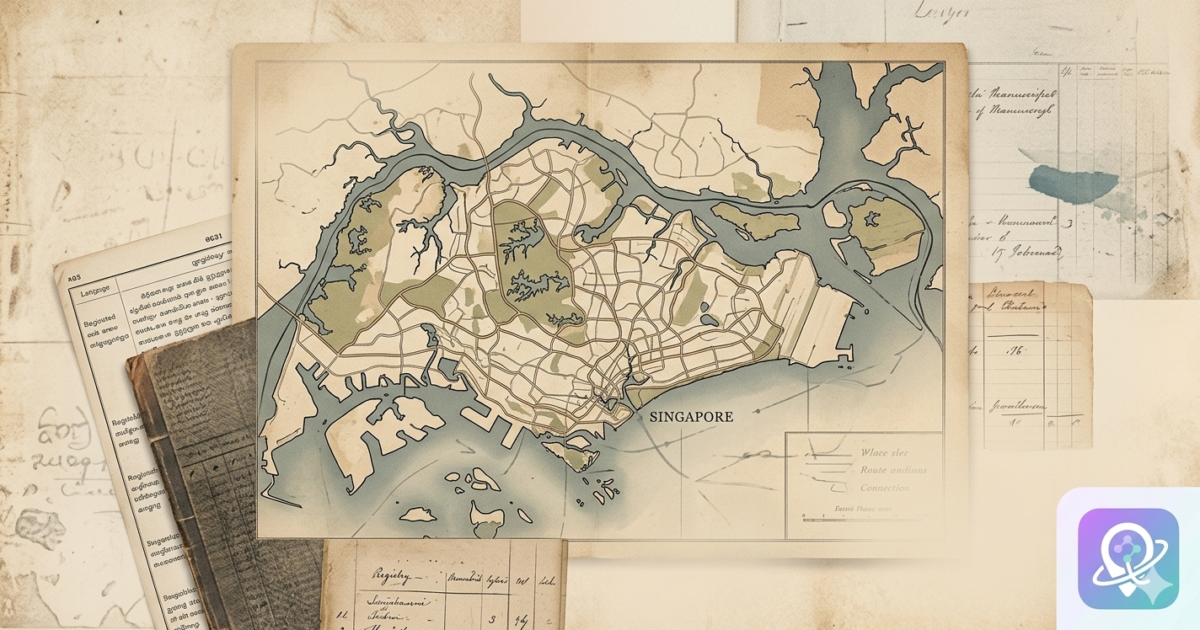
Tamil ancestry in Singapore traces primarily to two British colonial migration waves: 1820s–1870s Chetty merchant settlements and dock labour from Madras Presidency (the oldest Tamil community, concentrated around Serangoon Road and Little India), and 1890s–1940s Kangani-system plantation and rubber estate labour migration across the peninsula, much of which shifted into Singapore’s urban economy after Malayan independence. Singapore records for these communities are unusually well-preserved — the Straits Settlements Archives, the National Archives of Singapore, and the Indian Heritage Centre together hold passport registers, shipping records, labour rolls, and Hindu Endowments Board temple archives dating back to the 1850s. Most Singapore Tamil families can trace ancestry to a Tamil Nadu district and a specific 19th-century ship with sustained effort.
The history of Tamils in Singapore is rich, dating back to the founding of modern Singapore in 1819, with significant waves of migration for labor, trade, and settlement. This post will guide you through the process, from identifying initial clues within your family to navigating various archives and community resources available to researchers.
Understanding Early Tamil Migration to Singapore
Tamil presence in Singapore predates the British colonial era, with traders and settlers establishing communities long before Sir Stamford Raffles arrived. However, the largest waves of migration occurred during the 19th and early 20th centuries under British rule. These migrants primarily came from the Madras Presidency, encompassing much of present-day Tamil Nadu, and arrived in Singapore for diverse reasons.
Many were indentured laborers recruited to work on rubber plantations, in construction, or as port workers. Others arrived as free laborers, merchants, money lenders (chettiar), civil servants, or professionals. This diverse occupational background often influenced where they settled in Singapore and the types of records they might appear in. Understanding these historical contexts can help you anticipate the challenges and opportunities in your research. For example, indentured laborers often left fewer detailed personal records than merchants or civil servants, making their ancestral lines particularly challenging to trace without strong family oral traditions.
Starting Your Research: Family and Oral History
Your most valuable initial resource is often within your own family. Begin by gathering all known information from living relatives, particularly elders. Ask about names (full names, nicknames, ancestral village names), birth dates, death dates, marriage details, occupations, and any stories about their arrival in Singapore. Pay close attention to details about their district or village of origin in Tamil Nadu, even if it’s just a general area like "Madras" or "Pondicherry." These place names are crucial anchors for later research.
Collect any documents your family may possess: old photographs, birth certificates, death certificates, marriage certificates, passports, letters, land deeds, or even religious texts with family inscriptions. Even seemingly insignificant items can hold vital clues. Document everything meticulously, noting down who provided the information and when. This initial phase helps establish a baseline and provides keywords and names to search for in official records.
Navigating Singaporean Archives and Records
Singapore offers several key institutions for genealogical research. The National Archives of Singapore (NAS) is an excellent starting point. Their collection includes passenger lists, immigration records (though these can be patchy for earlier periods), birth, marriage, and death registers, and colonial government records. While comprehensive, early immigration records often lack specific village details from India, focusing more on port of embarkation.
Key record types at NAS that might be useful include:
- Passenger Lists: These can sometimes indicate the port of origin in India, but rarely the specific village.
- Birth, Marriage, and Death Registers: These records, especially from the early 20th century onwards, can provide parents’ names, occupations, and sometimes their place of birth or former residence. For Tamils, civil registrations may be supplemented by religious records from temples.
- Colonial Government Records: These might include records related to public works, civil service, or court cases, which could mention individuals by name.
- Newspapers and Directories: Historical newspapers (digitized and available via the National Library Board) can contain obituaries, advertisements, or mentions of prominent individuals. Early residential and business directories can also list names and addresses.
The National Library Board (NLB) provides access to digitized newspapers, maps, and other historical materials that can offer context or direct information. The Registry of Births and Deaths and the Registry of Marriages are official sources for vital records, though access might be restricted depending on the recency of the event and your relationship to the individual.
Leveraging Community Resources and Religious Institutions
Beyond official archives, Singapore’s vibrant Tamil community and its institutions are invaluable. Many Tamil temples, particularly older ones like the Sri Mariamman Temple or Sri Veeramakaliamman Temple, may have historical records of devotees, donations, or religious ceremonies. While not always systematically cataloged for genealogical purposes, these records can sometimes provide unexpected connections.
Community organizations, cultural associations, and even specific caste or village associations (if your family remembers such affiliations) can be rich sources of information and oral history. Engage with elders in these communities; they often hold a collective memory of migration patterns and prominent families. Social media groups dedicated to Singaporean Tamil heritage or genealogy can also connect you with fellow researchers and shared resources.
Bridging to India: The Next Step
Once you have exhausted Singaporean resources and ideally have a strong lead on an ancestral village or district in Tamil Nadu, the next phase of research involves delving into Indian records. This is often the most challenging part due to the decentralized nature of historical records in India and the difficulty of accessing them remotely.
However, having a specific village name is crucial. With this, you might explore:
- Temple Records (Kovil Register): Many ancient temples in Tamil Nadu maintain records of devotees, births, marriages, and deaths, particularly for specific communities or castes. The Kula Deivam (family deity) temple is an especially important place to investigate.
- Village Administrative Officer (VAO) Records: These local government offices in India might hold land records, tax records, or other administrative documents that list residents.
- Caste Association Records: If your family has a strong caste identity, their respective associations in India may have historical registers.
- Panchayat Records: Local village councils might have minutes or registers that mention residents.
Consulting with professional genealogists specializing in Indian ancestry can be immensely helpful at this stage, as they often have local contacts and expertise in navigating the complexities of Indian record-keeping. Tracing your Tamil ancestry to Singapore is a journey of discovery, blending historical research with personal connection. While challenging, each piece of information you uncover brings you closer to understanding your unique heritage.