TamizhConnect Blog
13 Mar 2026 · TamizhConnect
Tracing Tamil Ancestry: Beyond the Last 100 Years
Tamil genealogy article
Tamil communities are widespread globally due to millennia of migration, not just recent IT-driven movements. This post explores historical waves and methods for tracing roots from ancient trade to indentured labor.
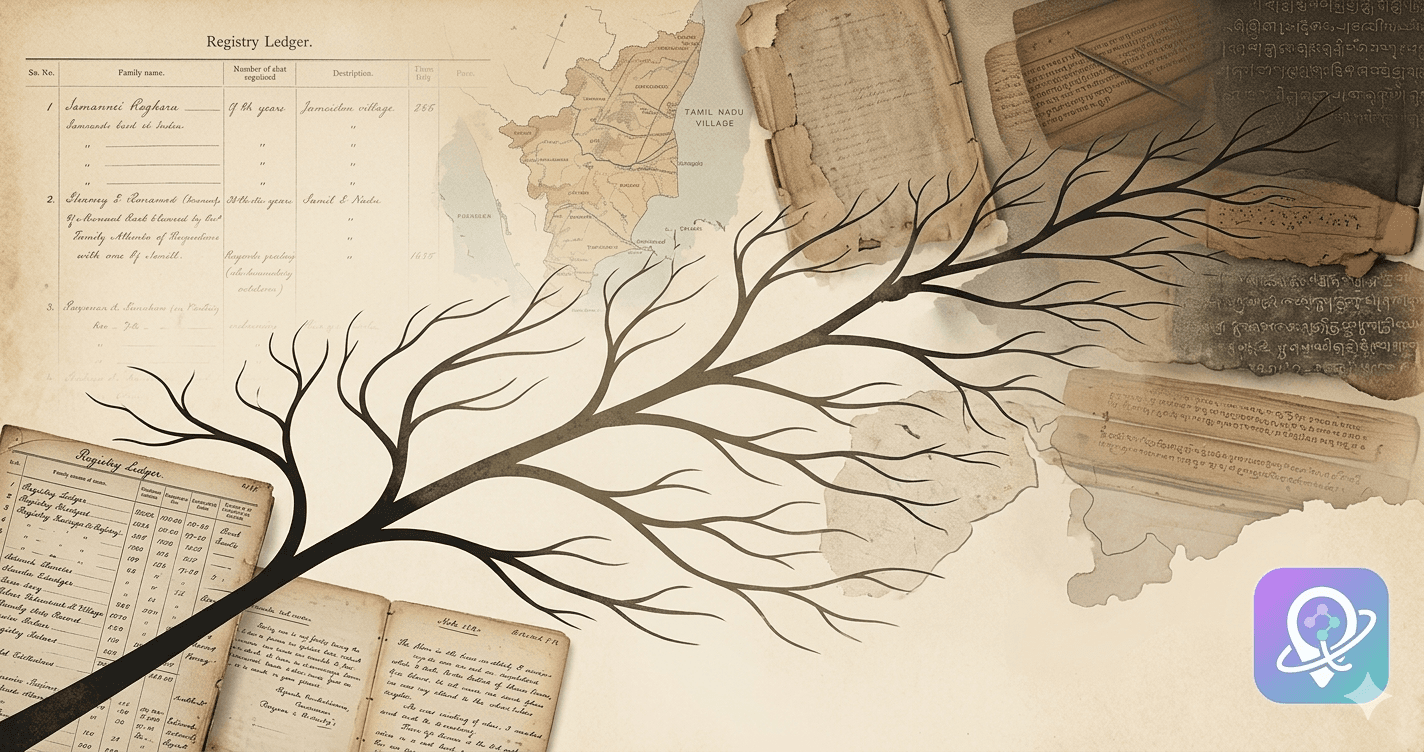
Document Digitisation
Turn documents into verified Tamil lineage.
Choose the depth you need. One-time service, results stay in your account.
Tamil migration abroad runs in five documented waves, each producing different records: Chola-era maritime trade (c. 9th–13th century, inscriptional evidence in Southeast Asia), Nayak and Chettiar commercial networks (16th–19th century, private firm ledgers), British indenture (1834–1917, colonial emigration passes), Kangani-system plantation labour to Malaya and Sri Lanka (1870s–1930s, estate employment rolls), and post-independence professional migration (1950s–present, visa + employer records). Most family research hits a wall around the 1900s because the pre-indenture waves produced less standardized paperwork. Beyond 100 years typically means moving from civil records to temple inscriptions, palm-leaf family thombus, and caste-community association archives.
Ancient Trade Routes: The First Diaspora
Long before European colonialism, Tamil traders established a vast maritime network connecting the Coromandel Coast with Southeast Asia, the Middle East, and East Africa. From at least the Sangam period (300 BCE – 300 CE) onwards, Tamil merchants, sailors, and artisans traveled extensively, establishing settlements in places like Sri Lanka, Malaysia (then Malaya), Indonesia, Thailand, and even as far as Yemen and Oman. Evidence for this early diaspora comes from archaeological finds, ancient inscriptions, and literary works like Pattinappalai and Silappatikaram, which vividly describe bustling port cities and overseas trade.
Researching ancestry from this period is, admittedly, exceptionally challenging for individuals. There are no personal records or passenger manifests. Instead, the focus shifts to understanding broader historical patterns and the cultural legacy left behind. If your family has deep roots in regions like northern Sri Lanka, parts of Malaysia, or coastal Indonesia, it's worth exploring local historical societies, university archives, and archaeological reports that might document Tamil presence. Genetic genealogy can sometimes offer broad regional insights, but pinpointing specific ancestral lines from this era is largely beyond individual genealogical efforts. The goal here is often to connect with a shared cultural heritage rather than a specific family tree.
The Age of Empires: Colonial Migrations
The colonial era, particularly under British rule, spurred the next major wave of Tamil migration, fundamentally reshaping the global diaspora. From the late 18th century through the early 20th century, Tamils were recruited or coerced to work in various British colonies. This period saw large-scale movements to:
- Sri Lanka: Primarily for tea and rubber plantations in the central highlands, leading to the formation of the 'Indian Tamil' community.
- Malaysia and Singapore: For rubber plantations, railways, and civil service, forming a significant segment of the Malaysian Indian and Singaporean Indian populations.
- Myanmar (Burma): For rice cultivation and as merchants, clerks, and laborers.
- Mauritius, Fiji, Reunion, Seychelles: As indentured laborers on sugar cane plantations.
- South Africa: Also as indentured laborers for sugar cane farms in Natal.
- Caribbean (Trinidad and Tobago, Guyana, Suriname, Jamaica): For sugar plantations.
Researching ancestry from this period is more feasible due to the existence of colonial records. The key is to identify the destination country and the approximate time of migration. Records to look for include:
- Indenture Records: These are invaluable. Countries like Mauritius, Fiji, Trinidad, Guyana, and South Africa often have digitized or archived registers of indentured laborers, which typically include name, father's name, age, village of origin in India, and ship name/date. The National Archives of India (NAI) in Delhi also holds some emigration passes.
- Plantation Records: Some larger plantations kept their own records of workers, though these are rarer and harder to access.
- Church and Temple Records: If ancestors converted or participated in community religious life in the destination country, these records might contain birth, marriage, and death information.
- Colonial Census Records: These can place families in specific locations at specific times.
The challenge here is often the Anglicization or phonetic spelling of Tamil names in colonial records, requiring patience and creative search strategies.
Post-Independence and Economic Migrations
After India's independence in 1947 and the dismantling of colonial empires, new patterns of migration emerged. The mid-to-late 20th century saw Tamils moving for economic opportunities, education, and sometimes due to conflict (e.g., Sri Lankan Tamils seeking refuge). This includes migrations to:
- Gulf Countries (UAE, Saudi Arabia, Kuwait): For construction, oil, and service industries.
- Western Countries (US, UK, Canada, Australia, Europe): Primarily for professional work, education, and family reunification.
Researching ancestry for these more recent migrations is generally the easiest. Modern records are more comprehensive and often digitized:
- Immigration and Visa Records: While often private for living individuals, these can be a goldmine for deceased ancestors.
- Passport Records: If available, these can confirm birthplaces and parentage.
- University and Employment Records: Can trace an ancestor's professional journey.
- Community Archives: Many diaspora communities have established their own archives, cultural centers, or online forums that can be helpful.
- Family Papers: Letters, photographs, and personal documents from this era are often well-preserved within families.
Bridging the Gaps: Connecting Across Eras
Regardless of the migration wave, the fundamental principle of Tamil ancestry research remains: anchor every person to a place and a year. Start with the most recent known ancestor and work backward, meticulously documenting names, relationships, and locations. Oral histories from elders are invaluable, but always seek to corroborate them with documented evidence. When faced with a lack of records, consider genetic genealogy services, but interpret results cautiously and in conjunction with historical knowledge. The story of the Tamil diaspora is rich and complex, stretching far beyond the last few generations, and with careful research, you can connect your family's unique narrative to this broader historical tapestry.
Share this article
TamizhConnect
TamizhConnect helps Tamil families worldwide trace their ancestry using voter records, indenture archives, and origin village matching. Our research team combines genealogy expertise with digitised Tamil Nadu datasets to help you discover your roots.
Ready to start your Tamil family tree?
TamizhConnect helps you discover relatives, trace your origin village, and keep your family history alive for the next generation.
Create your free TamizhConnect accountGo to my family treeDocument Digitisation
Have old documents? Upload them and we'll verify, trace, and add them to your tree.
Was this article helpful?
Get new articles in your inbox
Tamil genealogy tips, research guides, and new feature updates.
You might also like
Tracing Tamil Roots in Singapore: A Guide to Ancestry Research (English)
Uncover the journey of your Tamil ancestors to Singapore with this practical guide to historical records, community resources, and research strategies.
01 Apr 2026
Tracing Tamil Ancestry: Beyond the Last 100 Years (English)
Tamil communities are widespread globally due to millennia of migration, not just recent IT-driven movements. This post explores historical waves and methods for tracing roots from ancient trade to indentured labor.
09 Feb 2026
Why Some Nations Have No Tamil Diaspora (English)
While the Tamil diaspora is vast, some non-colonial nations notably lack a significant Tamil presence. This post explores the historical and geographical reasons behind these untraced journeys.
26 Jan 2026
Understanding Tamil Naming Conventions: Beyond 'Last Names' (English)
Tamil naming conventions traditionally do not feature fixed, inherited 'last names' in the Western sense, instead relying on a system of patronymics, village names, or caste indicators.
26 Apr 2026
தமிழ் மூதாதையர் ஆய்வு நூலகம் (Tamil)
TamizhConnect-க்கு தேவையான தமிழ் வம்சாவளி முறைகள், பதிவுகள், இனவியல் மற்றும் பாரம்பரியச் சரிபார்ப்புக்கான அனைத்து ஆழமான வழிகாட்டிகளும் ஒரே இடத்தில்.
02T22:13:46.073Z Sep 2026
Tamil ancestry research: Complete guide for genealogical methods (English)
All our deep-dive guides on Tamil genealogical methods, records, ethnography, and heritage validation for TamizhConnect.
02T22:13:46.072Z Sep 2026
Related by topic
Unearthing Tamil Nadu Ancestry: A Comprehensive Guide (English)
Tracing Tamil Nadu ancestry requires navigating a rich tapestry of ancient history, diverse migrations, and a unique record-keeping landscape. This guide explores the distinct challenges and rewarding paths for uncovering your roots.
18 Apr 2026
Tracing Your Tamil Ancestry: A Beginner's Guide (English)
Embark on a journey to uncover your Tamil roots. This guide provides a starting point for genealogical research, addressing common challenges and relevant records for those in Tamil Nadu and the diaspora.
9 Apr 2026
More from TamizhConnect
Tamil Elder Interview Kit: Ready-to-Use Questions & Prompts (English)
A ready-to-copy interview kit for capturing Tamil family history from elders — grouped by topic, sequenced from easy to sensitive, with recording tips and follow-ups that unlock the stories behind the names.
21 Aug 2026
The Tamils of Dharavi: A Hundred Years from Tirunelveli to Mumbai (English)
From the droughts of Tirunelveli to the tanneries and textile mills of Mumbai, the Tamil community of Dharavi has built one of the largest Tamil cities outside Tamil Nadu. With redevelopment underway, here's how families can preserve their migration story for the next generation.
15 May 2026
Core topics
What is Tamil, really? Language, identity, and where it comes from
A clear, human explanation of what Tamil is-language, identity, people, and history-plus how to talk about it without stereotypes.
4 Feb 2026
What Defines Tamil Identity Beyond Borders and Sub-Groups? (English)
Tamil identity is primarily defined by shared language and cultural heritage, rather than by geographic borders or internal sub-group affiliations. This core identity persists across the diaspora and within Tamil Nadu.
17 Apr 2026
Continue reading
Unraveling the Genetic Tapestry of Sri Lankan Tamils (English)
11 Mar 2026
Tracing Sri Lankan Tamil Ancestry: Records and Resources (English)
10 Mar 2026
Digitizing Tamil Family Records: OCR and Manual Strategies (English)
9 Mar 2026
Tracing South Indian Roots in the Caribbean Diaspora (English)
8 Mar 2026