TamizhConnect Blog
8 Mar 2026 · TamizhConnect
Tracing South Indian Roots in the Caribbean Diaspora
Tamil genealogy article
Uncover the complexities and methods for tracing South Indian ancestry among descendants of indentured laborers in the Caribbean, navigating fragmented historical records.
Document Digitisation
Turn documents into verified Tamil lineage.
Choose the depth you need. One-time service, results stay in your account.
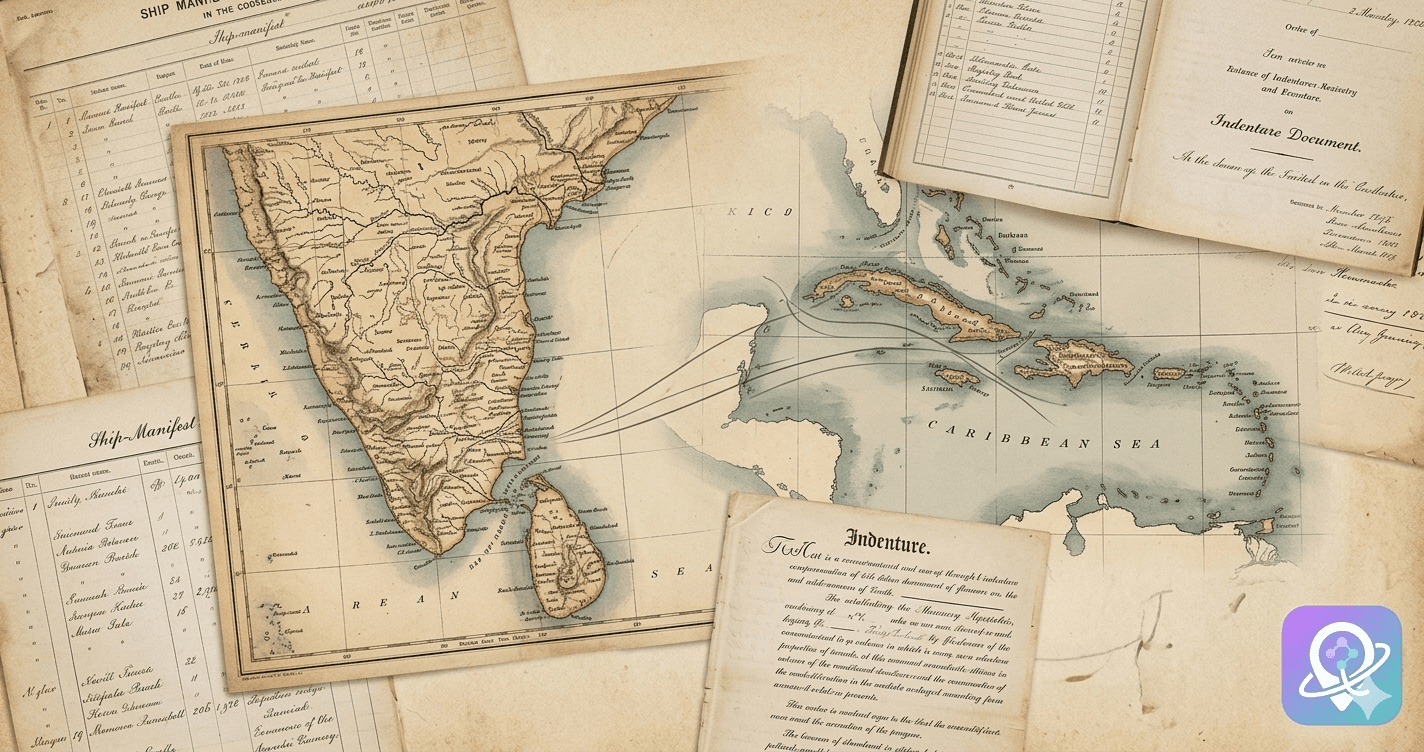
For Caribbean families with South Indian indentured ancestry, identifying a specific origin village requires combining three record layers: British emigration passes from Madras (1845–1917, held at the UK National Archives and regional Tamil Nadu archives), plantation arrival rolls in the Caribbean colony (held in Trinidad, Guyana, and Suriname national archives), and post-1945 return-passage records where relatives went back to India. The emigration records are the thinnest layer because Madras kept less detailed paperwork than Calcutta — most Caribbean South Indian families can trace ancestry to a general district (Tirunelveli, Madurai, North Arcot) but not a specific village without multi-source cross-referencing. Ship name + emigration pass number + plantation rolls together often narrow the origin to a taluk.
The Indenture System and Record Keeping
The British colonial indenture system, which brought over a million laborers from India to various colonies between 1834 and 1917, was primarily concerned with labor supply rather than detailed individual origins. Records were kept at various points: the emigration depots in India (primarily Calcutta and Madras), during the sea voyage, and upon arrival in the destination colony. The Madras Presidency, which encompassed much of present-day Tamil Nadu, Andhra Pradesh, Kerala, and Karnataka, was a significant source of labor for colonies like Trinidad, Guyana, and Suriname, particularly in the later waves of migration. However, the records often aggregated migrants under broad regional headings rather than specific linguistic or caste distinctions.
The initial recruitment process in India was often chaotic, with agents known as 'arkatis' or 'kanganis' enticing laborers with promises of work and prosperity. Many recruits were from rural areas, unaccustomed to bureaucratic procedures, and sometimes gave simplified or anglicized versions of their names. Crucially, the primary identifier recorded was often the father's name, the individual's age, and a broad district of origin, such as "Madras Presidency" or "Arcot." Specific village names were less consistently recorded, and when they were, spellings could be inconsistent due to transliteration by British clerks.
Types of Records Available
Several types of records can be useful, though none offer a complete picture on their own:
1. Ship's Registers and Emigration Passes
These documents, generated at the embarkation ports of Calcutta and Madras, are among the most direct sources. They list the name of the emigrant, their father's name, age, caste (sometimes), and a declared district or village of origin. For migrants from the Madras Presidency, these registers are crucial. However, the quality of information varies, and as mentioned, village names can be ambiguous or misspelled. These records are often housed in national archives in India (e.g., Tamil Nadu Archives) and in the destination countries.
2. Colonial Immigration Registers
Upon arrival in the Caribbean colonies, immigrants were registered again. These registers, often found in the national archives of countries like Trinidad and Tobago, Guyana, or Suriname, typically contain similar information to the ship's registers but may include the name of the estate where the laborer was assigned, their 'indenture number,' and sometimes details about subsequent contracts. Cross-referencing these with the Indian embarkation records can help confirm identities and piece together timelines.
3. Estate Records and Plantation Ledgers
Some plantations kept detailed records of their laborers, including names, assigned tasks, wages, and even family units. These are rarer and often less centralized, but if discovered, they can provide granular details about daily life and family connections on the ground. These records are usually found in private collections, university archives, or local historical societies.
4. Birth, Marriage, and Death Certificates (Colonial Era)
As Indian immigrants settled and formed families, their life events were recorded by colonial administrations. Early certificates might list the parents' place of origin as "India" or "Madras," providing a general clue. Later generations' certificates might be more specific if the family maintained knowledge of their ancestral village. However, the names recorded on these documents often reflect anglicization or creolization, making direct phonetic matches to original Indian names difficult.
The Challenge of Identifying "Tamil" Ancestry
The most significant hurdle in tracing specific South Indian origins is the lack of explicit ethnic or linguistic markers in the records. A person listed as originating from the "Madras Presidency" could be Tamil, Telugu, Malayalam, Kannada, or even from a tribal group within that vast geographical area. Caste names, when recorded, can sometimes offer clues, as certain castes are more prevalent in specific linguistic regions. For example, a "Gounder" or "Pillai" surname strongly suggests Tamil ancestry, while a "Reddy" points to Telugu origins. However, not all castes were consistently recorded, and many common caste names exist across multiple South Indian linguistic groups.
Linguistic drift also occurred rapidly in the Caribbean. While initial immigrant communities might have maintained their mother tongues, subsequent generations often adopted local creoles or English, making linguistic heritage a less reliable indicator over time. Cultural practices, religious traditions, and family stories passed down through generations often provide stronger, albeit anecdotal, clues than official documents.
Strategies for Research
- Start with the Known: Begin with your Caribbean family tree and work backward. Collect all available birth, marriage, and death certificates, and interview elder family members for names, places, and stories.
- Identify the Immigrant Ancestor: Pinpoint the first ancestor who arrived from India. Their name, estimated arrival year, and the name of the ship they traveled on are critical.
- Search Emigration Records: Use the immigrant ancestor's details to search the digitized ship's registers from Madras (if applicable) or Calcutta. Websites like FamilySearch, Ancestry.com (though less comprehensive for this specific niche), and specialized archives often host these records.
- Cross-Reference with Colonial Records: Match the details from the Indian emigration records with the immigration registers in the Caribbean destination country. Look for indenture numbers, assigned estates, and consistent names.
- Analyze Place Names and Castes: If a district or village name is recorded, research its location within the historical Madras Presidency. If a caste is mentioned, investigate its geographical distribution in South India. Tools like Google Maps, historical gazetteers, and academic resources on South Indian castes can be invaluable.
- Genealogical DNA Testing: While not a definitive answer to specific village origins, DNA testing can confirm broader South Asian ancestry and sometimes even reveal more granular regional genetic markers, which can corroborate or guide documentary research.
Connecting with your South Indian heritage from the Caribbean requires patience, detective work, and an appreciation for the historical context of indentured labor. While specific village names can be elusive, the journey of discovery often reveals a rich tapestry of cultural resilience and ancestral identity that transcends the limitations of colonial record-keeping.
Share this article
TamizhConnect
TamizhConnect helps Tamil families worldwide trace their ancestry using voter records, indenture archives, and origin village matching. Our research team combines genealogy expertise with digitised Tamil Nadu datasets to help you discover your roots.
Ready to start your Tamil family tree?
TamizhConnect helps you discover relatives, trace your origin village, and keep your family history alive for the next generation.
Create your free TamizhConnect accountGo to my family treeDocument Digitisation
Have old documents? Upload them and we'll verify, trace, and add them to your tree.
Was this article helpful?
Get new articles in your inbox
Tamil genealogy tips, research guides, and new feature updates.
You might also like
Beyond 'Madras': Unpacking South Indian Ancestry in the Diaspora (English)
The colonial term 'Madras' often obscured the distinct linguistic and regional identities of South Indian indentured laborers. Learn how descendants can trace their specific Tamil, Telugu, or Malayalam heritage.
21 Apr 2026
Digitizing Tamil Family Records: OCR and Manual Strategies (English)
Unlock your family history by digitizing old Tamil documents. Learn practical tips for scanning, using OCR tools, and manual transcription techniques for challenging records.
21 Apr 2026
Tracing Indentured Tamil Ancestry: Records and Realities (English)
Uncover the specific challenges and available records for tracing Tamil ancestors who emigrated under the indentured labor system, connecting diaspora families back to their origins.
21 Apr 2026
Telugu Voices in Tamil Nadu: Identity, Ancestry, and Assimilation (English)
Explore the complex journey of Telugu-speaking communities in Tamil Nadu, examining how migration, politics, and social integration have shaped their linguistic and ancestral ties.
28 Mar 2026
தமிழ் மூதாதையர் ஆய்வு நூலகம் (Tamil)
TamizhConnect-க்கு தேவையான தமிழ் வம்சாவளி முறைகள், பதிவுகள், இனவியல் மற்றும் பாரம்பரியச் சரிபார்ப்புக்கான அனைத்து ஆழமான வழிகாட்டிகளும் ஒரே இடத்தில்.
03T12:28:13.960Z Sep 2026
Tamil ancestry research: Complete guide for genealogical methods (English)
All our deep-dive guides on Tamil genealogical methods, records, ethnography, and heritage validation for TamizhConnect.
03T12:28:13.955Z Sep 2026
Related by topic
Tracing Your Tamil Roots: A Step-by-Step Guide to Ancestry (English)
Unlock your family's past with this comprehensive guide to researching Tamil ancestry, from oral histories to digital archives and DNA insights.
22 Mar 2026
Tracing Tamil Ancestry Without Names: Beyond the Family Tree (English)
Discover practical strategies for uncovering Tamil ancestry when specific names are unknown, focusing on migration stories, village names, and contextual clues for both diaspora and Tamil Nadu research.
19 Mar 2026
More from TamizhConnect
Tamil Elder Interview Kit: Ready-to-Use Questions & Prompts (English)
A ready-to-copy interview kit for capturing Tamil family history from elders — grouped by topic, sequenced from easy to sensitive, with recording tips and follow-ups that unlock the stories behind the names.
21 Aug 2026
The Tamils of Dharavi: A Hundred Years from Tirunelveli to Mumbai (English)
From the droughts of Tirunelveli to the tanneries and textile mills of Mumbai, the Tamil community of Dharavi has built one of the largest Tamil cities outside Tamil Nadu. With redevelopment underway, here's how families can preserve their migration story for the next generation.
15 May 2026
Core topics
What is Tamil, really? Language, identity, and where it comes from
A clear, human explanation of what Tamil is-language, identity, people, and history-plus how to talk about it without stereotypes.
4 Feb 2026
What Defines Tamil Identity Beyond Borders and Sub-Groups? (English)
Tamil identity is primarily defined by shared language and cultural heritage, rather than by geographic borders or internal sub-group affiliations. This core identity persists across the diaspora and within Tamil Nadu.
17 Apr 2026