TamizhConnect Blog
4 Mar 2026 · TamizhConnect
Decoding Your DNA Test: South Indian Ancestry Explained
Tamil genealogy article
Commercial DNA tests offer intriguing insights into our heritage, but interpreting results for South Indian ancestry requires a nuanced understanding of their capabilities and limitations.
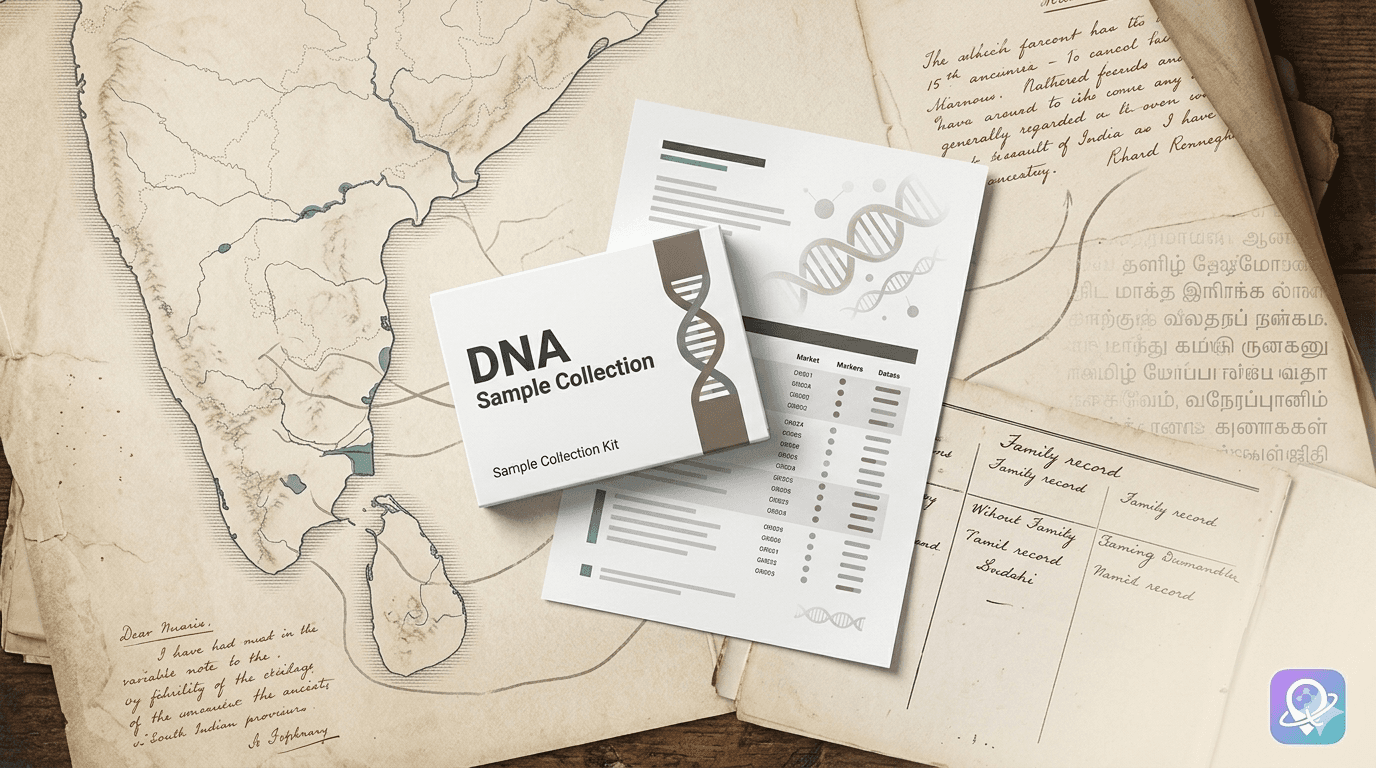
Commercial DNA tests (AncestryDNA, 23andMe, MyHeritage, FamilyTreeDNA) return South Indian results as broad regional labels like "Southern India," "Dravidian," or "South Indian" — not specific ethnic labels like "Tamil," "Malayali," or "Telugu" — because their reference populations cluster too tightly to distinguish between neighbouring Dravidian-speaking groups. That's not a flaw in the test; it reflects genetic reality. Tamil, Malayalam-speaking, and Telugu-speaking populations share roughly 85–95% of their ancestry at the population level. Interpreting your results for South Indian heritage means understanding this grouping and combining the DNA estimate with cultural genealogy — village, gotra, kula deivam, language of ritual — to narrow down the specific community the test can't name.
The Geographic vs. Ethnic Conundrum
One of the most common points of confusion for those with South Indian ancestry is the lack of specific ethnic group names in their DNA results. Instead of 'Tamil' or 'Telugu,' you'll likely see broader categories like 'South India,' 'Central & South Asia,' or even more granular regional breakdowns like 'Kerala' or 'Andhra Pradesh' depending on the testing company. Why is this the case?
Commercial DNA tests primarily identify 'ethnicity estimates' by comparing your DNA to reference panels—collections of DNA samples from people with long family histories in specific geographic regions. The challenge in South Asia is its incredible genetic diversity and long history of migrations, intermarriages, and ancient population movements. While distinct cultural and linguistic groups like Tamils exist, their genetic signatures often overlap significantly with neighboring groups due to shared deep ancestral roots and centuries of interaction. Moreover, the reference panels for South Asia are still evolving and becoming more refined. It's a vast region with thousands of endogamous communities, and creating perfectly distinct genetic profiles for each is an ongoing scientific endeavor. The tests are designed to identify ancestral geographic origins rather than modern ethno-linguistic identities.
Interpreting Your South Indian Percentage
When your results show a high percentage for 'South India' or a similar category, it's a strong indicator that a significant portion of your recent ancestry originates from the Indian subcontinent, specifically the southern regions. This might seem obvious if you know your family is from South India, but it can be validating nonetheless. The smaller percentages for other regions, such as 'Central Asia,' 'East Asia,' or even 'European,' are also worth noting. These can reflect ancient migrations, historical trade routes, or more recent colonial influences. For example, a small percentage of 'Central Asian' could point to ancient movements of people through the subcontinent or more recent historical interactions.
It's important to remember that these percentages are estimates and can vary slightly between different testing companies due to their unique reference panels and algorithms. Don't get fixated on a precise number; instead, look at the overall pattern and the predominant regions identified.
The Limits of DNA for Deep Ancestry
While DNA tests are powerful for tracing relatively recent ancestry (typically within the last 500-1000 years), their ability to pinpoint very deep ancestral migrations or link you to ancient civilizations in South India is more limited. For instance, while you might share genetic markers with ancient populations that contributed to the diverse genetic tapestry of South India, the tests won't tell you if you are directly descended from a specific Sangam-era poet or an individual from the Indus Valley Civilization. That level of specificity is beyond the current capabilities of consumer DNA testing and often requires specialized academic research.
Complementary Genealogical Research: Beyond the Genes
To truly understand your South Indian heritage, DNA test results are best used as a starting point, not the final word. They can provide clues, but traditional genealogical research is crucial for building out your family tree and connecting with specific ethnic and cultural identities. Here's how to complement your DNA results:
- Interview Elders: Your family members are living archives. Talk to your parents, grandparents, aunts, and uncles. Ask about their parents, grandparents, where they lived, their traditional occupations, family stories, and any known migrations. Pay close attention to village names, temple affiliations, and community names.
- Examine Family Records: Look for old photographs, letters, birth/marriage certificates, land deeds, and religious records. These can contain names, dates, and locations that are invaluable.
- Explore Historical Documents: While public records in South India can be challenging to access for pre-colonial periods, temple records, caste association records, and some colonial-era administrative documents (like census records, if available) can offer insights. University archives and local historical societies might also hold relevant materials.
- Leverage DNA Matches: Most DNA testing companies provide a list of genetic relatives. Reach out to these matches, especially those with shared South Indian ancestry. You might discover distant cousins who have already done extensive genealogical research or who can fill in gaps in your family tree.
Understanding your South Indian ancestry through DNA testing is an exciting journey, but it requires patience and a willingness to look beyond the initial percentages. By combining the scientific insights of genetics with the rich tapestry of family stories and historical records, you can piece together a more complete and meaningful picture of your unique heritage.
Share this article
TamizhConnect
TamizhConnect helps Tamil families worldwide trace their ancestry using voter records, indenture archives, and origin village matching. Our research team combines genealogy expertise with digitised Tamil Nadu datasets to help you discover your roots.
Ready to start your Tamil family tree?
TamizhConnect helps you discover relatives, trace your origin village, and keep your family history alive for the next generation.
Create your free TamizhConnect accountGo to my family treeDocument Digitisation
Have old documents? Upload them and we'll verify, trace, and add them to your tree.
Was this article helpful?
Get new articles in your inbox
Tamil genealogy tips, research guides, and new feature updates.
You might also like
Understanding Tamil Naming Conventions: Beyond 'Last Names' (English)
Tamil naming conventions traditionally do not feature fixed, inherited 'last names' in the Western sense, instead relying on a system of patronymics, village names, or caste indicators.
26 Apr 2026
Beyond 'Madras': Unpacking South Indian Ancestry in the Diaspora (English)
The colonial term 'Madras' often obscured the distinct linguistic and regional identities of South Indian indentured laborers. Learn how descendants can trace their specific Tamil, Telugu, or Malayalam heritage.
21 Apr 2026
Tracing Indentured Tamil Ancestry: Records and Realities (English)
Uncover the specific challenges and available records for tracing Tamil ancestors who emigrated under the indentured labor system, connecting diaspora families back to their origins.
21 Apr 2026
Unearthing Tamil Nadu Ancestry: A Comprehensive Guide (English)
Tracing Tamil Nadu ancestry requires navigating a rich tapestry of ancient history, diverse migrations, and a unique record-keeping landscape. This guide explores the distinct challenges and rewarding paths for uncovering your roots.
18 Apr 2026
தமிழ் மூதாதையர் ஆய்வு நூலகம் (Tamil)
TamizhConnect-க்கு தேவையான தமிழ் வம்சாவளி முறைகள், பதிவுகள், இனவியல் மற்றும் பாரம்பரியச் சரிபார்ப்புக்கான அனைத்து ஆழமான வழிகாட்டிகளும் ஒரே இடத்தில்.
02T21:31:40.701Z Sep 2026
Tamil ancestry research: Complete guide for genealogical methods (English)
All our deep-dive guides on Tamil genealogical methods, records, ethnography, and heritage validation for TamizhConnect.
02T21:31:40.700Z Sep 2026
Related by topic
Tracing Telugu Roots in Tamil Nadu: A Journey Through Time and Heritage (English)
Unravel the fascinating history of Telugu-speaking communities in Tamil Nadu, exploring migrations, cultural integration, and how to research your dual heritage.
15 Apr 2026
Understanding Your Roots: The Ancient Tamil Kingdoms (English)
Explore the historical significance and cultural impact of the Chola, Chera, and Pandya kingdoms to understand the broader context of your Tamil ancestry.
13 Apr 2026
More from TamizhConnect
Tamil Elder Interview Kit: Ready-to-Use Questions & Prompts (English)
A ready-to-copy interview kit for capturing Tamil family history from elders — grouped by topic, sequenced from easy to sensitive, with recording tips and follow-ups that unlock the stories behind the names.
21 Aug 2026
The Tamils of Dharavi: A Hundred Years from Tirunelveli to Mumbai (English)
From the droughts of Tirunelveli to the tanneries and textile mills of Mumbai, the Tamil community of Dharavi has built one of the largest Tamil cities outside Tamil Nadu. With redevelopment underway, here's how families can preserve their migration story for the next generation.
15 May 2026
Core topics
What is Tamil, really? Language, identity, and where it comes from
A clear, human explanation of what Tamil is-language, identity, people, and history-plus how to talk about it without stereotypes.
4 Feb 2026
What Defines Tamil Identity Beyond Borders and Sub-Groups? (English)
Tamil identity is primarily defined by shared language and cultural heritage, rather than by geographic borders or internal sub-group affiliations. This core identity persists across the diaspora and within Tamil Nadu.
17 Apr 2026
Continue reading
Tamil and Telugu: Separate Branches, Shared Roots (English)
3 Mar 2026
Genetic Ancestry Tests for Sri Lankan Tamils: What to Expect (English)
2 Mar 2026
Tracing Dravidian Roots: Tamil and Telugu's Shared Heritage (English)
1 Mar 2026
Crafting Your Tamil Family History: Narrative Paths to Explore (English)
27 Feb 2026