TamizhConnect Blog
2 Mar 2026 · TamizhConnect
Genetic Ancestry Tests for Sri Lankan Tamils: What to Expect
Tamil genealogy article
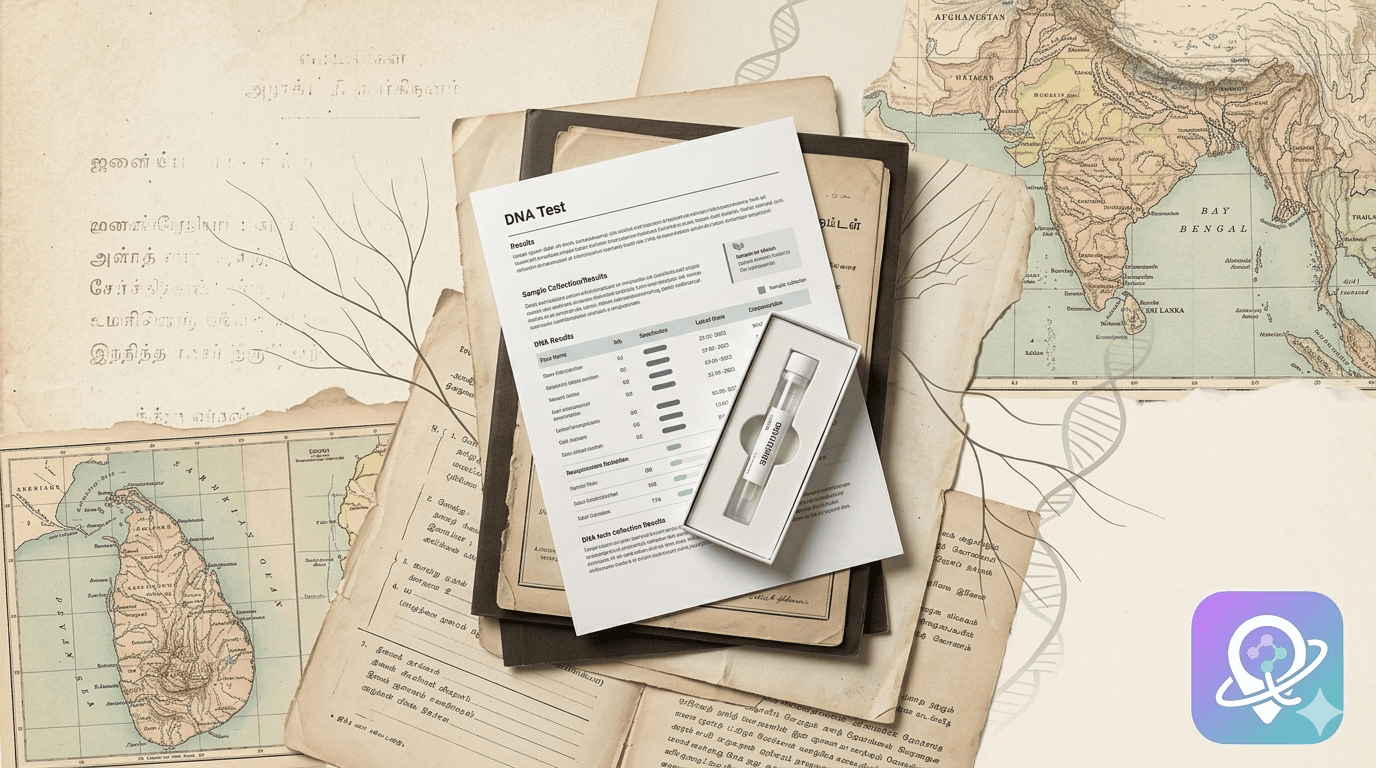
Genetic ancestry tests offer a glimpse into the deep past for Sri Lankan Tamils, often revealing a complex tapestry of South Asian and regional influences.
Document Digitisation
Turn documents into verified Tamil lineage.
Choose the depth you need. One-time service, results stay in your account.
Genetic ancestry tests for Sri Lankan Tamils typically reflect a primary affiliation with broad South Asian populations, alongside specific regional markers that hint at historical migrations and intermingling. These results, while fascinating, often require careful interpretation due to the current limitations of genomic reference panels, particularly for highly localized populations within the Indian subcontinent and Sri Lanka. Understanding the historical context of Tamil settlement and movement is crucial for making sense of the genetic data.
Understanding the Core South Asian Component
When a Sri Lankan Tamil takes a genetic ancestry test from services like 23andMe, AncestryDNA, or MyHeritage, the most prominent result will almost invariably be a large percentage assigned to a broad "South Indian & Sri Lankan" or "Southern Indian" category. This is not surprising, as the genetic makeup of Sri Lankan Tamils is deeply rooted in the broader South Indian gene pool, reflecting millennia of shared ancestry and continuous, though sometimes disrupted, cultural exchange across the Palk Strait. This foundational component represents the ancient migrations that populated the Indian subcontinent and subsequently Sri Lanka, establishing the common genetic threads that bind various Dravidian-speaking populations. The tests are adept at identifying this macro-level connection, affirming the shared heritage with populations in Tamil Nadu, Kerala, and parts of Andhra Pradesh and Karnataka.
The Nuance of Regional Specificity and Limitations
While the broad South Asian component is clear, the ability of current genetic tests to pinpoint specific regional origins within Sri Lanka or even within Tamil Nadu with high granularity is still evolving. This limitation stems from several factors. Firstly, the reference populations used by commercial DNA testing companies, while improving, often lack sufficient samples from highly localized or endogamous communities within Sri Lanka and even specific districts of Tamil Nadu. This means that genetic markers unique to a particular Sri Lankan Tamil sub-group (e.g., Jaffna Tamils, Batticaloa Tamils, Up-Country Tamils) might not have distinct enough representations in the databases to be identified separately from a broader "South Indian" category. Secondly, the continuous historical movement of people, including traders, migrants, and settlers between South India and Sri Lanka over millennia, has created a relatively homogenous genetic landscape in certain aspects, blurring the lines that these tests attempt to draw. Therefore, while a test might identify a strong "Tamil Nadu" or "Sri Lankan Tamil" component, it's less likely to distinguish between, say, a family from Mannar and one from Trincomalee with definitive percentages.
Tracing Historical Migrations Through Genetic Signatures
Beyond the dominant South Asian component, Sri Lankan Tamil genetic profiles can sometimes reveal intriguing minor percentages that reflect historical migrations and interactions. For instance, a small percentage of "East Asian" or "Southeast Asian" ancestry is not uncommon, especially among communities with historical ties to maritime trade routes or interactions with populations from Southeast Asia. Similarly, faint traces of "North Indian," "Central Asian," or even "Middle Eastern" ancestry can appear, hinting at ancient trade networks, invasions, or religious conversions that brought new genetic material into the South Asian gene pool. For example, the Kalingas, who migrated from present-day Odisha, India, to Sri Lanka, or the influence of Arab traders on coastal communities, could leave subtle genetic imprints. These smaller percentages are often the most captivating, as they open doors to exploring specific historical events or long-distance ancestral connections that might not be evident from family records or oral traditions alone.
Interpreting Results and Managing Expectations
It is vital for Sri Lankan Tamils approaching genetic ancestry tests to have realistic expectations. The results will provide a broad strokes picture of deep ancestry, affirming connections to the wider South Asian diaspora and perhaps hinting at ancient migrations. However, they are unlikely to provide specific village-level origins or definitively solve recent genealogical puzzles (e.g., identifying a great-grandparent's specific district in Jaffna). The real value lies in understanding the broader patterns of human migration, confirming long-held cultural narratives of connection to South India, and potentially uncovering unexpected influences that prompt further historical or genealogical research. As reference databases expand and genetic science advances, the granularity of these tests will undoubtedly improve, offering an even clearer window into the rich and complex tapestry of Sri Lankan Tamil heritage.
The Future of Tamil Genetic Research
The field of genetic genealogy is rapidly evolving. Ongoing academic studies focusing on isolated or underrepresented populations, including specific Sri Lankan Tamil communities, are continually adding to our understanding of genetic diversity. As more individuals from diverse backgrounds participate in these tests and contribute to research, the resolution and accuracy for finer regional distinctions will undoubtedly increase. For Sri Lankan Tamils, this means future tests may offer even more detailed insights into their unique ancestral journeys, helping to bridge gaps in historical records and oral traditions.
Share this article
TamizhConnect
TamizhConnect helps Tamil families worldwide trace their ancestry using voter records, indenture archives, and origin village matching. Our research team combines genealogy expertise with digitised Tamil Nadu datasets to help you discover your roots.
Ready to start your Tamil family tree?
TamizhConnect helps you discover relatives, trace your origin village, and keep your family history alive for the next generation.
Create your free TamizhConnect accountGo to my family treeDocument Digitisation
Have old documents? Upload them and we'll verify, trace, and add them to your tree.
Was this article helpful?
Get new articles in your inbox
Tamil genealogy tips, research guides, and new feature updates.
You might also like
Unearthing Roots: A Guide to Tracing Sri Lankan Tamil Ancestry (English)
Embark on a journey to discover your Sri Lankan Tamil heritage. This guide explores available records, research strategies, and common challenges in piecing together your family history.
03 Apr 2026
Beyond 'Madras': Unpacking South Indian Ancestry in the Diaspora (English)
The colonial term 'Madras' often obscured the distinct linguistic and regional identities of South Indian indentured laborers. Learn how descendants can trace their specific Tamil, Telugu, or Malayalam heritage.
21 Apr 2026
Tracing Indentured Tamil Ancestry: Records and Realities (English)
Uncover the specific challenges and available records for tracing Tamil ancestors who emigrated under the indentured labor system, connecting diaspora families back to their origins.
21 Apr 2026
What Defines Tamil Identity Beyond Borders and Sub-Groups? (English)
Tamil identity is primarily defined by shared language and cultural heritage, rather than by geographic borders or internal sub-group affiliations. This core identity persists across the diaspora and within Tamil Nadu.
17 Apr 2026
தமிழ் மூதாதையர் ஆய்வு நூலகம் (Tamil)
TamizhConnect-க்கு தேவையான தமிழ் வம்சாவளி முறைகள், பதிவுகள், இனவியல் மற்றும் பாரம்பரியச் சரிபார்ப்புக்கான அனைத்து ஆழமான வழிகாட்டிகளும் ஒரே இடத்தில்.
03T19:44:08.934Z Sep 2026
Tamil ancestry research: Complete guide for genealogical methods (English)
All our deep-dive guides on Tamil genealogical methods, records, ethnography, and heritage validation for TamizhConnect.
03T19:44:08.933Z Sep 2026
Related by topic
Untangling Tamil Roots: Genetics, Language, and Identity (English)
Explore the complex interplay between genetic ancestry and cultural identity in the Tamil context, examining how these elements converge and diverge across communities.
24 Mar 2026
Tracing Tamil Ancestry Without Names: Beyond the Family Tree (English)
Discover practical strategies for uncovering Tamil ancestry when specific names are unknown, focusing on migration stories, village names, and contextual clues for both diaspora and Tamil Nadu research.
19 Mar 2026
More from TamizhConnect
Tamil Elder Interview Kit: Ready-to-Use Questions & Prompts (English)
A ready-to-copy interview kit for capturing Tamil family history from elders — grouped by topic, sequenced from easy to sensitive, with recording tips and follow-ups that unlock the stories behind the names.
21 Aug 2026
The Tamils of Dharavi: A Hundred Years from Tirunelveli to Mumbai (English)
From the droughts of Tirunelveli to the tanneries and textile mills of Mumbai, the Tamil community of Dharavi has built one of the largest Tamil cities outside Tamil Nadu. With redevelopment underway, here's how families can preserve their migration story for the next generation.
15 May 2026
Core topics
What is Tamil, really? Language, identity, and where it comes from
A clear, human explanation of what Tamil is-language, identity, people, and history-plus how to talk about it without stereotypes.
4 Feb 2026
Tracing Telugu Roots in Tamil Nadu: A Journey Through Time and Heritage (English)
Unravel the fascinating history of Telugu-speaking communities in Tamil Nadu, exploring migrations, cultural integration, and how to research your dual heritage.
15 Apr 2026
Continue reading
Tracing Dravidian Roots: Tamil and Telugu's Shared Heritage (English)
1 Mar 2026
Crafting Your Tamil Family History: Narrative Paths to Explore (English)
27 Feb 2026
How to find your Kula Deivam: A guide to Tamil ancestral deities
26 Feb 2026
How to read Tamil electoral rolls: A genealogy research guide
26 Feb 2026