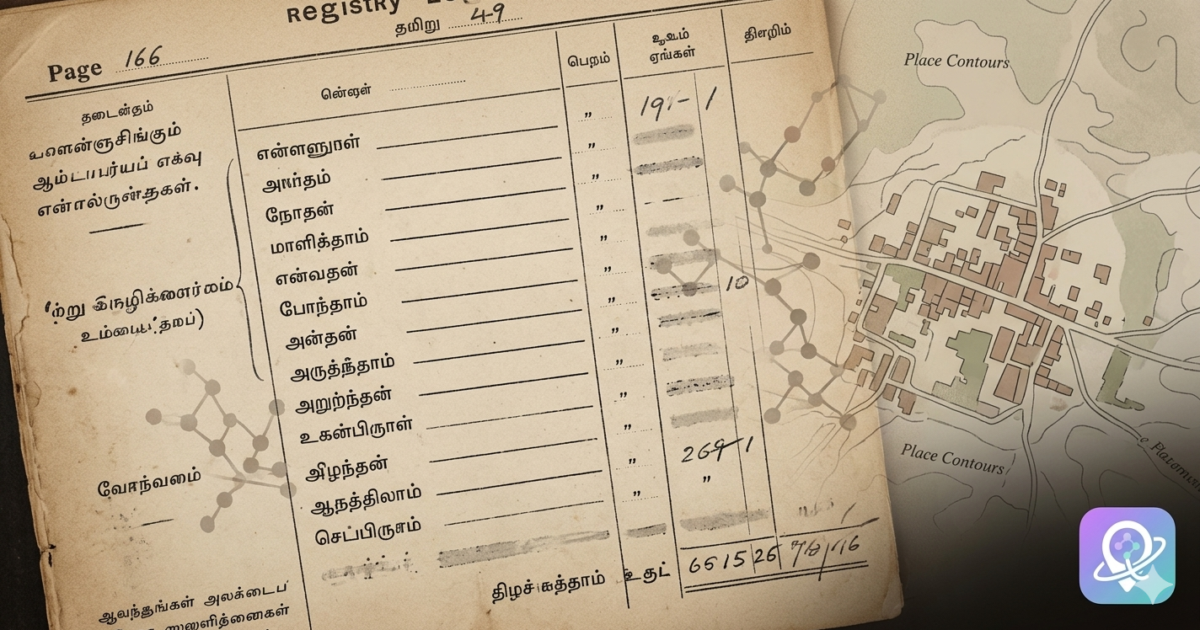
When Tamil ancestry research lacks specific names — common for diaspora families whose elders only passed down village or occupation details — the research shifts from person-indexed records (voter rolls, birth certificates) to place-and-community-indexed records (village gazetteers, caste-association rolls, temple trustee lists, land-grant inscriptions). The four anchors that work without names: ancestral village (narrows to a district’s land records), caste or jati (narrows to a specific community’s sabha archives and migration-corridor documents), kula deivam (narrows to a specific temple’s donor and trustee rolls), and occupation + approximate migration date (narrows to plantation, military, or merchant-guild records for that period). Any two of these usually produce enough context to reconstruct likely family paths even without name matches.
The Power of Place: Starting with Village Names
Even without a name, a village or town name can be an incredibly powerful starting point for Tamil ancestry research. Many families, especially those who emigrated during the indenture period or later migrations, often retain a memory of their ancestral village, even if the specific family names have been lost or changed. For diaspora descendants, this single piece of geographic information can unlock entire archives. Look for this in old letters, family stories, travel documents, or even community records from the destination country. Once a village is identified, research can focus on its history, prominent families, and any known migration patterns from that specific area.
Within Tamil Nadu, knowing a village name allows for a different kind of investigation. Local temples often maintain records or have strong oral traditions associated with specific families or kula deivams (family deities). Land records, while challenging to access without names, can sometimes reveal historical land ownership patterns associated with certain communities in a village. Local historians or long-term residents might also recall significant families or events that could provide clues. The key is to saturate your research in the specific locality, looking for any information that points to who lived there and when.
Migration Stories: Your Ancestor’s Journey as a Clue
Every migration has a story, and these narratives, even if fragmented, can offer crucial breadcrumbs. For diaspora Tamils, understanding the ‘how’ and ‘when’ of their ancestors’ journey can be more valuable than knowing a specific name. Was it during the British colonial period for indentured labor to Sri Lanka, Malaysia, Singapore, Fiji, or the Caribbean? Was it a later economic migration to the Gulf, Europe, or North America? Each wave of migration has distinct record-keeping practices and common origin regions in Tamil Nadu. For instance, indentured laborers often came from specific districts like Tiruchirappalli, Thanjavur, and Pudukkottai.
Investigate the destination country’s archives for immigration records, plantation registers, or community histories. While individual names might be missing, ship manifests or labor contracts sometimes list the district of origin, age, or even physical descriptions that could match family lore. These records can then be cross-referenced with known migration routes and timelines. Even if a direct link to an ancestor isn’t found, understanding the broader context of Tamil migration to a specific region can narrow down the potential origin points in Tamil Nadu, guiding further research.
Kula Deivam: The Anchor of Ancestral Identity
A kula deivam, or family deity, is perhaps the most enduring and powerful non-name-based identifier in Tamil culture. Unlike personal names which can be lost or changed, the kula deivam and its associated temple often remain constant across generations and migrations. Many Tamil families, even those who have been abroad for centuries, retain knowledge of their kula deivam and the village where its temple is located. This is because the kula deivam is central to family rituals, identity, and community.
If you know your kula deivam, the search becomes significantly more focused. Identify the primary temple associated with that deity. Temples often have records of families who worship there, or at the very least, local knowledge about the communities historically associated with them. The temple’s location immediately points to a specific village or region in Tamil Nadu. From there, you can explore local land records, community histories, and speak to elders who might recall specific family lines connected to the kula deivam. Even if a name is unknown, being able to say, "My family worships [Deity Name] at [Village Name] temple" can open many doors in Tamil Nadu.
Leveraging Community and Oral Histories
When official records are scarce, community and oral histories become paramount. For diaspora communities, connect with cultural organizations, temples, and elder groups from your ancestral region. They often hold collective memories, shared migration stories, and even informal genealogical knowledge that can bridge gaps. Community newsletters, old photographs, and oral interviews can reveal names of early settlers, their origins, and their connections to others.
Within Tamil Nadu, the approach is similar but more localized. Engage with village elders, local historians, and temple priests. Attend local festivals and gatherings where community memory is often strongest. While names might not surface immediately, repeated conversations and building trust can reveal stories of families who left, families who arrived, and the social dynamics of the village that might align with your family’s known history. Be patient and respectful, as this form of research relies heavily on human connection and trust.
Tracing Tamil ancestry without specific names is a challenging but not impossible endeavor. By focusing on geographic anchors, migration narratives, cultural identifiers like the kula deivam, and the rich tapestry of community memory, researchers can often piece together a compelling picture of their heritage, even when individual names remain elusive.