TamizhConnect Blog
17 Mar 2026 · TamizhConnect
From Ancient Shores: The Shared Tapestry of Tamil and...
Tamil genealogy article
Explore the deep linguistic and historical roots connecting Tamil and Malayalam, tracing their divergence from a common ancestor through centuries of cultural and geographical evolution.
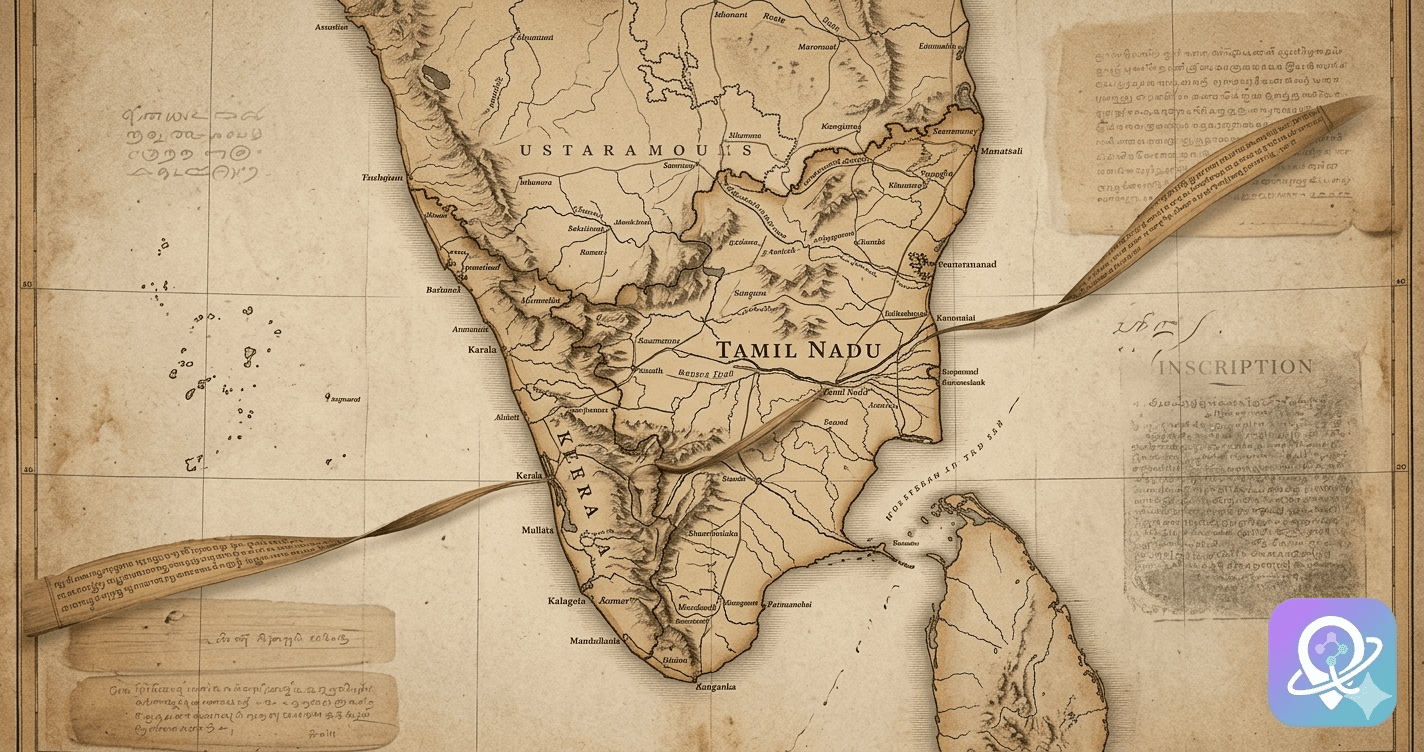
Tamil and Malayalam split from a shared Proto-Tamil-Malayalam ancestor around the 8th–9th century CE — roughly 1,100–1,200 years ago — making them the closest linguistic siblings within the Dravidian language family. Before the split, the language spoken across present-day Kerala was a western dialect of Old Tamil sometimes called Kodun-Tamil or "Kerala Tamil," documented in 9th- and 10th-century Chera inscriptions. The divergence accelerated under Chera dynasty vernacular-literature patronage, heavy Namboothiri Brahmin Sanskrit influence on Kerala's speech, and Kerala's distinct maritime trade contacts with West Asia. Today the two languages share roughly 70% of core vocabulary but have diverged significantly in grammar — Malayalam dropped the verb-subject agreement Tamil retained.
The Proto-Dravidian Roots
To understand the relationship between Tamil and Malayalam, we must first look to Proto-Dravidian, the reconstructed ancestor of all Dravidian languages. From this ancient linguistic wellspring emerged Old Tamil, a language that, for a significant period, served as the dominant literary and spoken form across a vast swathe of South India, including what is now Kerala. Inscriptions and literary works from the Sangam era (roughly 300 BCE to 300 CE) found in both Tamil Nadu and Kerala bear testament to this shared linguistic heritage. The Chera dynasty, one of the three great Tamil kingdoms of the Sangam age, ruled over much of present-day Kerala, further cementing the cultural and linguistic unity of the region. During this period, the language spoken in the Chera heartland was essentially Old Tamil, albeit with regional variations that would eventually become the seeds of a new language.
The Divergence: A Slow Separation
The separation of Malayalam from Old Tamil was not a sudden event but a gradual process spanning several centuries, primarily from the 9th to the 14th century CE. Several factors contributed to this linguistic divergence:
Geographical Isolation and Local Dialects
The formidable Western Ghats acted as a natural barrier, isolating the western coastal strip (modern-day Kerala) from the eastern plains (modern-day Tamil Nadu). This geographical separation fostered the development of distinct local dialects within Old Tamil spoken in Kerala. Over time, these dialects evolved independently, accumulating unique phonetic, morphological, and lexical features.
Political Independence and Cultural Identity
With the decline of the Chera empire, new regional powers emerged in Kerala, such as the Mahodayapuram Cheras. These independent polities began to cultivate their own cultural identity, distinct from the Tamil heartland. The development of a unique literary tradition, even if initially borrowing heavily from Tamil, became a crucial step in establishing a separate linguistic identity.
Sanskrit's Profound Influence
Perhaps the most significant factor in the divergence was the intense influence of Sanskrit. Kerala's long-standing maritime trade routes and its embrace of Brahminical traditions led to a much stronger and more pervasive influx of Sanskrit vocabulary and grammatical structures into the local Old Tamil dialects compared to Tamil Nadu. This phenomenon, known as 'Manipravalam' (meaning 'ruby and coral' – referring to the blend of Sanskrit and Tamil), was a literary style that combined Sanskrit words and grammatical forms with a Tamil base. While Tamil also absorbed Sanskrit words, Malayalam's adoption was far more extensive, particularly in its literary forms, leading to significant lexical and phonological differences.
Key Linguistic Shifts
The divergence manifested in several key linguistic changes:
- Phonology: Malayalam developed a simpler phonological system compared to Tamil, losing some of the retroflex consonants and certain word-final sounds. For instance, the Tamil word 'pazham' (fruit) became 'pazham' (with a different 'zh' sound) or 'pazham' in various Malayalam dialects, and the loss of final 'm' in some instances. The absence of the Tamil 'ai' diphthong, often becoming 'a' or 'e' in Malayalam, is another example.
- Morphology: Malayalam simplified some of the complex agglutinative structures of Old Tamil. For example, the Tamil verb conjugation system, which explicitly marks gender and number, became less prominent in Malayalam, often using a common ending for all genders and numbers in certain tenses.
- Lexicon: While both languages share a vast core vocabulary derived from Old Tamil, Malayalam's heavy Sanskritization introduced a large number of loanwords that are absent or less common in Tamil. This is particularly noticeable in religious, philosophical, and administrative terms.
A Shared Heritage, A Unique Path
Today, Tamil and Malayalam stand as two distinct Dravidian languages, each with its own rich literary tradition and cultural identity. Yet, the echoes of their shared past are undeniable. A Tamil speaker can often grasp the gist of a Malayalam conversation, and vice versa, especially when the context is simple and the vocabulary is less Sanskritized. The fundamental grammatical structures, many core words, and even cultural idioms reveal their common origin. The story of Tamil and Malayalam is a powerful testament to how language, like a river, can branch and flow in new directions while still retaining the essence of its source, enriching the landscape it traverses with unique beauty and character.
The journey of these languages from a single root to their present distinct forms is a compelling narrative of adaptation, influence, and the enduring power of human communication to reflect and shape identity across generations and geographies.
Share this article
TamizhConnect
TamizhConnect helps Tamil families worldwide trace their ancestry using voter records, indenture archives, and origin village matching. Our research team combines genealogy expertise with digitised Tamil Nadu datasets to help you discover your roots.
Ready to start your Tamil family tree?
TamizhConnect helps you discover relatives, trace your origin village, and keep your family history alive for the next generation.
Create your free TamizhConnect accountGo to my family treeDocument Digitisation
Have old documents? Upload them and we'll verify, trace, and add them to your tree.
Was this article helpful?
Get new articles in your inbox
Tamil genealogy tips, research guides, and new feature updates.
You might also like
When Did Malayalam Become Its Own Language? (English)
Malayalam's emergence as a distinct language from Old Tamil was a gradual process, shaped by unique geographical, political, and cultural forces over centuries. This post explores the key factors and timeline of this linguistic divergence.
04 Feb 2026
Tamil and Telugu: Shared Roots, Distinct Branches (English)
Tamil and Telugu are distinct branches of the South Dravidian language family, both originating from a common ancestor, Proto-Dravidian, but evolving independently over millennia.
06 Mar 2026
Tamil and Telugu: Separate Branches, Shared Roots (English)
Tamil and Telugu are distinct sister languages within the Dravidian family, both evolving independently from a common ancestor, Proto-Dravidian, rather than one being a root of the other.
03 Mar 2026
Tracing Dravidian Roots: Tamil and Telugu's Shared Heritage (English)
Tamil and Telugu are distinct branches of the South Dravidian and South-Central Dravidian language families, respectively, both originating from Proto-Dravidian.
01 Mar 2026
தமிழ் மூதாதையர் ஆய்வு நூலகம் (Tamil)
TamizhConnect-க்கு தேவையான தமிழ் வம்சாவளி முறைகள், பதிவுகள், இனவியல் மற்றும் பாரம்பரியச் சரிபார்ப்புக்கான அனைத்து ஆழமான வழிகாட்டிகளும் ஒரே இடத்தில்.
02T17:55:42.988Z Sep 2026
Tamil ancestry research: Complete guide for genealogical methods (English)
All our deep-dive guides on Tamil genealogical methods, records, ethnography, and heritage validation for TamizhConnect.
02T17:55:42.987Z Sep 2026
Related by topic
The Dravidian Language Family: Origins and Relationships (English)
Explore the shared roots and distinct paths of Tamil, Telugu, Kannada, and Malayalam, understanding their common linguistic heritage and individual literary journeys.
29 Jan 2026
The Dravidian Language Family: Common Roots, Distinct Paths (English)
Explore the shared origins and unique evolutions of Tamil, Telugu, Kannada, and Malayalam, the four major Dravidian languages.
27 Jan 2026
More from TamizhConnect
Tamil Elder Interview Kit: Ready-to-Use Questions & Prompts (English)
A ready-to-copy interview kit for capturing Tamil family history from elders — grouped by topic, sequenced from easy to sensitive, with recording tips and follow-ups that unlock the stories behind the names.
21 Aug 2026
The Tamils of Dharavi: A Hundred Years from Tirunelveli to Mumbai (English)
From the droughts of Tirunelveli to the tanneries and textile mills of Mumbai, the Tamil community of Dharavi has built one of the largest Tamil cities outside Tamil Nadu. With redevelopment underway, here's how families can preserve their migration story for the next generation.
15 May 2026
Core topics
What is Tamil, really? Language, identity, and where it comes from
A clear, human explanation of what Tamil is-language, identity, people, and history-plus how to talk about it without stereotypes.
4 Feb 2026
What Defines Tamil Identity Beyond Borders and Sub-Groups? (English)
Tamil identity is primarily defined by shared language and cultural heritage, rather than by geographic borders or internal sub-group affiliations. This core identity persists across the diaspora and within Tamil Nadu.
17 Apr 2026