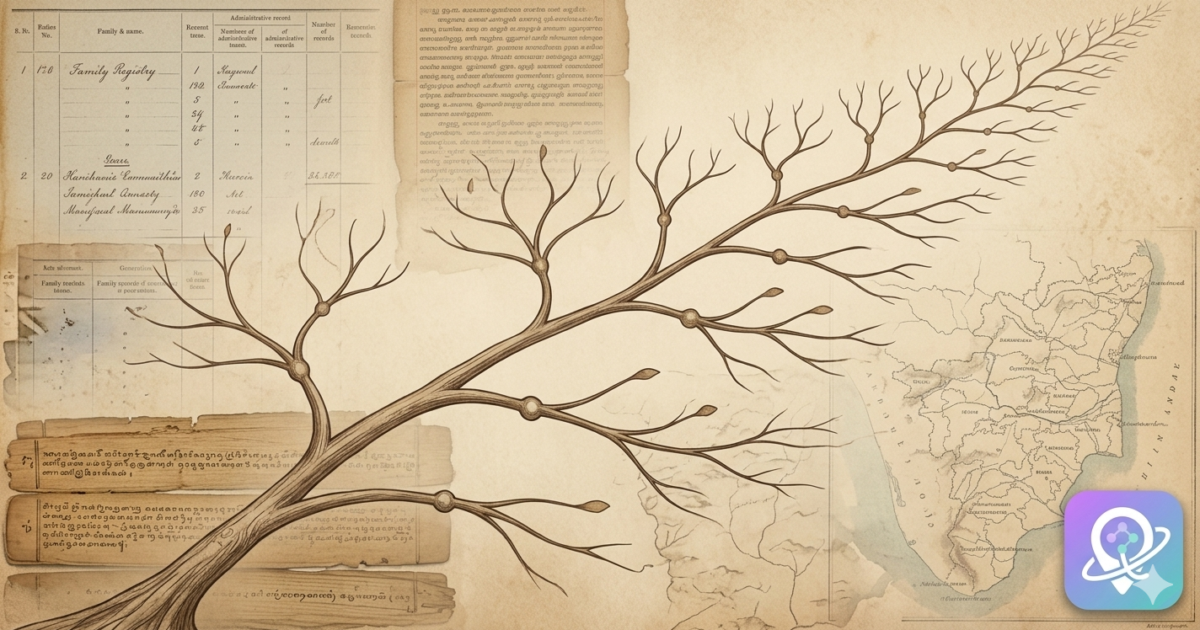
Tamil genealogy typically hits a records wall around the 5th generation back (~late 19th century) because Indian civil registration only became mandatory nationwide in 1969, colonial British records covered only property and tax matters, and village-level records were hand-kept on palm leaves that rarely survived. Pushing past this wall requires shifting from civil records to four older source types: temple donor inscription lists (family names chiseled onto temple walls), palm-leaf family thombus (lineage books kept by specific castes), British India gazetteers (land-revenue settlement reports with named households), and caste-community sabha archives where they exist. None are complete. Combining them is what turns a 5-generation tree into a 10-generation one.
The Limits of Modern Records
While modern record-keeping has become increasingly standardized, its depth in India often doesn’t extend as far back as in some Western countries. Civil registration of births and deaths, for instance, became more widespread and systematic in British India from the late 19th and early 20th centuries, but its thoroughness varied significantly by region and social class. Before this, records were often maintained at a local, religious, or administrative level, and their preservation has been inconsistent. This means that relying solely on what we might consider ‘standard’ genealogical documents will quickly hit a wall, often around the 1880s to 1900s for most families.
Unearthing Village-Level Documents
The real breakthroughs beyond five generations often come from delving into village and district-level records. These are less centralized and require a more localized approach:
- Land Records (Patta/Chitta/Adangal): These documents, particularly those related to land ownership and revenue collection, can be incredibly rich. They often list names of landowners, their fathers, and sometimes even their grandfathers, along with details about the land parcels. The British introduced extensive land surveys and record-keeping systems (like the Permanent Settlement or Ryotwari system in different regions) which, while complex, created a paper trail. Accessing these might involve visiting Tahsildar offices or district archives.
- Temple Records (Kovil Register): Many ancient temples maintained registers of patrons, donors, and even priests and their families over centuries. While not uniformly available or easily decipherable, these can be a goldmine for specific lineages, especially those associated with temple service or significant donations. Some temples also have inscriptions (epigraphs) that mention individuals and their families, though these are typically for very prominent figures.
- Karnam/Village Accountant Records: Before modern administration, the Karnam or village accountant played a crucial role, maintaining various local records, including land, revenue, and sometimes even rudimentary population details. Their personal records, if they survive, can provide glimpses into village life and family structures.
- Caste and Community Records: Historically, various caste associations or community groups maintained their own registers, particularly for marriages, births, and deaths within their community. These are often private collections and require networking within the specific community to access.
Interpreting Historical Documents: A Detective’s Skill
Accessing these documents is only half the battle; interpreting them requires a specific skill set:
- Language and Script: Older records are often in Tamil, but the script might be an older form (like Vatteluttu or Grantha for very ancient records, though most colonial-era documents will be in modern Tamil script). Knowing Tamil is essential, and familiarity with older handwriting styles is a significant advantage. Some records might also be in English or even other regional languages depending on the administrative context.
- Naming Conventions: Tamil naming conventions can be fluid. The use of patronymics (father’s name as an initial or part of the name), village names, and caste names can vary. A person might be known by different names in different contexts or records. Understanding these patterns is crucial for accurately connecting individuals.
- Dates and Eras: Dates might be recorded using different calendars – the Gregorian calendar (post-British influence), the Tamil calendar, or even local era systems. Converting and cross-referencing dates is vital for accuracy.
- Contextual Knowledge: Understanding the historical, social, and administrative context of the time period is paramount. Knowledge of local history, major events, migration patterns, and the socio-economic conditions of your ancestral village can help fill in gaps and make sense of fragmented information.
The Diaspora Challenge
For those whose ancestors migrated from Tamil Nadu, an additional layer of complexity exists. Records in host countries (e.g., Malaysia, Singapore, Sri Lanka, Fiji, South Africa, Caribbean nations) might provide a starting point, often detailing the port of origin and sometimes even the village in Tamil Nadu. However, linking these records back to specific village documents in India requires careful cross-referencing and often involves traveling to the ancestral village or connecting with local researchers.
Tracing Tamil ancestry beyond five generations is a journey of discovery, often requiring perseverance and a willingness to explore unconventional sources. While not every branch of a family tree will extend indefinitely, the process itself offers profound insights into the lives, struggles, and triumphs of those who came before us, connecting us more deeply to our shared heritage and the rich tapestry of Tamil history.