TamizhConnect Blog
4 Feb 2026 · TamizhConnect
When Did Malayalam Become Its Own Language?
Tamil genealogy article
Malayalam's emergence as a distinct language from Old Tamil was a gradual process, shaped by unique geographical, political, and cultural forces over centuries. This post explores the key factors and timeline of this linguistic divergence.
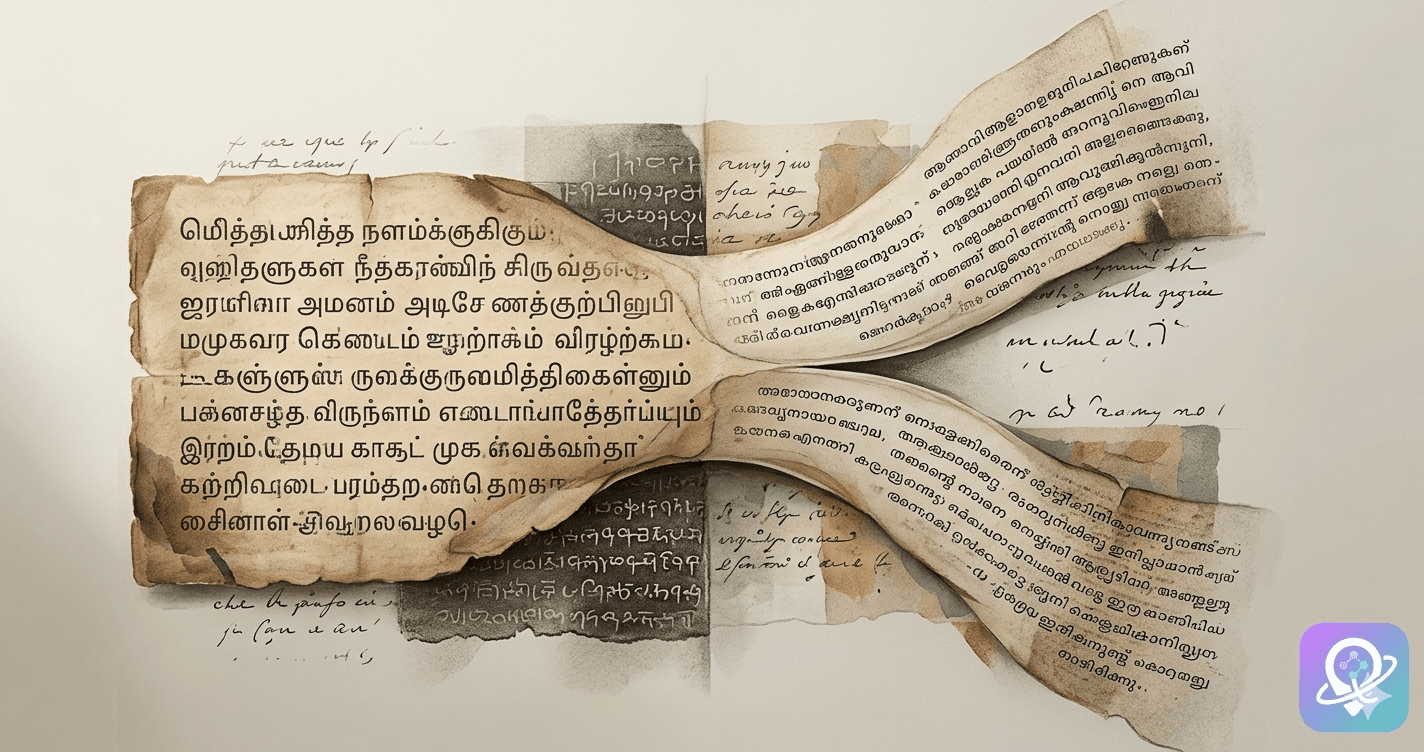
Malayalam split from Old Tamil between the 8th and 10th centuries CE through a gradual divergence — not a single event — driven by the Western Ghats separating Kerala from the rest of Tamil-speaking South India, heavy Namboothiri Brahmin Sanskrit influence on Kerala's speech, and the Chera dynasty's patronage of local vernacular literature. The earliest unambiguously Malayalam inscriptions date to the 12th–13th century; before then, what's now Kerala spoke a western dialect of Old Tamil called Kodun-Tamil. This is the youngest major Dravidian language split on record.
The Shared Proto-Dravidian Root
Both Tamil and Malayalam belong to the Southern Dravidian language family, tracing their origins back to a common ancestor, Proto-Dravidian. For centuries, the linguistic landscape of what is now Kerala and Tamil Nadu was more of a dialect continuum than a sharp divide. Early inscriptions and literary works from the Chera kingdom, particularly those from the Sangam period (roughly 300 BCE to 300 CE), show a language that is often referred to as 'Old Tamil' or 'Proto-Malayalam', exhibiting features common to both modern Tamil and Malayalam. The PattuPattu and Ettuthogai anthologies, for example, contain poems attributed to Chera kings and poets, written in a language that is recognizably Old Tamil, yet with hints of the phonetic and grammatical shifts that would later characterize Malayalam. This shared linguistic foundation underscores a long period of cultural and political unity, where the people on both sides of the Western Ghats communicated in closely related dialects.
Geographical Isolation and the Western Ghats
The formidable barrier of the Western Ghats played a pivotal role in the linguistic divergence. While the mountains did not completely cut off interaction, they significantly limited continuous contact and fostered distinct cultural and linguistic developments on the western coast compared to the eastern plains. The people of the Chera kingdom, situated along the Malabar Coast, developed a unique identity shaped by their maritime trade with West Asia, Rome, and later, the Arab world. This coastal orientation, different from the predominantly agrarian and inland focus of the Tamil kingdoms to the east, led to different influences and priorities. Over time, the dialects spoken on the western side of the Ghats began to evolve independently, accumulating distinct phonetic, lexical, and grammatical features that were less pronounced or absent in the eastern dialects. This geographical separation allowed for the gradual accumulation of innovations that, when coupled with other factors, would eventually lead to a separate language.
Political Autonomy and the Chera Kingdom
The political history of the Chera kingdom also contributed significantly to the linguistic separation. While initially part of the larger 'Tamilakam' cultural sphere, the Cheras maintained a distinct political identity. The decline of the early Chera dynasty around the 5th century CE, followed by a period often referred to as the 'Kalabhra interregnum', saw a weakening of central authority and increased regionalization. When the later Cheras (also known as the Kulasekharas) rose to prominence from the 9th to the 12th centuries, they established a powerful and independent kingdom centered in Mahodayapuram (modern Kodungallur). This political autonomy fostered a sense of distinct identity, which in turn supported the development of a unique linguistic standard. The royal patronage of local literary and cultural forms, distinct from those of the Cholas or Pandyas, further accelerated the divergence. Inscriptions from the Kulasekhara period, such as the Mampalli Plate (974 CE) and the Jewish Copper Plate (1000 CE), demonstrate a language that, while still bearing strong resemblances to Tamil, clearly exhibits nascent Malayalam characteristics, including specific phonological shifts and the increasing use of Sanskrit loanwords.
Sanskrit and Prakrit Influence
Perhaps the most significant external influence on the development of Malayalam was the profound impact of Sanskrit and, to a lesser extent, Prakrit. While Tamil also absorbed Sanskrit words, the scale and manner of its integration into the emerging Malayalam were far more extensive. The Nambudiri Brahmins, who migrated to Kerala and established a strong social and religious presence, played a crucial role in this process. Their language, Sanskrit, deeply permeated the local dialects. This influence wasn't merely lexical; it also affected phonology, morphology, and syntax. The Manipravalam literary style, which flourished from the 9th century onwards, perfectly illustrates this fusion – it was a hybrid language blending local Dravidian forms with a heavy dose of Sanskrit, often in a highly ornate manner. While Manipravalam itself was an artificial literary dialect, its widespread use in religious texts, commentaries, and poetry significantly shaped the evolving Malayalam language, giving it a distinct character compared to Tamil, which consciously resisted such extensive Sanskritization during its classical revival periods.
The Grantha Script and Literary Tradition
The adoption and adaptation of the Grantha script also marked a crucial step in Malayalam's divergence. While Old Tamil used the Vatteluttu script (a variant of Brahmi), the increasing influx of Sanskrit words and the need to represent their unique phonemes led to the development of a modified script. The Grantha script, originally used for writing Sanskrit texts in South India, was adapted to include letters for sounds found in Dravidian languages, eventually evolving into the modern Malayalam script. This distinct writing system further solidified Malayalam's independent identity and allowed for the development of its own literary tradition, separate from the established Tamil literary canon. Texts like the Ramacharitam (12th century), considered one of the earliest literary works in Malayalam, showcase a language that has clearly moved beyond Old Tamil, demonstrating the consolidation of its unique grammatical and lexical features.
In conclusion, the separation of Malayalam from Old Tamil was a complex and protracted process, spanning several centuries and driven by a confluence of geographical, political, and cultural factors. It was not an abrupt event but a gradual evolution, where local dialects, influenced by isolation, political autonomy, and significant Sanskrit input, slowly developed a distinct identity that eventually coalesced into the language we know today as Malayalam. This journey highlights the dynamic nature of language and its deep connection to the history and identity of its speakers.
Share this article
TamizhConnect
TamizhConnect helps Tamil families worldwide trace their ancestry using voter records, indenture archives, and origin village matching. Our research team combines genealogy expertise with digitised Tamil Nadu datasets to help you discover your roots.
Ready to start your Tamil family tree?
TamizhConnect helps you discover relatives, trace your origin village, and keep your family history alive for the next generation.
Create your free TamizhConnect accountGo to my family treeDocument Digitisation
Have old documents? Upload them and we'll verify, trace, and add them to your tree.
Was this article helpful?
Get new articles in your inbox
Tamil genealogy tips, research guides, and new feature updates.
You might also like
From Ancient Shores: The Shared Tapestry of Tamil and Malayalam (English)
Explore the deep linguistic and historical roots connecting Tamil and Malayalam, tracing their divergence from a common ancestor through centuries of cultural and geographical evolution.
17 Mar 2026
Dravidian Identity: History, Language, and Genetic Roots (English)
Explore the distinct historical, linguistic, and genetic evidence that defines the Dravidian identity, separate from Indo-Aryan cultures. Uncover the deep roots of Tamil people in South India.
16 Apr 2026
Tracing Tamil Roots: The Distinctive Dravidian Heritage (English)
Explore the historical, linguistic, and genetic evidence that defines Dravidian identity, distinct from Indo-Aryan cultures and deeply rooted in South India.
26 Mar 2026
Tamil and Telugu: Shared Roots, Distinct Branches (English)
Tamil and Telugu are distinct branches of the South Dravidian language family, both originating from a common ancestor, Proto-Dravidian, but evolving independently over millennia.
06 Mar 2026
தமிழ் மூதாதையர் ஆய்வு நூலகம் (Tamil)
TamizhConnect-க்கு தேவையான தமிழ் வம்சாவளி முறைகள், பதிவுகள், இனவியல் மற்றும் பாரம்பரியச் சரிபார்ப்புக்கான அனைத்து ஆழமான வழிகாட்டிகளும் ஒரே இடத்தில்.
02T21:31:40.701Z Sep 2026
Tamil ancestry research: Complete guide for genealogical methods (English)
All our deep-dive guides on Tamil genealogical methods, records, ethnography, and heritage validation for TamizhConnect.
02T21:31:40.700Z Sep 2026
Related by topic
Tamil and Telugu: Separate Branches, Shared Roots (English)
Tamil and Telugu are distinct sister languages within the Dravidian family, both evolving independently from a common ancestor, Proto-Dravidian, rather than one being a root of the other.
3 Mar 2026
Tracing Dravidian Roots: Tamil and Telugu's Shared Heritage (English)
Tamil and Telugu are distinct branches of the South Dravidian and South-Central Dravidian language families, respectively, both originating from Proto-Dravidian.
1 Mar 2026
More from TamizhConnect
Tamil Elder Interview Kit: Ready-to-Use Questions & Prompts (English)
A ready-to-copy interview kit for capturing Tamil family history from elders — grouped by topic, sequenced from easy to sensitive, with recording tips and follow-ups that unlock the stories behind the names.
21 Aug 2026
The Tamils of Dharavi: A Hundred Years from Tirunelveli to Mumbai (English)
From the droughts of Tirunelveli to the tanneries and textile mills of Mumbai, the Tamil community of Dharavi has built one of the largest Tamil cities outside Tamil Nadu. With redevelopment underway, here's how families can preserve their migration story for the next generation.
15 May 2026
Core topics
What is Tamil, really? Language, identity, and where it comes from
A clear, human explanation of what Tamil is-language, identity, people, and history-plus how to talk about it without stereotypes.
4 Feb 2026
What Defines Tamil Identity Beyond Borders and Sub-Groups? (English)
Tamil identity is primarily defined by shared language and cultural heritage, rather than by geographic borders or internal sub-group affiliations. This core identity persists across the diaspora and within Tamil Nadu.
17 Apr 2026
Continue reading
Tracing Brahmin Ancestry Between Tamil Nadu and Sri Lanka (English)
3 Feb 2026
Decoding Your Tamil Genetic Ancestry: Beyond the Buzzwords (English)
2 Feb 2026
Tracing Influential Tamil Families: Beyond Public Records (English)
1 Feb 2026
Tracing Brahmin Ancestry in South India: Beyond North-South Migrations (English)
31 Jan 2026