TamizhConnect Blog
31 Jan 2026 · TamizhConnect
Tracing Brahmin Ancestry in South India
Tamil genealogy article
Explore the diverse origins and historical development of South Indian Brahmin communities, challenging the singular North Indian origin misconception.
Document Digitisation
Turn documents into verified Tamil lineage.
Choose the depth you need. One-time service, results stay in your account.
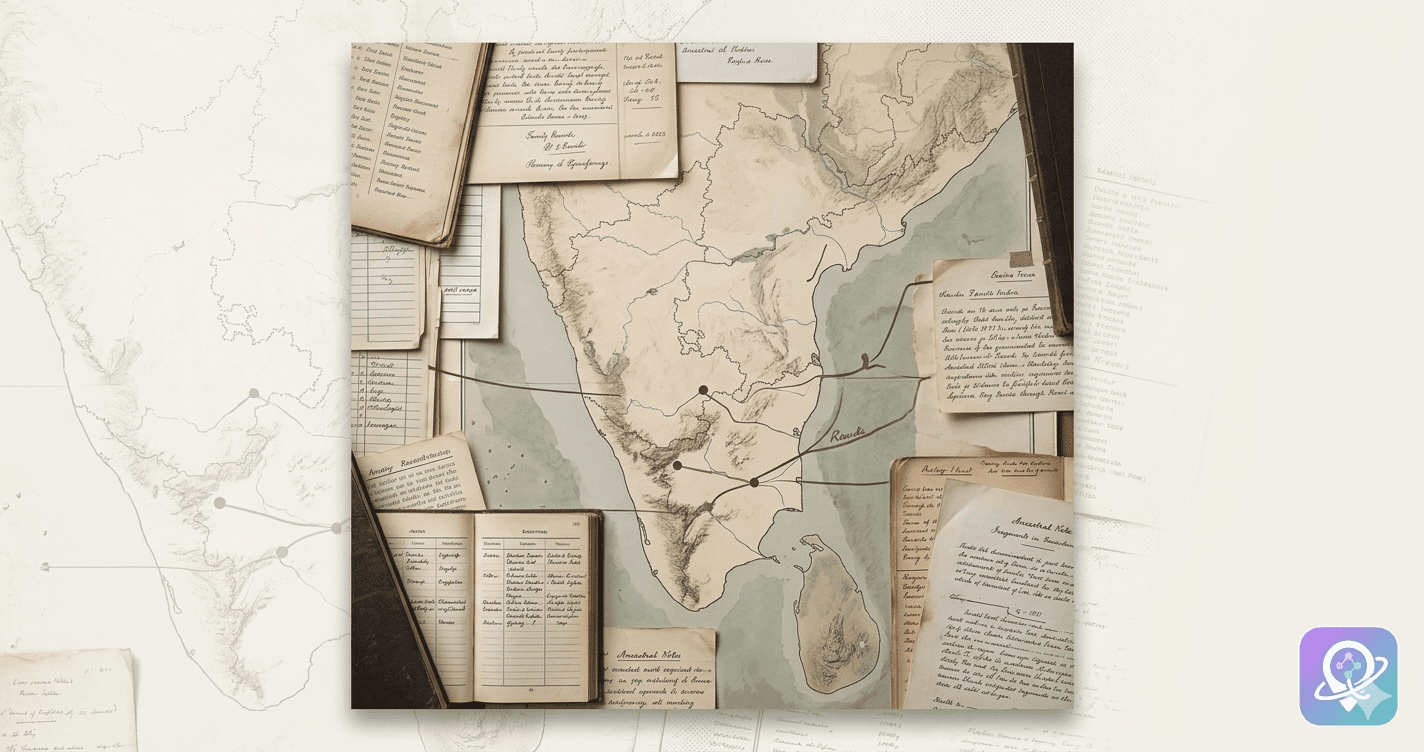
Tracing Brahmin ancestry in South India reveals a complex tapestry of local evolution, regional migrations, and distinct cultural development that extends far beyond a singular North Indian origin. While some Brahmin groups do have historical connections to northern migrations, many others have deep roots within the Deccan and Southern India, shaped by centuries of interaction with local kingdoms, linguistic shifts, and unique social structures. Understanding this multifaceted history is crucial for anyone researching their Brahmin heritage in the region, as it moves past oversimplified narratives to embrace a richer, more accurate picture of identity.
The Myth of a Singular North Indian Origin
The notion that all South Indian Brahmins solely originate from North India is a simplification that overlooks significant historical and anthropological evidence. While early Vedic traditions certainly spread southward, the communities that embraced and propagated them did not remain static or monolithic. Over millennia, distinct Brahmin groups emerged in the South, such as the Tamil Iyers and Iyengars, the Telugu Niyogis and Vaidikas, the Kannada Havyakas and Smarthas, and the Malayali Nambudiris. Each of these groups developed unique rituals, linguistic variations in their Sanskrit recitation, dietary practices, and even social hierarchies that distinguish them from their northern counterparts and from each other. These differences are not mere superficialities but reflect deep historical divergences and local adaptations that have solidified over centuries.
Local Evolution and Regional Kingdoms
Many Brahmin communities in South India evolved intrinsically within the local socio-political landscape, often patronized by powerful regional dynasties. The Pallavas, Cholas, Pandyas, Cheras, Chalukyas, Rashtrakutas, and Vijayanagara rulers all played pivotal roles in establishing and supporting Brahmin settlements, temples, and educational institutions. These kingdoms frequently granted lands (brahmadeyas) to Brahmins, encouraging their settlement and the propagation of Vedic knowledge, which in turn fostered unique local traditions. For instance, the Nambudiris of Kerala developed a distinct social structure and land ownership system under the patronage of local rulers, largely isolated from broader pan-Indian Brahminical trends for centuries. Similarly, the Agrahara villages of Karnataka and Tamil Nadu became centers of learning and culture, where Brahmin families resided for generations, developing deep ties to the local language and customs while preserving their specific Vedic sakhas (branches).
Linguistic and Cultural Divergence
One of the clearest indicators of diverse origins and localized development is the linguistic identity of South Indian Brahmin communities. While Sanskrit remained the language of scripture and ritual, the home languages of these groups mirrored the regional linguistic boundaries. Tamil Brahmins spoke Tamil, Telugu Brahmins spoke Telugu, and so forth. This wasn't merely a matter of convenience; these languages deeply influenced their cultural expressions, folk traditions, and even the pronunciation of Sanskrit chants. The adoption and adaptation of local deities into the Brahminical pantheon, the development of unique culinary practices influenced by regional ingredients, and distinct dress codes further illustrate this deep integration. These cultural markers point to a long history of local settlement and interaction, rather than a continuous, singular migratory wave from the North.
Inter-Regional Migrations within the South
Beyond the North-South narrative, significant migrations occurred within South India, contributing to the complex tapestry of Brahmin ancestry. For example, during periods of political upheaval or economic opportunity, Tamil Brahmins migrated into parts of Andhra Pradesh, Karnataka, and Kerala, and vice-versa. The expansion of the Vijayanagara Empire, in particular, led to considerable movement of Brahmin scholars and administrators across its vast territories, fostering intermingling and the establishment of new communities. This explains why one might find Tamil-speaking Brahmins with surnames common to Telugu or Kannada regions, or vice-versa. These internal movements often created hybrid identities, where families maintained aspects of their ancestral linguistic and ritual traditions while adopting new local customs. Tracing these specific movements often requires detailed family histories and a deep understanding of regional historical boundaries and political shifts.
Researching Your South Indian Brahmin Ancestry
For those researching their South Indian Brahmin ancestry, it is crucial to move beyond broad generalizations. Start by identifying the specific sub-caste (e.g., Vadama Iyer, Tengalai Iyengar, Smartha, Niyogi) and the gothra (patrilineal clan) and pravara (lineage of rishis) as these are foundational. Then, focus on identifying specific ancestral villages or towns, as these locations often hold clues about migration patterns and community origins. Temple records, land deeds, and published community histories can be invaluable resources. Remember that Brahmin ancestry in South India is a rich, layered story of adaptation, resilience, and unique cultural evolution, reflecting millennia of diverse historical forces.
Understanding the nuanced history of South Indian Brahmin communities allows for a more accurate and respectful appreciation of their heritage. It encourages a genealogical approach that prioritizes specific family histories and regional contexts over sweeping, often inaccurate, pan-Indian narratives.
Share this article
TamizhConnect
TamizhConnect helps Tamil families worldwide trace their ancestry using voter records, indenture archives, and origin village matching. Our research team combines genealogy expertise with digitised Tamil Nadu datasets to help you discover your roots.
Ready to start your Tamil family tree?
TamizhConnect helps you discover relatives, trace your origin village, and keep your family history alive for the next generation.
Create your free TamizhConnect accountGo to my family treeDocument Digitisation
Have old documents? Upload them and we'll verify, trace, and add them to your tree.
Was this article helpful?
Get new articles in your inbox
Tamil genealogy tips, research guides, and new feature updates.
You might also like
Tracing Brahmin Ancestry Between Tamil Nadu and Sri Lanka (English)
Explore the historical ties and migratory patterns of Brahmin communities connecting Tamil Nadu and Sri Lanka, and learn how to trace this unique heritage.
03 Feb 2026
Beyond 'Madras': Unpacking South Indian Ancestry in the Diaspora (English)
The colonial term 'Madras' often obscured the distinct linguistic and regional identities of South Indian indentured laborers. Learn how descendants can trace their specific Tamil, Telugu, or Malayalam heritage.
21 Apr 2026
Tracing Indentured Tamil Ancestry: Records and Realities (English)
Uncover the specific challenges and available records for tracing Tamil ancestors who emigrated under the indentured labor system, connecting diaspora families back to their origins.
21 Apr 2026
Unearthing Tamil Nadu Ancestry: A Comprehensive Guide (English)
Tracing Tamil Nadu ancestry requires navigating a rich tapestry of ancient history, diverse migrations, and a unique record-keeping landscape. This guide explores the distinct challenges and rewarding paths for uncovering your roots.
18 Apr 2026
தமிழ் மூதாதையர் ஆய்வு நூலகம் (Tamil)
TamizhConnect-க்கு தேவையான தமிழ் வம்சாவளி முறைகள், பதிவுகள், இனவியல் மற்றும் பாரம்பரியச் சரிபார்ப்புக்கான அனைத்து ஆழமான வழிகாட்டிகளும் ஒரே இடத்தில்.
03T19:44:08.934Z Sep 2026
Tamil ancestry research: Complete guide for genealogical methods (English)
All our deep-dive guides on Tamil genealogical methods, records, ethnography, and heritage validation for TamizhConnect.
03T19:44:08.933Z Sep 2026
Related by topic
Tracing Tamil Roots in Singapore: A Guide to Ancestry Research (English)
Uncover the journey of your Tamil ancestors to Singapore with this practical guide to historical records, community resources, and research strategies.
1 Apr 2026
Tracing Tamil Ancestry in Karnataka and Andhra Pradesh (English)
Uncover the unique challenges and opportunities for tracing Tamil ancestry in border regions like Karnataka and Andhra Pradesh, where identity and records often blend across linguistic and administrative lines.
15 Mar 2026
More from TamizhConnect
Tamil Elder Interview Kit: Ready-to-Use Questions & Prompts (English)
A ready-to-copy interview kit for capturing Tamil family history from elders — grouped by topic, sequenced from easy to sensitive, with recording tips and follow-ups that unlock the stories behind the names.
21 Aug 2026
The Tamils of Dharavi: A Hundred Years from Tirunelveli to Mumbai (English)
From the droughts of Tirunelveli to the tanneries and textile mills of Mumbai, the Tamil community of Dharavi has built one of the largest Tamil cities outside Tamil Nadu. With redevelopment underway, here's how families can preserve their migration story for the next generation.
15 May 2026
Core topics
What is Tamil, really? Language, identity, and where it comes from
A clear, human explanation of what Tamil is-language, identity, people, and history-plus how to talk about it without stereotypes.
4 Feb 2026
What Defines Tamil Identity Beyond Borders and Sub-Groups? (English)
Tamil identity is primarily defined by shared language and cultural heritage, rather than by geographic borders or internal sub-group affiliations. This core identity persists across the diaspora and within Tamil Nadu.
17 Apr 2026
Continue reading
India's Inter-State Water Disputes: A Legacy of Colonial Pacts and Shifting Needs (English)
30 Jan 2026
The Dravidian Language Family: Origins and Relationships (English)
29 Jan 2026
Tracing Deep Tamil Roots: Archaeology and Genetics (English)
28 Jan 2026
The Dravidian Language Family: Common Roots, Distinct Paths (English)
27 Jan 2026