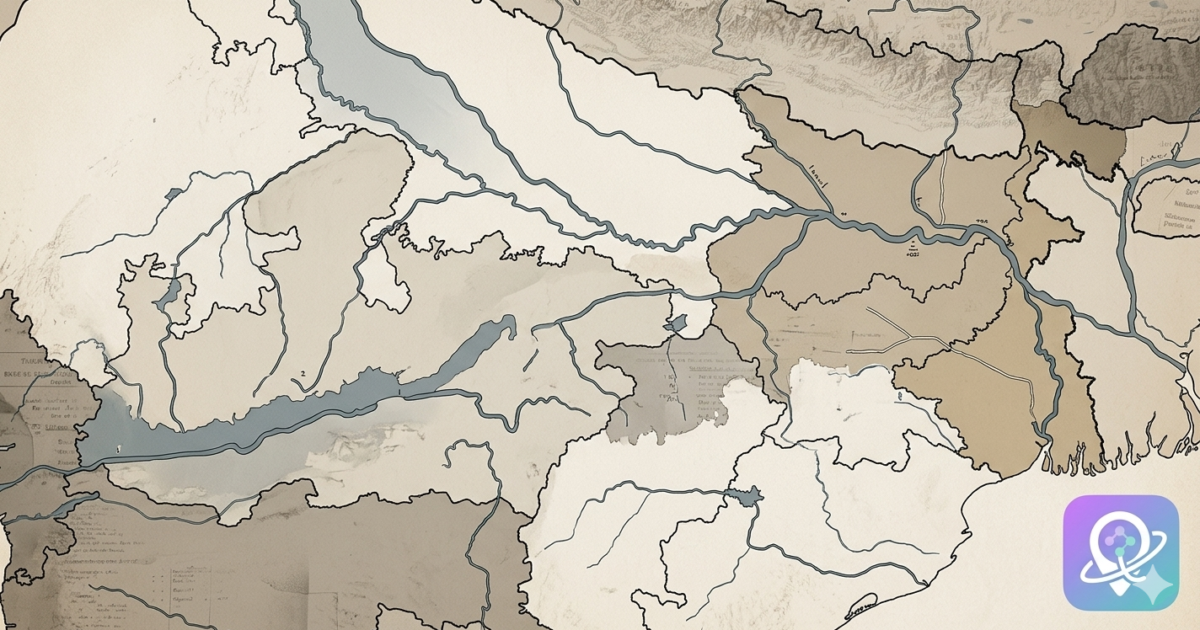
India’s major inter-state water disputes — Cauvery (Tamil Nadu–Karnataka), Krishna (Andhra Pradesh–Karnataka–Maharashtra), Ravi-Beas (Punjab–Haryana), Mullaperiyar (Tamil Nadu–Kerala), Mahanadi (Odisha–Chhattisgarh) — all trace their legal DNA to colonial-era agreements between princely states and British presidencies that disregarded hydrological realities and later population growth. Post-independence state reorganization (1956, 1960, 2014) redrew political boundaries without redrawing river-basin responsibilities, so upstream and downstream states now answer to different legislatures. Understanding any current dispute requires knowing which British-era agreement still governs it.
The Colonial Legacy: Agreements and Arbitrary Lines
The British colonial administration, in its efforts to consolidate power and exploit resources, often drew administrative boundaries that paid little heed to natural river basins. Furthermore, agreements regarding water sharing were frequently forged between disparate entities — princely states, British provinces, or directly with the Crown — under varying degrees of coercion or strategic interest. These pacts, such as the 1892 agreement between the Madras Presidency and the princely state of Mysore regarding the Cauvery river, or the 1886 Periyar Lease Agreement between the Secretary of State for India (representing the Madras Presidency) and the Maharaja of Travancore, became foundational legal documents. They often granted perpetual rights or extremely long leases, creating entitlements that are incredibly difficult to renegotiate in a modern, democratic federal structure. The long duration of these agreements, sometimes for 999 years, exemplifies a colonial mindset that could not foresee the demographic and environmental shifts of centuries, locking future generations into arrangements that quickly became anachronistic.
The Mullaperiyar Dam: A Case Study in Enduring Conflict
The Mullaperiyar Dam dispute between Tamil Nadu and Kerala offers a potent illustration of these historical complexities. Constructed between 1887 and 1895, the dam diverts water from the west-flowing Periyar River, originating in Kerala, eastward into Tamil Nadu’s arid regions. The 1886 Periyar Lease Agreement granted the Madras Presidency the rights to construct and operate the dam, and to divert its waters, for 999 years. Today, Kerala expresses concerns over the dam’s structural safety, given its age and seismic activity in the region, advocating for its decommissioning and the construction of a new dam. Tamil Nadu, heavily reliant on Mullaperiyar water for irrigation in five southern districts and for power generation, insists on its right to maintain and operate the existing dam, citing the original lease and subsequent Supreme Court judgments that have largely affirmed its operational rights. This dispute is not just about water; it’s about historical sovereignty, engineering integrity, and the very livelihood of millions.
Cauvery River Dispute: A Century of Contention
Another enduring conflict, the Cauvery water dispute, involves Tamil Nadu, Karnataka, Kerala, and Puducherry. Its roots trace back to the aforementioned 1892 and 1924 agreements between the Madras Presidency and the princely state of Mysore. These agreements laid down rules for water utilization and the construction of new irrigation projects. Post-independence, with the reorganization of states, the original parties were replaced by new state entities, each with growing populations and agricultural needs. Karnataka (formerly Mysore) argues that the colonial agreements were inequitable and that it has an inherent right to a larger share of the river’s waters, especially from its upper riparian areas. Tamil Nadu, as the lower riparian state, relies on the historical water flows and the established agreements to sustain its vast agricultural lands in the Cauvery delta. Decades of tribunals, inter-state negotiations, and Supreme Court interventions have sought to allocate water shares, but drought years inevitably reignite tensions, demonstrating the profound challenge of balancing historical rights with present-day demands and future uncertainties.
Socio-Economic Pressures and Political Will
Beyond the legal and historical frameworks, socio-economic factors significantly exacerbate water disputes. Rapid population growth, increasing urbanization, industrialization, and the expansion of irrigated agriculture place immense pressure on finite water resources. Each state views its share of river water as critical for food security, economic development, and the well-being of its populace. This often translates into intense political mobilization, where water rights become a powerful emotional and electoral issue. Political leaders find it challenging to make concessions, as such moves can be perceived as betraying regional interests. The lack of a comprehensive national water policy that transcends state boundaries and prioritizes integrated river basin management further complicates matters. While tribunals and judicial bodies provide legal frameworks, the ultimate resolution often requires political will, collaborative dialogue, and a long-term vision that transcends immediate electoral cycles.
The Path Forward: Balancing History and Future Needs
Resolving India’s inter-state water disputes requires a delicate balance between respecting historical agreements and adapting to contemporary realities. While colonial-era pacts provide a legal foundation, their rigidity often clashes with modern ecological concerns, technological advancements, and the undeniable needs of growing populations. Future-oriented solutions must involve scientific data on water availability, climate change impacts, and efficient water management practices, including conservation and rainwater harvesting. Encouraging inter-state dialogue, facilitated by neutral expert bodies, and fostering a spirit of cooperative federalism could pave the way for more equitable and sustainable water-sharing arrangements. Ultimately, moving beyond the historical grievances to a shared vision of water security for all riparian states is essential for regional harmony and development.