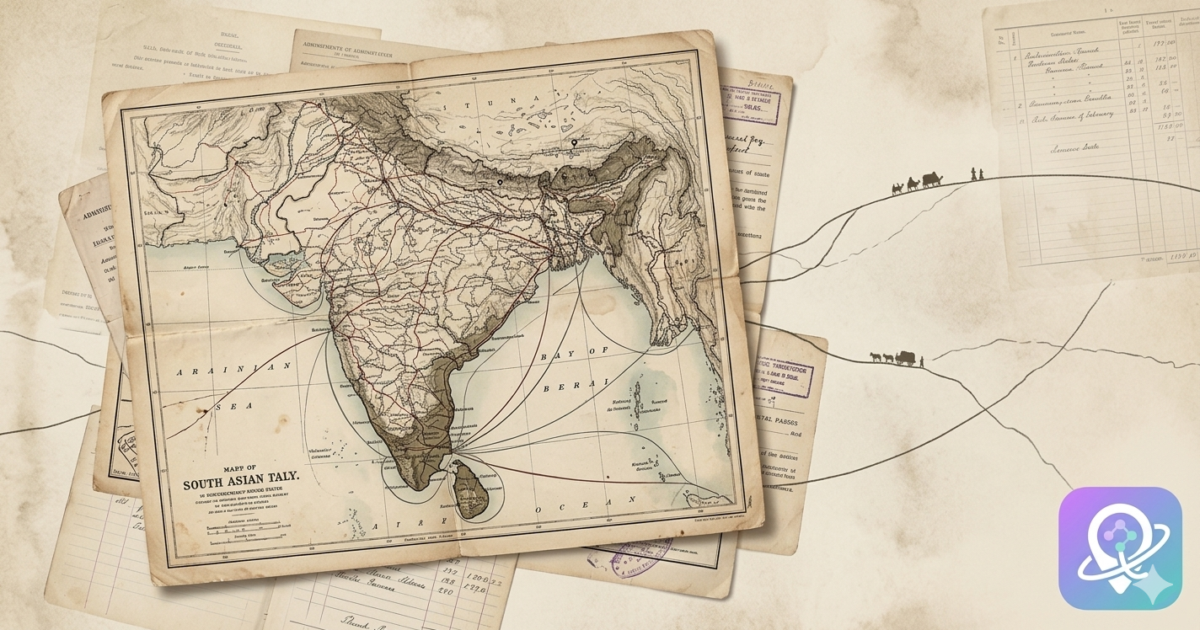
The absence of a significant Tamil diaspora in certain non-colonial nations is primarily due to a confluence of restrictive immigration policies, geographical barriers, and a lack of economic opportunities that would have attracted large-scale labor migration. While Tamils embarked on journeys across oceans for work and settlement, driven by colonial-era labor demands and economic hardship, these specific destinations remained largely untouched by the waves of Tamil migration. Understanding these exceptions helps to illuminate the broader patterns and underlying forces that shaped the global Tamil diaspora.
The Colonial Engine of Diaspora
Most large Tamil diaspora communities around the world trace their origins to the British Empire’s indentured labor system or other colonial economic ventures. From the plantations of Malaysia and Sri Lanka to the sugar fields of Fiji, Mauritius, and the Caribbean, Tamils were actively recruited, often under duress, to serve the labor needs of colonial enterprises. This system created well-worn migration routes and established communities that persisted and grew over generations. The British and other European colonial powers actively facilitated these movements, sometimes even subsidizing them, to meet their economic imperatives. Nations that fell outside this colonial orbit, or those that had little to offer in terms of resource extraction or agricultural development that required external labor, naturally did not become destinations for this type of migration.
Geographic Isolation and Political Autonomy
Nations like Bhutan and Nepal, often cited for their lack of a significant Tamil presence, exemplify the role of geography and political autonomy. Both are landlocked Himalayan kingdoms with historically isolationist policies. Bhutan, in particular, maintained strict controls over immigration and settlement, aiming to preserve its unique culture and environment. Its mountainous terrain made large-scale agricultural development, which often spurred demand for external labor, less feasible compared to tropical plantation economies. Nepal, while sharing a long border with India, also had a distinct socio-political structure that did not create the same pull factors for Tamil labor. Migrations into Nepal from India were primarily from contiguous regions and often involved shared linguistic or cultural ties, neither of which characterized the relationship with distant Tamil Nadu.
Furthermore, these nations were never directly colonized by European powers in the same way as much of South and Southeast Asia. This meant they were not integrated into the global colonial economic system that fueled large-scale labor migrations. Their economies remained largely agrarian and self-sufficient, without the external pressures or opportunities that drove the Tamil diaspora to other parts of the world.
The Nature of Non-Colonial Migration
While the colonial era accounts for the largest movements, voluntary migration to non-colonial states did occur, albeit on a smaller scale and for different reasons. This typically involved highly skilled professionals, traders, or individuals seeking educational opportunities, rather than large groups of agricultural or manual laborers. For instance, Tamils migrated to countries like Singapore and Malaysia even before and after the height of indenture, but these movements were still within a British colonial or post-colonial framework that facilitated such exchanges. The economic drivers and social networks that supported these migrations were fundamentally different from those that might have led to settlement in an isolated, autonomous nation.
In the modern era, with increased global mobility, a handful of Tamils might be found in virtually any country due to professional opportunities, marriage, or individual choice. However, these are typically small, scattered populations that do not constitute a ‘diaspora community’ in the historical sense of large-scale, multigenerational settlement linked to specific historical events or labor demands. The absence of such a community in places like Bhutan or Nepal is not about individual Tamils never visiting or residing there, but rather the lack of a discernible historical migration wave that led to the establishment of a lasting, identifiable community.
Tracing the Untraced
For those researching Tamil genealogy, the lack of a diaspora in certain regions reinforces the importance of understanding historical migration patterns. If an ancestor is believed to have settled in a nation without a known Tamil diaspora, it warrants careful scrutiny. It might indicate a much more recent, individual migration, or perhaps a misattribution of origin. The historical records, whether colonial manifests, census data, or oral histories, are largely silent on large-scale Tamil movements to these non-colonial states because such movements simply did not occur. This absence of evidence is, in itself, a significant piece of historical information, highlighting the selective nature of global migration and the specific conditions that fostered the rich and widespread Tamil diaspora we observe today.