TamizhConnect Blog
25 Jan 2026 · TamizhConnect
Ancient Tamil Trade: Inscriptions Beyond India and Sri Lanka
Tamil genealogy article
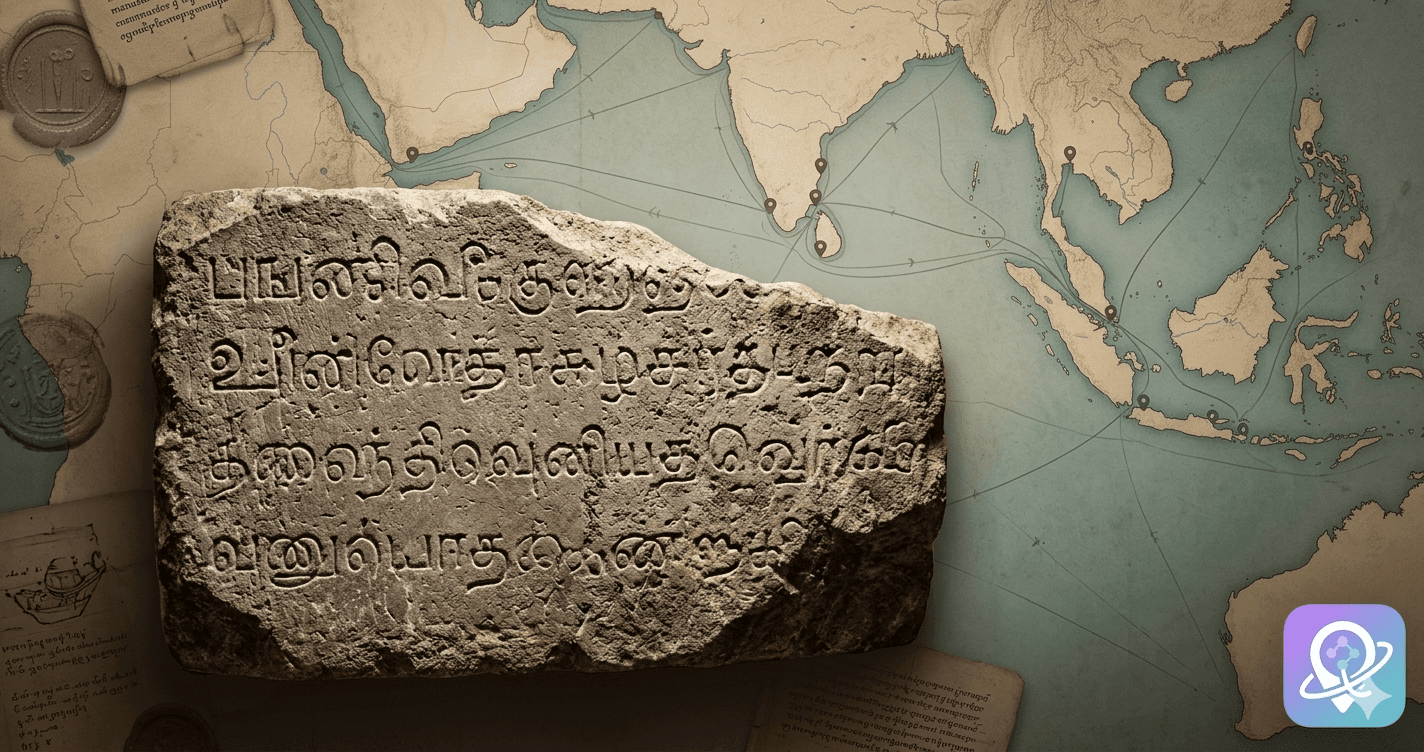
Tamil language inscriptions and artifacts found in Southeast Asia and China offer compelling evidence of extensive ancient Tamil trade networks and cultural exchange far beyond South Asia.
Document Digitisation
Turn documents into verified Tamil lineage.
Choose the depth you need. One-time service, results stay in your account.
Tamil-script inscriptions and artifacts from the 3rd century BCE through the 14th century CE have been physically recovered from Thailand (Krabi, Takuapa), Indonesia (Lobu Tua on Sumatra), peninsular Malaysia, Vietnam, China (Quanzhou), Myanmar, and the Maldives — archaeological evidence that Tamil merchant guilds operated across maritime Asia roughly 1,000 years before European colonization. The Ainnurruvar, Manigramam, and Anjuvannam guilds appear by name on these inscriptions, anchoring specific Tamil mercantile communities to specific overseas locations. For heritage research, these inscriptions are the oldest direct evidence that ancestral Tamil communities lived outside Tamil Nadu for centuries.
The Spice Route and Early Tamil Presence in Southeast Asia
The allure of spices, textiles, and precious metals drew Tamil merchants across the Bay of Bengal for millennia. The Isthmus of Kra, a narrow strip of land connecting the Malay Peninsula to mainland Asia (present-day Thailand), was a crucial transit point, allowing traders to bypass the treacherous Strait of Malacca. Here, archaeological sites have yielded some of the earliest and most compelling evidence of Tamil presence. One notable find is the Takua Pa inscription from Thailand, dating back to the 9th century CE. Written in Tamil script, it refers to a tank (water reservoir) built by a merchant guild, Manigramam, and placed under the protection of a local Vishnu temple. This inscription is significant not only for its language but also for demonstrating the organizational capacity of Tamil merchant guilds and their integration into local religious and economic life.
Further south, in Malaysia, the Bujang Valley in Kedah has revealed extensive evidence of early Indianized settlements, including structures resembling Hindu and Buddhist temples, and pottery fragments. While not all of these are explicitly Tamil, the cultural milieu strongly suggests interaction with South Indian traditions, including those from Tamil Nadu. Similarly, in Indonesia, particularly Sumatra, inscriptions from the Srivijaya kingdom (7th-13th centuries CE) show strong Sanskrit influence, but historical accounts and later inscriptions indicate a continuous interaction with South Indian, including Tamil, traders. The port city of Barus in Sumatra, for instance, has yielded pottery shards and gravestones with Tamil inscriptions, testifying to a long-standing Tamil mercantile presence.
The Chola Empire's Maritime Reach and Beyond
During the reign of the Chola dynasty (9th-13th centuries CE), Tamil maritime power reached its zenith. Rajendra Chola I's naval expedition against Srivijaya in the 11th century CE, though primarily military, was also a strategic move to secure trade routes and assert dominance over maritime commerce. While direct Chola inscriptions are rarer in Southeast Asia compared to earlier mercantile records, their influence is seen in the continued flow of Tamil cultural and religious ideas, as well as the sustained presence of Tamil merchant communities. The port of Nagapattinam in Tamil Nadu was a major hub for this trade, fostering connections that extended deep into the archipelago.
Beyond Southeast Asia, evidence of Tamil trade has also been found in China. Historical records from the Tang and Song dynasties mention Kunlun (likely referring to people from the Malay archipelago, but also possibly including South Indians) and Chola merchants visiting Chinese ports. The most striking evidence is the Quanzhou inscription in Fujian province, dating to the 13th century CE. This bilingual inscription, in Tamil and Chinese, commemorates the construction of a Siva temple by a Tamil merchant, Perumal, and records land grants for its maintenance. The discovery of Hindu deities and architectural fragments in Quanzhou further supports the presence of a thriving Tamil mercantile community that had established its own places of worship, indicating a significant and sustained presence rather than just transient visits.
Cultural Exchange and Lasting Legacies
The presence of Tamil inscriptions and artifacts in these distant lands is not merely a testament to trade; it also highlights a profound cultural exchange. Tamil merchants, while primarily focused on commerce, also acted as conduits for the spread of religious ideas (Hinduism and Buddhism), architectural styles, and linguistic influences. The adoption of South Indian script forms in early Southeast Asian writing systems, for instance, is a direct result of these interactions. The concept of Manigramam and Ayyavole (another prominent merchant guild) demonstrates a self-organizing diaspora that maintained its identity while integrating into local economies.
However, it is important to acknowledge the limitations of the available evidence. While inscriptions offer concrete proof, they represent only a fraction of the historical reality. Many interactions would have left no permanent stone records. The exact size and demographic composition of these early Tamil settlements are often inferred rather than explicitly stated. Nonetheless, the existing archaeological and textual evidence paints a vivid picture of a vibrant, interconnected world where Tamil maritime enterprise played a pivotal role.
Conclusion
The journey of Tamil merchants across ancient seas was an extraordinary feat of navigation, entrepreneurship, and cultural diplomacy. The inscriptions and artifacts found in Thailand, Malaysia, Indonesia, and China stand as enduring monuments to their adventurous spirit and the enduring legacy of Tamil civilization. These discoveries not only enrich our understanding of Tamil history but also illuminate the intricate web of global connections that characterized the ancient world, demonstrating how commerce fostered a vibrant exchange of ideas and cultures across vast distances.
Share this article
TamizhConnect
TamizhConnect helps Tamil families worldwide trace their ancestry using voter records, indenture archives, and origin village matching. Our research team combines genealogy expertise with digitised Tamil Nadu datasets to help you discover your roots.
Ready to start your Tamil family tree?
TamizhConnect helps you discover relatives, trace your origin village, and keep your family history alive for the next generation.
Create your free TamizhConnect accountGo to my family treeDocument Digitisation
Have old documents? Upload them and we'll verify, trace, and add them to your tree.
Was this article helpful?
Get new articles in your inbox
Tamil genealogy tips, research guides, and new feature updates.
You might also like
Diaspora Tamils: How Language Policies Shape Identity (English)
Explore how language policies and community efforts in Malaysia, Singapore, and Sri Lanka impact Tamil identity across generations, examining challenges and successes.
21 Apr 2026
Who Are the Tamil People? A Foundational Overview (English)
The Tamil people are an ancient ethnolinguistic group with a rich history spanning millennia, primarily rooted in South India and Northeastern Sri Lanka.
19 Apr 2026
Dravidian Identity: History, Language, and Genetic Roots (English)
Explore the distinct historical, linguistic, and genetic evidence that defines the Dravidian identity, separate from Indo-Aryan cultures. Uncover the deep roots of Tamil people in South India.
16 Apr 2026
Tracing Your Tamil Ancestry: A Beginner's Guide (English)
Embark on a journey to uncover your Tamil roots. This guide provides a starting point for genealogical research, addressing common challenges and relevant records for those in Tamil Nadu and the diaspora.
09 Apr 2026
தமிழ் மூதாதையர் ஆய்வு நூலகம் (Tamil)
TamizhConnect-க்கு தேவையான தமிழ் வம்சாவளி முறைகள், பதிவுகள், இனவியல் மற்றும் பாரம்பரியச் சரிபார்ப்புக்கான அனைத்து ஆழமான வழிகாட்டிகளும் ஒரே இடத்தில்.
03T12:28:12.832Z Sep 2026
Tamil ancestry research: Complete guide for genealogical methods (English)
All our deep-dive guides on Tamil genealogical methods, records, ethnography, and heritage validation for TamizhConnect.
03T12:28:12.830Z Sep 2026
Related by topic
Tracing Tamil Roots in Singapore: A Guide to Ancestry Research (English)
Uncover the journey of your Tamil ancestors to Singapore with this practical guide to historical records, community resources, and research strategies.
1 Apr 2026
Tracing Tamil Ancestry in Sri Lanka's Complex Tapestry (English)
Uncover the unique challenges and surprising opportunities for researching Tamil family history in Sri Lanka, navigating centuries of records and recent conflicts.
18 Mar 2026
More from TamizhConnect
Tamil Elder Interview Kit: Ready-to-Use Questions & Prompts (English)
A ready-to-copy interview kit for capturing Tamil family history from elders — grouped by topic, sequenced from easy to sensitive, with recording tips and follow-ups that unlock the stories behind the names.
21 Aug 2026
The Tamils of Dharavi: A Hundred Years from Tirunelveli to Mumbai (English)
From the droughts of Tirunelveli to the tanneries and textile mills of Mumbai, the Tamil community of Dharavi has built one of the largest Tamil cities outside Tamil Nadu. With redevelopment underway, here's how families can preserve their migration story for the next generation.
15 May 2026
Core topics
What is Tamil, really? Language, identity, and where it comes from
A clear, human explanation of what Tamil is-language, identity, people, and history-plus how to talk about it without stereotypes.
4 Feb 2026
What Defines Tamil Identity Beyond Borders and Sub-Groups? (English)
Tamil identity is primarily defined by shared language and cultural heritage, rather than by geographic borders or internal sub-group affiliations. This core identity persists across the diaspora and within Tamil Nadu.
17 Apr 2026
Continue reading
Tamil: The Enduring Cornerstone of Identity and Ancestry (English)
24 Jan 2026
Chola Ancestry: Unraveling Myths, Uncovering History (English)
23 Jan 2026
Tracing Tamil Ancestry in Sri Lanka's Complex Tapestry (English)
22 Jan 2026
Tracing Roots: The Enduring Legacy of Ancient Tamil Kingdoms (English)
21 Jan 2026