TamizhConnect Blog
16 Apr 2026 · TamizhConnect
Dravidian Identity: History, Language, and Genetic Roots
Tamil genealogy article
Explore the distinct historical, linguistic, and genetic evidence that defines the Dravidian identity, separate from Indo-Aryan cultures. Uncover the deep roots of Tamil people in South India.
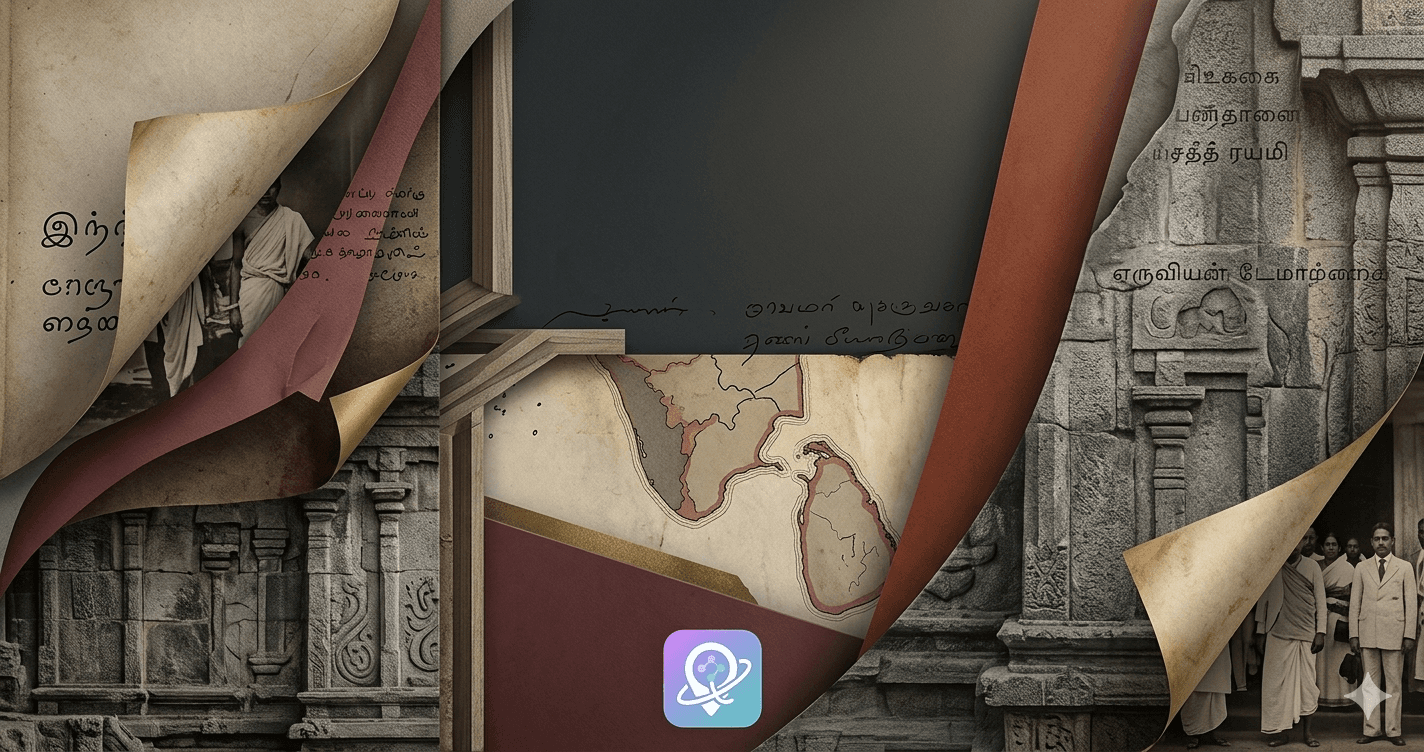
Document Digitisation
Turn documents into verified Tamil lineage.
Choose the depth you need. One-time service, results stay in your account.
"Dravidian" is a linguistic term, not a racial or ethnic one — it names the language family that includes Tamil, Telugu, Kannada, Malayalam, Tulu, Brahui, Gondi, Kurukh, and ~80 others, all descended from reconstructed Proto-Dravidian. Speakers of Dravidian languages share significant genetic overlap (the Ancestral South Indian component is concentrated in this group), but "Dravidian identity" as a political or cultural category was largely constructed in the late 19th and 20th centuries, not inherited from ancient times. The ancient Tamil texts do not use "Dravidian" as a self-identifier; they use specific community, kingdom, or regional names. Modern discussions of Dravidian identity conflate three separate things: language family, genetic substrate, and 20th-century political movement.
The Linguistic Foundation of Dravidian Identity
The most overt marker of Dravidian identity is the Dravidian language family, a group of over 70 languages predominantly spoken in South India and parts of Sri Lanka, with isolated pockets elsewhere, notably Brahui in Pakistan. Tamil is the oldest and most prominent member of this family, boasting a literary tradition that dates back over two millennia, exemplified by Sangam literature. Unlike Indo-Aryan languages (like Hindi, Bengali, Gujarati), which belong to the Indo-European family and derive from Sanskrit, Dravidian languages have an entirely independent origin and grammatical structure. Historical linguists have established that the split between Proto-Dravidian and Proto-Indo-European occurred thousands of years ago, indicating separate evolutionary paths. The resilience of Dravidian languages, particularly Tamil, in maintaining their distinctiveness despite centuries of interaction with Indo-Aryan cultures, highlights a deep-seated linguistic and cultural lineage.
Archaeological Insights: Indus Valley and South India
Archaeological evidence offers compelling, albeit indirect, support for a pre-Indo-Aryan Dravidian presence. The enigmatic Indus Valley Civilization (c. 2500–1900 BCE), which flourished in what is now Pakistan and northwest India, is a focal point of discussion. While its script remains undeciphered, many scholars propose a Dravidian substratum, suggesting that the language spoken by the Indus people may have been an early form of Dravidian. The geographical spread of Indus artifacts and their subsequent decline, coinciding with the likely period of Indo-Aryan migrations, hints at a displacement or southward shift of populations. In South India itself, archaeological sites like Adichanallur in Tamil Nadu, dating back to at least 900 BCE, reveal distinct cultural practices, burial rituals, and material cultures that are not directly linked to contemporaneous Indo-Aryan sites further north. These findings point to an indigenous, well-developed civilization in the South that evolved independently for centuries.
Genetic Studies: Tracing Ancestral Journeys
Modern genetic research provides some of the most compelling insights into the ancestry of the Tamil people. Studies on Y-chromosome (paternally inherited) and mitochondrial DNA (maternally inherited) haplogroups reveal distinct genetic signatures that differentiate South Indian populations, including Tamils, from North Indian Indo-Aryan groups. For instance, the haplogroup L1, commonly found in South India, and certain clades of M, are considered indigenous to the Indian subcontinent, with deep roots stretching back tens of thousands of years. While there is evidence of some gene flow between North and South India over millennia, particularly along trade routes and during periods of migration, the predominant genetic ancestry of Tamils shows a strong continuity with ancient South Indian populations. Crucially, the genetic markers associated with the major Indo-Aryan migration, such as R1a-Z93, are present in South India but at significantly lower frequencies compared to North India, and often show evidence of more recent admixture rather than deep ancestral roots. These studies consistently support the notion of a largely indigenous South Indian genetic landscape with a distinct evolutionary history.
Cultural Resilience and Identity Markers
Beyond language, archaeology, and genetics, the cultural distinctiveness of Tamil Nadu further solidifies its Dravidian identity. The architectural grandeur of Dravidian temples, with their towering gopurams and intricate carvings, stands in stark contrast to North Indian temple styles. Traditional Tamil music, dance forms like Bharatanatyam, and culinary practices also exhibit unique characteristics that have evolved within a distinct cultural framework. The historical narratives, epic poems, and philosophical traditions of Tamil literature, such as the Tirukkural, reflect a worldview and ethical framework that, while engaging with pan-Indian ideas, maintains its own unique voice and emphasis. These cultural markers are not merely superficial differences but are deeply interwoven with the historical trajectory and self-perception of the Tamil people as inheritors of an ancient and distinct Dravidian civilization.
In conclusion, the question of whether Tamilians have an Aryan genealogy is largely answered in the negative when considering the primary lines of descent. While no human population is entirely isolated and some degree of genetic and cultural exchange has occurred throughout history, the overwhelming evidence from linguistics, archaeology, and genetics firmly establishes the Tamil people as primarily descendants of the ancient Dravidian civilization. Their identity is rooted in a deep, indigenous history in South India, characterized by a unique language family, distinct cultural practices, and a genetic legacy that predates the major Indo-Aryan migrations, making them a vibrant and distinct thread in the rich tapestry of Indian heritage.
Share this article
TamizhConnect
TamizhConnect helps Tamil families worldwide trace their ancestry using voter records, indenture archives, and origin village matching. Our research team combines genealogy expertise with digitised Tamil Nadu datasets to help you discover your roots.
Ready to start your Tamil family tree?
TamizhConnect helps you discover relatives, trace your origin village, and keep your family history alive for the next generation.
Create your free TamizhConnect accountGo to my family treeDocument Digitisation
Have old documents? Upload them and we'll verify, trace, and add them to your tree.
Was this article helpful?
Get new articles in your inbox
Tamil genealogy tips, research guides, and new feature updates.
You might also like
Tracing Tamil Roots: The Distinctive Dravidian Heritage (English)
Explore the historical, linguistic, and genetic evidence that defines Dravidian identity, distinct from Indo-Aryan cultures and deeply rooted in South India.
26 Mar 2026
Tracing Tamil Ancestry: Beyond Religious Narratives (English)
Uncover how modern research, from archaeology to genetics, sheds light on Tamil origins, moving beyond traditional religious accounts to explore a richer, evidence-based history.
20 Feb 2026
Tracing Deep Tamil Roots: Archaeology and Genetics (English)
Uncover how recent archaeological finds and genetic research are reshaping our understanding of Tamil origins, exploring both indigenous development and ancient migrations within Tamil Nadu.
28 Jan 2026
Tracing Tamil Roots: Genetic & Linguistic Evidence for Indigenous Origins (English)
Explore the genetic and linguistic evidence supporting the indigenous origins of Tamil people in South India, differentiating their ancestry from Indo-Aryan groups.
30 Mar 2026
தமிழ் மூதாதையர் ஆய்வு நூலகம் (Tamil)
TamizhConnect-க்கு தேவையான தமிழ் வம்சாவளி முறைகள், பதிவுகள், இனவியல் மற்றும் பாரம்பரியச் சரிபார்ப்புக்கான அனைத்து ஆழமான வழிகாட்டிகளும் ஒரே இடத்தில்.
02T21:31:40.701Z Sep 2026
Tamil ancestry research: Complete guide for genealogical methods (English)
All our deep-dive guides on Tamil genealogical methods, records, ethnography, and heritage validation for TamizhConnect.
02T21:31:40.700Z Sep 2026
Related by topic
Tracing Tamil Origins: Genetic and Linguistic Evidence (English)
Uncover the deep roots of the Tamil people through archaeological findings, ancient texts, and modern genetic studies, differentiating their ancestry from Indo-Aryan groups.
21 Mar 2026
Who Are the Tamil People? A Foundational Overview (English)
The Tamil people are an ancient ethnolinguistic group with a rich history spanning millennia, primarily rooted in South India and Northeastern Sri Lanka.
19 Apr 2026
More from TamizhConnect
Tamil Elder Interview Kit: Ready-to-Use Questions & Prompts (English)
A ready-to-copy interview kit for capturing Tamil family history from elders — grouped by topic, sequenced from easy to sensitive, with recording tips and follow-ups that unlock the stories behind the names.
21 Aug 2026
The Tamils of Dharavi: A Hundred Years from Tirunelveli to Mumbai (English)
From the droughts of Tirunelveli to the tanneries and textile mills of Mumbai, the Tamil community of Dharavi has built one of the largest Tamil cities outside Tamil Nadu. With redevelopment underway, here's how families can preserve their migration story for the next generation.
15 May 2026
Core topics
What is Tamil, really? Language, identity, and where it comes from
A clear, human explanation of what Tamil is-language, identity, people, and history-plus how to talk about it without stereotypes.
4 Feb 2026
What Defines Tamil Identity Beyond Borders and Sub-Groups? (English)
Tamil identity is primarily defined by shared language and cultural heritage, rather than by geographic borders or internal sub-group affiliations. This core identity persists across the diaspora and within Tamil Nadu.
17 Apr 2026
Continue reading
How to Trace Your Tamil Roots: Step-by-Step Guide for Beginners (English)
15 Apr 2026
Tracing Telugu Roots in Tamil Nadu: A Journey Through Time and Heritage (English)
15 Apr 2026
Understanding Your Roots: The Ancient Tamil Kingdoms (English)
13 Apr 2026
Tracing Telugu Ancestry Within Tamil Nadu (English)
11 Apr 2026