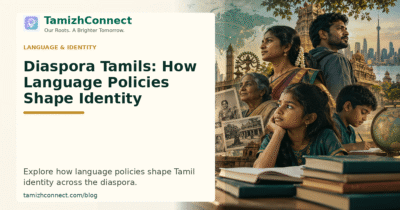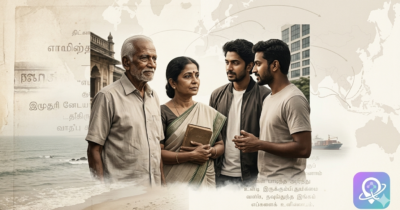
Tamil identity in the diaspora diverges from Tamil identity in Tamil Nadu along four predictable axes: language (diaspora families often lapse into the host-country language within two generations while preserving ritual Tamil), religion (diaspora Hindu practice foregrounds temple attendance and major festivals; mainland practice is more woven into daily life), community (diaspora Tamil-ness is explicit and organized via associations; mainland Tamil-ness is a default assumption), and food plus dress (diaspora foregrounds these as identity markers; mainland treats them as everyday). Neither form is more "authentic" — they are different adaptations of the same heritage under different pressures. Most mainland-diaspora friction stems from assuming the other group is doing Tamil identity wrong.
The Homeland Perspective: A Lived Reality
In Tamil Nadu, being Tamil is often an intrinsic, pervasive aspect of daily life, deeply intertwined with the landscape, social fabric, and political discourse. Language, Tamil, is not merely a heritage marker but the dominant medium of communication, education, government, and popular culture. Religious practices, predominantly Hinduism with its unique Tamil variations, are integrated into community life, with temples and festivals being ubiquitous. While there are internal distinctions based on caste, regional dialects, and socio-economic status, the overarching Tamil identity is a given, a foundational element that rarely needs explicit articulation or defense against external influences. The focus is often on the evolution and modernization of Tamil culture within its historical boundaries, rather than its preservation against assimilation. This environment allows for a nuanced, often subconscious, understanding of identity that doesn’t rely on overt cultural performance to assert its existence.
The Diaspora Experience: Forging Identity Amidst Difference
For Tamils in the diaspora, the journey of identity formation is often a more conscious and deliberate act. Stripped of the immersive environment of Tamil Nadu, communities in places like South Africa, Malaysia, Singapore, Sri Lanka, and various Western nations have had to actively cultivate and maintain their heritage. The factors shaping their identity are multifaceted:
Language as a Cultural Anchor
Language, Tamil, often becomes a critical, albeit challenging, marker of identity in the diaspora. While first-generation migrants might be fluent, subsequent generations often experience language attrition. Efforts to teach Tamil in supplementary schools, cultural centers, and at home become vital acts of preservation. For many, speaking Tamil, even if imperfectly, is a direct link to their ancestors and a powerful differentiator from the host society. The emotional weight attached to the language can be immense, often leading to a sense of guilt or loss if it’s not maintained. In some contexts, like Sri Lanka, language has been a central point of political and ethnic conflict, further solidifying its role as an identity anchor.
Religion and Community Cohesion
Religion, particularly Hinduism, frequently serves as a robust framework for maintaining Tamil identity abroad. Temples become more than places of worship; they are cultural hubs, community centers, and sites for language and dance classes. The rituals, festivals, and spiritual narratives provide a continuous connection to ancestral practices and offer a space for collective identity expression. In some diaspora contexts, especially those with strong Christian or Muslim Tamil populations, these religious identities also become significant markers, often fostering distinct sub-identities within the broader Tamil diaspora. The Quora question’s observation about people in South Africa identifying as ‘Tamil’ when asked their religion points to this phenomenon: for many, their ethnic identity and religious practice are so intertwined as to be indistinguishable, especially when confronting a dominant non-Tamil, non-Hindu culture.
Historical Context and Traumatic Memory
Each diaspora community carries its unique historical baggage. For instance, the descendants of indentured laborers in South Africa, Malaysia, and the Caribbean often grapple with a history of forced migration, exploitation, and the subsequent struggle for recognition and rights. This shared history of adversity strengthens a collective identity rooted in resilience and the preservation of culture against formidable odds. Similarly, Tamils who emigrated from Sri Lanka due to conflict often carry the trauma of war and displacement, which profoundly shapes their identity and their relationship with their homeland and host countries.
Interaction with Host Cultures
Identity in the diaspora is also a dynamic interplay with the host culture. Hybrid identities often emerge, where individuals seamlessly navigate between their Tamil heritage and the cultural norms of their adopted country. This can manifest in food, music, clothing, and social customs. While some communities strive for cultural purity, many embrace a synthesis, creating new forms of ‘Tamilness’ that are unique to their specific diasporic context. This constant negotiation enriches the global tapestry of Tamil identity, demonstrating its adaptability and enduring spirit.
In essence, while Tamils in Tamil Nadu inhabit their identity as an inherent birthright, their counterparts in the diaspora actively construct, maintain, and often redefine what it means to be Tamil. This ongoing process, driven by a complex interplay of language, religion, history, and cultural exchange, ensures that Tamil identity, though varied in its expression, remains a vibrant and evolving force across the globe.