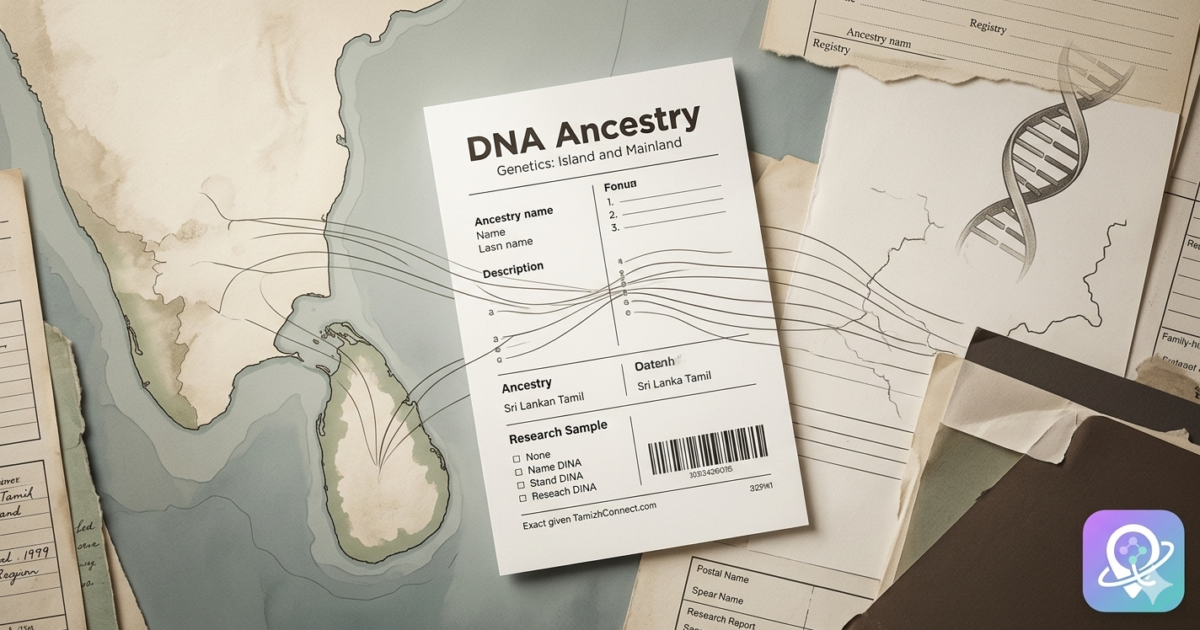
Sri Lankan Tamils share measurable genetic affinity with both mainland South Indian Tamil populations (via the Palk Strait migration corridor, documented from c. 300 BCE trade contacts) and the Sinhalese population of Sri Lanka (via ~2,500 years of island coexistence, intermarriage, and shared indigenous Vedda substrate). The signal challenges the post-colonial political framing that treats the two island communities as genetically distinct races. Neither group is a "pure" lineage; both are products of layered migrations. Distinguishing Sri Lankan Tamils from mainland Tamils is possible through subtle founder-effect markers specific to island populations, but the broad ancestry profile is closer than typical political rhetoric implies.
The Genetic Landscape of Sri Lanka
Genetic studies consistently show that the major ethnic groups of Sri Lanka — the Sinhalese and the Tamils — share a substantial common genetic heritage, largely derived from ancient migrations from the Indian subcontinent. While distinct cultural and linguistic identities have evolved, the underlying genetic patterns reveal a shared ancestral pool. This is not surprising given Sri Lanka’s geographical proximity to the southern tip of India, making it a natural extension for human migration throughout history. The Palk Strait, often more a bridge than a barrier, has facilitated continuous movement of people, ideas, and genes for millennia.
Early settlers likely arrived in waves, contributing to the foundational genetic structure of the island. Subsequent migrations, including those associated with the spread of Buddhism and later the establishment of Tamil kingdoms in the north, further shaped this landscape. Modern genetic analysis, particularly through studies of mitochondrial DNA (mtDNA) and Y-chromosome markers, which trace maternal and paternal lineages respectively, helps to reconstruct these ancient movements and identify shared markers across groups.
Tracing Ancestry: Mainland Indian Tamils
While sharing a common island heritage with the Sinhalese, Sri Lankan Tamils also exhibit strong genetic ties to Tamil populations in South India. This connection is primarily due to several waves of migration from the Tamilakam region of peninsular India over at least two millennia. Historical records, archaeological evidence, and linguistic studies all point to continuous interactions and movements across the Palk Strait. The establishment of the Jaffna Kingdom, for instance, saw significant migration from South India, reinforcing Tamil cultural and genetic presence in the northern parts of the island.
Genetically, this is reflected in shared haplogroups and allele frequencies that are characteristic of Dravidian populations in South India. Studies often find that certain genetic markers are present at similar frequencies in both Sri Lankan Tamils and their mainland counterparts, indicating a relatively recent common ancestry or sustained gene flow. This genetic flow was not unidirectional; there is also evidence of Sri Lankan populations contributing to the genetic diversity of South India, albeit perhaps to a lesser extent.
The Sinhalese Connection: Shared Island Heritage
Perhaps more surprisingly to some, genetic studies frequently highlight a close genetic relationship between Sri Lankan Tamils and the Sinhalese. This proximity is often stronger than the genetic distance between Sri Lankan Tamils and some more distant Indian Tamil groups. This indicates extensive intermingling and shared ancestry within the island over centuries. The historical narrative of distinct ethnic groups often overshadows the reality of shared living spaces, trade, and intermarriage that would naturally lead to genetic exchange.
This shared heritage is attributed to several factors: the initial common migration waves from the Indian subcontinent that formed the ancestral base for both groups, subsequent gene flow between the groups on the island, and the process of ethnogenesis where individuals may have adopted a different linguistic or religious identity over generations. While the Sinhalese predominantly speak an Indo-Aryan language and Tamils a Dravidian one, their genetic roots often converge, pointing to a shared deep history on the island that predates the full linguistic and cultural divergence observed today.
The Vedda Contribution
The indigenous Vedda people of Sri Lanka represent a crucial, yet often overlooked, component of the island’s genetic tapestry. Considered to be the descendants of the earliest inhabitants of Sri Lanka, the Vedda carry unique genetic markers that distinguish them from later arrivals. Genetic studies have shown that both the Sinhalese and Sri Lankan Tamils carry a small but significant genetic contribution from the Vedda. This admixture indicates that as later migrants arrived and settled, they interacted with and absorbed some of the genetic heritage of the island’s original inhabitants.
This finding underscores the complex layering of populations on Sri Lanka, where no single group represents a purely unadmixed lineage. The Vedda contribution serves as a reminder that the island’s history is one of continuous interaction and integration, leading to a rich and diverse genetic heritage for all its modern inhabitants.
Conclusion
The genetic evidence paints a nuanced picture of Sri Lankan Tamil ancestry, demonstrating deep connections to both mainland Indian Tamils and the Sinhalese. This complex genetic tapestry is a testament to Sri Lanka’s long history as a crossroads of migration and cultural exchange, where geographical proximity, shared island life, and continuous human interaction have shaped a unique heritage. Ancestry is rarely a simple, linear path but rather a braided river, and the genetics of Sri Lankan Tamils beautifully illustrate this intricate reality.