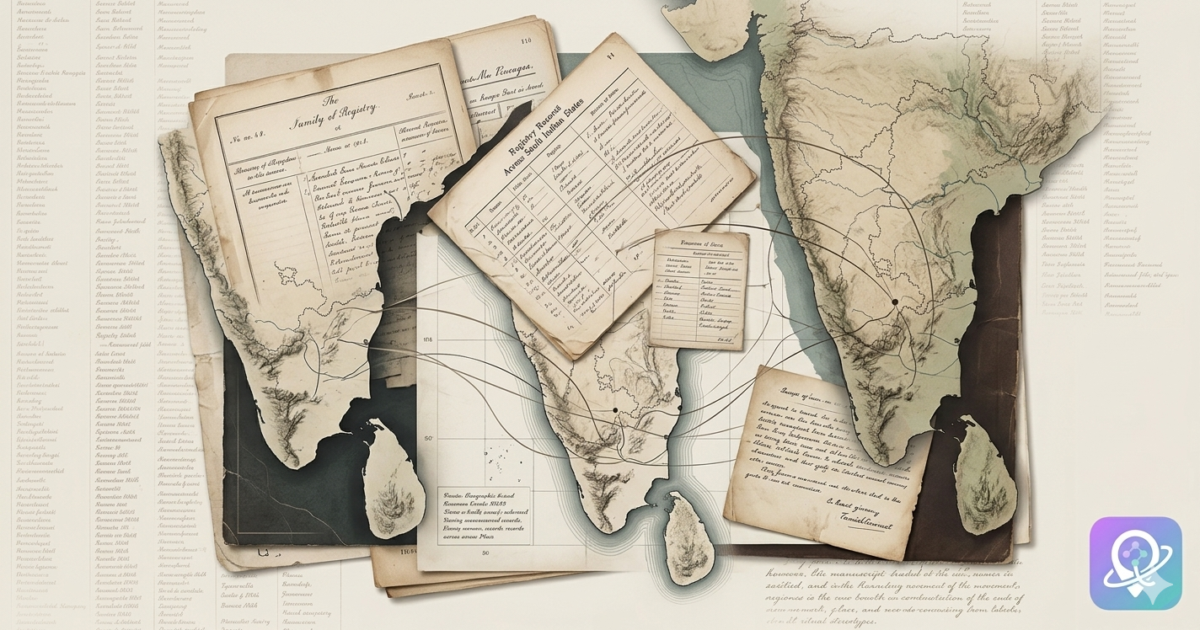
Brahmin communities across Tamil Nadu, Andhra Pradesh, Karnataka, and Kerala share deep historical overlap — Iyers and Iyengars in Tamil Nadu have documented migration links to Kannadiga Brahmins in Karnataka and Telugu Brahmins in Andhra through medieval temple-grant networks (agraharams), Chola and Vijayanagara royal invitations, and famine-driven resettlement. Tracing this ancestry means crossing modern linguistic state boundaries that didn’t exist when your ancestors moved. The four anchors that actually pin a family to a specific origin taluk regardless of current state: gotra (patrilineal clan lineage), kula deivam (ancestral family deity + village temple), kuladevi name, and sabha/community-association records where preserved. Gotra + kula deivam + a known ancestral village together narrow the search to a specific taluk even when political borders have shifted four times.
The idea that ‘Tamil Brahmins are Iyers and Iyengars, and the same are seen in Karnataka as Kannadiga Brahmins’ touches upon a fundamental truth: while distinct sub-communities exist within each linguistic group, there’s a significant degree of historical overlap and shared heritage. The Brahmins of South India, broadly speaking, trace their origins to ancient Vedic traditions, and their presence in the Deccan plateau predates the clear linguistic demarcations we see today. Over millennia, various factors—political patronage, religious movements, famine, trade routes, and even personal choice—spurred communities to move, settle, and integrate into new regions.
The Fluidity of Ancient Boundaries and Migrations
Unlike the clearly drawn state lines of today, ancient and medieval South India was characterized by shifting empires and kingdoms. The Cholas, Pandyas, Pallavas, Chalukyas, Rashtrakutas, Vijayanagara, and later the Nayaks and Marathas, all held sway over vast territories that often encompassed multiple linguistic zones. Rulers frequently invited learned Brahmins from other regions to settle in their kingdoms, bestowing land grants (agraharams) and patronage. These migrations were not always massive exoduses but often involved smaller groups or even individual families moving for opportunities, religious service, or scholarly pursuits.
For example, many Telugu-speaking Brahmins migrated southwards into what is now Tamil Nadu during the Vijayanagara period, often serving in administrative or priestly roles in the courts of Nayak rulers. Similarly, Tamil Brahmins, particularly Vaishnavites, had strong connections with pilgrimage centers in Karnataka and Andhra Pradesh, leading to settlements there. Kerala’s Nambudiri Brahmins, while culturally distinct, also share ancient connections and some historical migrations with other South Indian Brahmin groups. These movements led to intermingling, cultural exchange, and sometimes, the adoption of local languages over generations while retaining core religious and social practices.
Gotra, Pravara, and Shakha: Enduring Lineage Markers
When modern records fall short, the most powerful tools for tracing deep Brahmin ancestry across linguistic boundaries are the concepts of gotra, pravara, and shakha. These are not unique to any single linguistic group but are pan-Indian markers of patrilineal descent and Vedic affiliation.
- Gotra: This refers to the patrilineal lineage, tracing back to one of the ancient Vedic rishis (sages). All Brahmins belong to a specific gotra. The gotra system is exogamous, meaning individuals cannot marry someone from the same gotra. Critically, a specific gotra (e.g., Kaundinya, Bharadwaja, Atri, Vasishta) is found across Tamil, Telugu, Kannada, and Malayalam Brahmin communities. If you find your gotra in a family tree from a different linguistic region, it suggests a shared ancient lineage.
- Pravara: These are a set of rishis who are ancestors of the gotra founder. They further delineate a sub-lineage within a gotra and are recited during religious rituals. Pravaras provide an even more specific identifier than gotras alone.
- Shakha: This indicates the specific branch of the Veda (Rig Veda, Yajur Veda, Sama Veda, Atharva Veda) that a family traditionally follows, and within that, the particular recension or school (e.g., Taittiriya Shakha of Krishna Yajur Veda, Kauthuma Shakha of Sama Veda). Shakhas also transcend linguistic boundaries.
By comparing these three markers, even in the absence of written genealogical records, one can infer deep historical connections between Brahmin families across different linguistic regions. For instance, finding a Tamil Iyer family of Kaundinya Gotra, Triple Pravara (Vasishta, Maitravaruna, Kaundinya), and Taittiriya Shakha of Krishna Yajur Veda, and then finding a Telugu Vaidiki Brahmin family with the exact same gotra, pravara, and shakha, strongly indicates a shared ancient lineage, possibly from a common ancestral group that later diverged geographically and linguistically.
Researching Cross-State Ancestral Ties
Researching Brahmin ancestry across modern state lines requires a multi-pronged approach:
- Document Your Family’s Oral History: Start by interviewing elders. Ask about any stories of migration, origins, or connections to other regions. Even vague references can provide crucial clues.
- Identify Your Gotra, Pravara, and Shakha: This is paramount. If you don’t know it, ask elders or consult family purohits. These details are often recorded in traditional marriage invitations or horoscopes.
- Explore Temple Records and Agraharam Histories: Many ancient temples in South India maintained records of donors, priests, and land grants, which often mention gotras and shakhas. Histories of specific agraharams (Brahmin settlements) can also reveal migration patterns. While these are not easily accessible public records, dedicated researchers might find success through local historical societies or temple archives.
- Look for Surnames and Titles: While not as definitive as gotra, certain surnames or titles (e.g., ‘Sharma’, ‘Rao’, ‘Ayyar’, ‘Acharya’) might have regional variations or commonalities that hint at shared origins.
- Consult Published Genealogies and Community Histories: Some Brahmin sub-communities have published their histories or compiled genealogical data. While rare, these can be invaluable.
- Genetic Genealogy (with caution): DNA testing can sometimes reveal broad ancestral origins and migration patterns, but it cannot currently identify specific gotras or pravaras. It can, however, corroborate or suggest regions of origin if your family’s oral history points in a particular direction.
It’s important to approach this research with patience and an understanding that definitive, unbroken paper trails spanning centuries are exceptionally rare. The goal is often to piece together a mosaic of evidence that suggests strong historical connections rather than finding a single ‘smoking gun’ document.
The question of whether Tamil Brahmins have Telugu ancestry (or Kannada, or Malayalam ancestry) isn’t a simple yes or no. It’s a complex tapestry woven over millennia, reflecting shared ancient origins, historical migrations, and the fluid nature of cultural and linguistic boundaries. By understanding the historical context and utilizing traditional lineage markers like gotra, pravara, and shakha, individuals can embark on a fascinating journey to uncover the deep, interconnected roots of their South Indian Brahmin heritage.