TamizhConnect Blog
2 Feb 2026 · TamizhConnect
Decoding Your Tamil Genetic Ancestry: Beyond the Buzzwords
Tamil genealogy article
Unpack the science behind genetic ancestry testing for Tamils, understand what terms like ANI and ASI really mean, and learn to interpret your results responsibly.
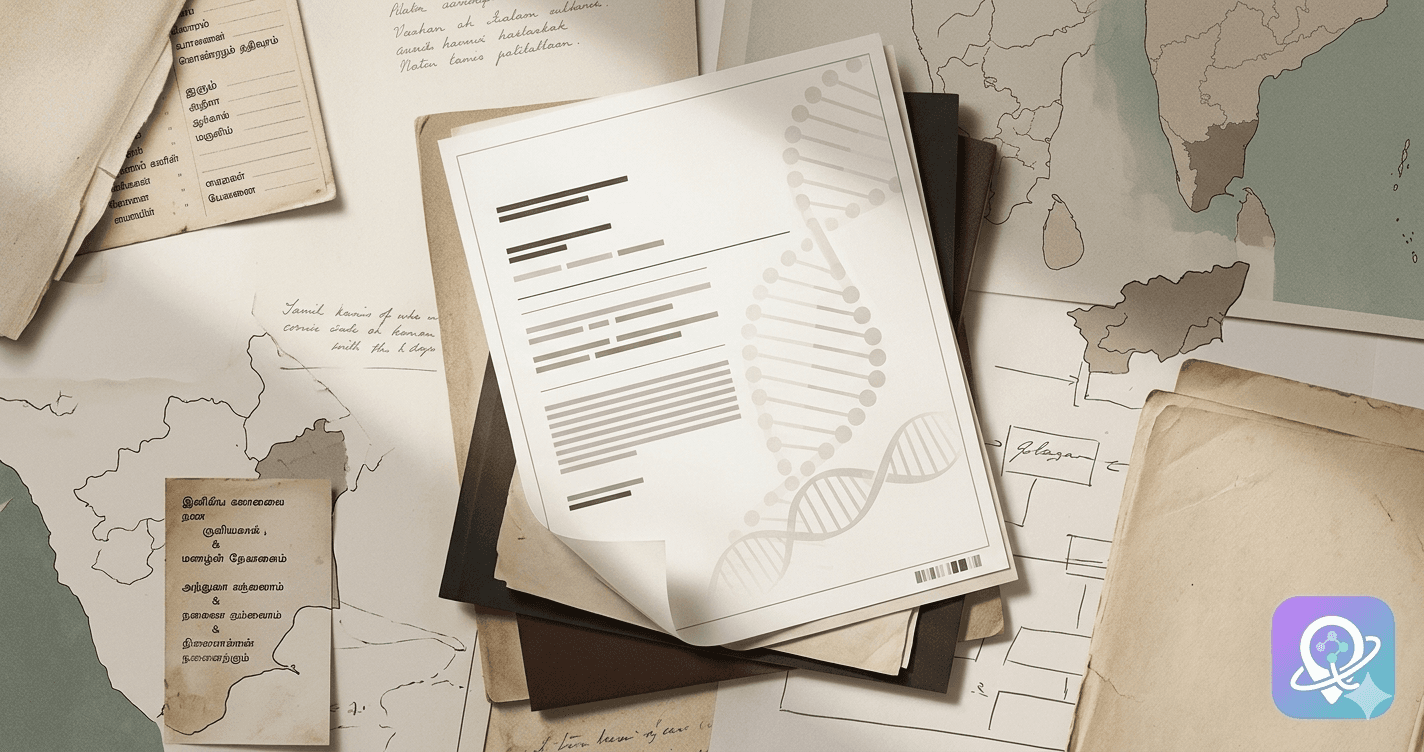
Document Digitisation
Turn documents into verified Tamil lineage.
Choose the depth you need. One-time service, results stay in your account.
Tamil genetic ancestry tests compare your SNP pattern against a few thousand South Asian reference individuals to produce percentage estimates like "72% South Asian, 18% East Asian, 10% West Asian" — those numbers are statistical probabilities of resembling reference populations, not claims about specific ancestors. For Tamil populations the tests face a particular limitation: thousands of years of endogamy (marriage within jati/community) produce dense genetic founder effects that most commercial algorithms flatten into broad buckets like "South Indian" or "Dravidian." Understanding what the percentages mean — and what they don't — is the difference between a real heritage signal and a marketing-friendly headline.
The Basics: How Genetic Ancestry Works
Genetic ancestry tests analyze your DNA, specifically looking at single nucleotide polymorphisms (SNPs) – tiny variations in your genetic code. These variations are like unique markers that are passed down through generations. By comparing your pattern of SNPs to reference populations from around the world, testing companies can estimate the geographic regions and ancestral groups your DNA most closely resembles. Think of it like a puzzle: your DNA is a unique picture, and the companies try to see which existing puzzle pieces (reference populations) best fit your picture.
It's crucial to understand that these tests don't tell you who your ancestors were, but rather where they likely came from. The results are statistical probabilities, not definitive declarations. For South Asian populations, this becomes particularly complex due to thousands of years of migrations, interactions, and deep-rooted endogamy (marriage within specific groups).
Unpacking ANI and ASI: Core South Asian Ancestry Components
When you receive your results, you might encounter terms like 'Ancestral North Indian' (ANI) and 'Ancestral South Indian' (ASI). These are not modern ethnic groups but rather genetic components identified by population geneticists to explain the broad genetic landscape of the Indian subcontinent.
- Ancestral North Indian (ANI): This component is thought to represent a genetic contribution primarily from populations related to ancient West Eurasians, including groups from the Iranian plateau and Central Asia. Its influence is generally higher in North Indian populations and decreases as one moves south.
- Ancestral South Indian (ASI): This component is associated with indigenous populations that have deep roots in the Indian subcontinent, predating the major migrations that brought the ANI component. Its influence is generally higher in South Indian populations.
Most South Asians, including Tamils, are a mix of ANI and ASI, along with other minor components depending on their specific regional and community history. The proportion of ANI and ASI varies significantly across different communities within Tamil Nadu. For instance, some communities, often those with a history of migration from northern parts of the subcontinent or specific endogamous practices, might show a relatively higher ANI component. Conversely, communities with deeper, more localized roots within the Tamil region might exhibit a higher ASI component.
It's important to reiterate: ANI and ASI are models used by scientists to understand genetic history. They do not correspond to specific ancient tribes or modern caste groups, nor do they imply any superiority or inferiority. They simply describe broad patterns of genetic admixture over millennia.
The Indus Valley Civilization (IVC) Connection: Tread Carefully
A common question, often seen online, asks about the connection between modern Tamil communities and ancient civilizations like the Indus Valley Civilization (IVC). Genetic studies have indeed shown that modern South Asians carry genetic signatures related to the ancient populations of the IVC. However, directly linking a high percentage of 'IVC ancestry' to a specific modern group, especially based on consumer genetic tests, is often an oversimplification.
Here's why:
- IVC was Diverse: The IVC was a vast and diverse civilization, likely composed of multiple ethnolinguistic groups. There isn't a single, monolithic 'IVC genome.'
- Genetic Continuity and Admixture: While there is genetic continuity from IVC populations into modern South Asians, this ancestry has been reshaped and diluted by thousands of years of subsequent migrations and admixtures. Attributing a direct, undiluted link to any single modern group is challenging.
- Reference Limitations: Consumer genetic tests rely on reference panels. While these panels are improving, they might not always capture the full complexity of ancient populations or the specific nuances of highly endogamous groups within South Asia.
- No Direct IVC Ancestry Category: You won't typically see 'IVC Ancestry' as a distinct category in your consumer genetic report. Any inferred connection is usually based on the components (like ASI) that are thought to be related to the ancestral populations of the IVC, but this is an indirect association.
While ongoing research continues to shed light on the genetic legacy of the IVC, it's crucial to interpret these findings with scientific rigor and avoid drawing overly simplistic or definitive conclusions about modern communities based solely on broad genetic percentages.
Interpreting Your Results as a Tamil
When you get your genetic ancestry results, approach them with an open mind and a critical eye:
- Regional Specificity: Look for percentages that align with broad South Asian or specific regional South Indian populations. Companies are getting better at identifying sub-regions within India.
- Migration Patterns: Your results might reflect ancient migration patterns that brought different genetic components to your ancestral region. For example, some Tamil communities may show small percentages from East Asia or even Sub-Saharan Africa, reflecting historical trade routes and interactions.
- Family History First: Always cross-reference your genetic results with documented family history, oral traditions, and genealogical research. Genetics provides a broad strokes picture; traditional genealogy fills in the details.
- Don't Over-Interpret: Remember that these are estimates. A small percentage from a distant region doesn't necessarily mean a direct ancestor from that region in recent generations. It could reflect ancient, widespread genetic flow.
Genetic ancestry tests offer a fascinating glimpse into our deep past, connecting us to migrations and populations that shaped humanity. For Tamils, these tests can highlight the incredible tapestry of genetic influences that have contributed to our vibrant heritage. However, it's vital to interpret these results with an understanding of their scientific basis, their limitations, and the complex, multi-layered history of the Indian subcontinent. Your ancestry is a story woven over millennia, far richer and more intricate than any single percentage can convey.
Share this article
TamizhConnect
TamizhConnect helps Tamil families worldwide trace their ancestry using voter records, indenture archives, and origin village matching. Our research team combines genealogy expertise with digitised Tamil Nadu datasets to help you discover your roots.
Ready to start your Tamil family tree?
TamizhConnect helps you discover relatives, trace your origin village, and keep your family history alive for the next generation.
Create your free TamizhConnect accountGo to my family treeDocument Digitisation
Have old documents? Upload them and we'll verify, trace, and add them to your tree.
Was this article helpful?
Get new articles in your inbox
Tamil genealogy tips, research guides, and new feature updates.
You might also like
Tracing Tamil Ancestry in Sri Lanka's Complex Tapestry (English)
Uncover the unique challenges and surprising opportunities for researching Tamil family history in Sri Lanka, navigating centuries of records and recent conflicts.
18 Mar 2026
Unraveling the Genetic Tapestry of Sri Lankan Tamils (English)
Explore the unique genetic heritage of Sri Lankan Tamils, examining how ancient migrations and historical interactions have shaped their distinct ancestral makeup compared to other Tamil populations.
11 Mar 2026
Crafting Your Tamil Family History: Narrative Paths to Explore (English)
Uncover various narrative structures for your Tamil family history, from chronological journeys to thematic explorations, and find the perfect fit for your unique story.
27 Feb 2026
Tamil Identity: Diaspora vs. Homeland (English)
Tamil identity has evolved distinctly in diaspora communities compared to Tamil Nadu, shaped by unique historical contexts, language maintenance, and cultural interactions.
22 Feb 2026
தமிழ் மூதாதையர் ஆய்வு நூலகம் (Tamil)
TamizhConnect-க்கு தேவையான தமிழ் வம்சாவளி முறைகள், பதிவுகள், இனவியல் மற்றும் பாரம்பரியச் சரிபார்ப்புக்கான அனைத்து ஆழமான வழிகாட்டிகளும் ஒரே இடத்தில்.
02T07:27:20.048Z Sep 2026
Tamil ancestry research: Complete guide for genealogical methods (English)
All our deep-dive guides on Tamil genealogical methods, records, ethnography, and heritage validation for TamizhConnect.
02T07:27:20.047Z Sep 2026
Related by topic
Why Some Nations Have No Tamil Diaspora (English)
While the Tamil diaspora is vast, some non-colonial nations notably lack a significant Tamil presence. This post explores the historical and geographical reasons behind these untraced journeys.
26 Jan 2026
Tracing Tamil Ancestry in Sri Lanka's Complex Tapestry (English)
Uncover the unique challenges and opportunities for tracing Tamil ancestry in Sri Lanka, navigating historical records, conflict impacts, and community resources.
22 Jan 2026
More from TamizhConnect
Tamil Elder Interview Kit: Ready-to-Use Questions & Prompts (English)
A ready-to-copy interview kit for capturing Tamil family history from elders — grouped by topic, sequenced from easy to sensitive, with recording tips and follow-ups that unlock the stories behind the names.
21 Aug 2026
The Tamils of Dharavi: A Hundred Years from Tirunelveli to Mumbai (English)
From the droughts of Tirunelveli to the tanneries and textile mills of Mumbai, the Tamil community of Dharavi has built one of the largest Tamil cities outside Tamil Nadu. With redevelopment underway, here's how families can preserve their migration story for the next generation.
15 May 2026
Core topics
What is Tamil, really? Language, identity, and where it comes from
A clear, human explanation of what Tamil is-language, identity, people, and history-plus how to talk about it without stereotypes.
4 Feb 2026
What Defines Tamil Identity Beyond Borders and Sub-Groups? (English)
Tamil identity is primarily defined by shared language and cultural heritage, rather than by geographic borders or internal sub-group affiliations. This core identity persists across the diaspora and within Tamil Nadu.
17 Apr 2026
Continue reading
Tracing Influential Tamil Families: Beyond Public Records (English)
1 Feb 2026
Tracing Brahmin Ancestry in South India: Beyond North-South Migrations (English)
31 Jan 2026
India's Inter-State Water Disputes: A Legacy of Colonial Pacts and Shifting Needs (English)
30 Jan 2026
The Dravidian Language Family: Origins and Relationships (English)
29 Jan 2026