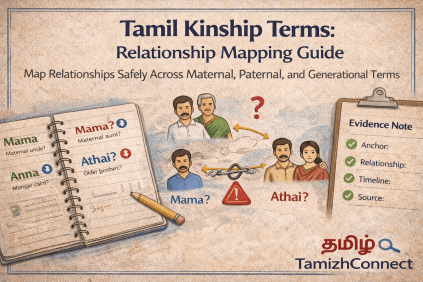
Tamil Kinship Terms Guide: Relationship Mapping
If your paatti calls someone "mama" and your amma calls the same person "chithappa", they might both be right — Tamil kinship terms shift depending on who’s speaking, which generation, and which side of the family. Get the term wrong and you’ll link the wrong parent in your tree.
Start with the hub guide: Tamil Ancestry.
Why kinship terms are tricky in genealogy
Tamil terms can encode:
- elder/younger ordering
- maternal/paternal side
- respect and social context
- household roles rather than strict biological links
Rule: treat kinship terms as clues; confirm via records and relationships.
High-value distinctions to capture
1) Maternal vs paternal side
If the term implies a specific side, store it explicitly:
- “maternal uncle” vs “paternal uncle”
2) Elder vs younger
Age ordering can resolve ambiguity and same-name collisions.
3) Relationship-by-marriage
Some terms refer to in-law roles; never assume biological linkage.
Disambiguation method (use this every time)
Step 1 — Identify the speaker
Who said “mama/athai/anna”? The term is defined relative to the speaker.
Step 2 — Identify the reference person
Is the term used relative to:
- the speaker’s parent?
- the spouse?
- a household elder?
Step 3 — Test against the timeline
Does the age ordering and generation make sense?
Step 4 — Confirm using one evidence anchor
Use at least one:
- spouse/parent name in a document
- household clustering
- wedding invitation relationship listing
- consistent address network
If you cannot confirm, store as “possible relationship” only.
How to store kinship terms safely (data model guidance)
For each relationship claim:
- term as spoken (raw)
- inferred relationship type (normalized)
- side: maternal/paternal/unknown
- confidence: confirmed/probable/possible
- evidence note
This prevents “hard commits” from conversational terms.
Common mistakes
- Treating conversational terms as strict biological relationships
- Ignoring the speaker perspective
- Merging people based on a term alone
Use the merge guide when uncertain: Avoid Duplicate Ancestors.
Next steps
- If initials complicate relationship mapping: Tamil Initials Decoder
- To anchor relationships to places: Find Ancestral Village
- Return to hub workflow: Tamil Ancestry