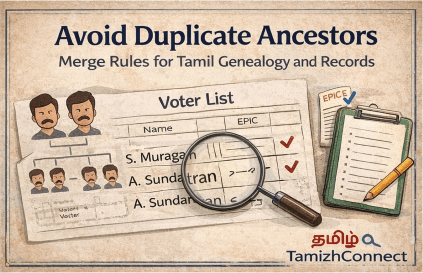
Avoid Duplicate Ancestors in Tamil Genealogy: Complete Guide to Safe Merge Rules & Evidence Grading
Duplicate ancestors represent the most expensive mistake in Tamil ancestry research. One incorrect merge can quietly distort an entire family tree for years, creating confusion that multiplies as more generations are added.
This comprehensive guide provides you with safe merge rules and an evidence grading system specifically designed for Tamil genealogy records, addressing the unique challenges of initials, patronymics, spelling variations, and household clustering patterns.
Tamil Ancestry Research Hub | Tamil Naming System Guide
What You’ll Learn in This Guide
- Why duplicates happen more frequently in Tamil genealogy
- Core merge rules to prevent incorrect merges
- Evidence grading system for confident decision-making
- Conflict resolution strategies when records disagree
- Safe workflow to identify and resolve duplicates
- Practical tips for complex naming scenarios
1. Why Duplicates Happen More Often in Tamil Genealogy
Tamil genealogy presents unique challenges that increase the likelihood of duplicate entries:
1.1 Initials Shift Across Documents
- Patronymic initials move between "first name" and "last name" fields
- Forced formatting in Western forms converts initials to surnames
- Multiple initials (grandfather + father) get compressed differently
1.2 Spelling Drift in Transliteration
- British vs. modern spelling conventions
- Regional dialect variations in English transliteration
- Clerk interpretation differences across decades
1.3 Repeated Personal Names
- Common names within the same village/community
- Religious naming patterns that repeat across generations
- Honorific-based names that appear identical
1.4 Household and Administrative Changes
- Boundary changes affecting village/town names
- Migration patterns within the same region
- Incomplete records missing key identifiers
1.5 Partial Documentation
- Missing parent names in some records
- Approximate dates instead of exact birth dates
- Incomplete electoral rolls or other public records
The Solution: Not "more confidence" but systematic merge discipline with evidence-based decision making.
2. Core Merge Rules: The Two-Anchor Principle
The Fundamental Rule
Never merge two identities using name similarity alone. Merge only when at least two independent anchors match.
The Three Critical Anchors
2.1 Relationship Anchor
- Direct relationships: parent, spouse, sibling, child
- Extended relationships: in-law, cousin, uncle/aunt
- Documented connections: marriage records, household entries
2.2 Place Anchor
- Specific location: village, street, neighborhood
- Administrative boundaries: DS division, taluk, district
- Household clustering: electoral rolls, census data
2.3 Timeline Anchor
- Age consistency: birth years, marriage periods, death dates
- Life event sequence: marriage before children, education timeline
- Historical context: war periods, migration events, economic changes
Decision Matrix
- 0-1 anchors: Keep separate, mark as potential duplicates
- 2 anchors: Merge with confidence
- 3 anchors: High-confidence merge with full documentation
3. Evidence Grading System: Simple and Practical
3.1 Confirmed Evidence
Definition: Highest confidence level with explicit documentation
Examples:
- A document explicitly states the relationship (parent/spouse) or full patronymic
- Two independent records align on relationship + address
- Official government records with matching details
- Multiple family members confirming the same connection
Action: Safe to merge and build additional generations
3.2 Probable Evidence
Definition: Strong circumstantial evidence with minor gaps
Examples:
- Consistent household clustering and timeline, but missing direct relationship label
- Multiple records showing same place + approximate age + similar names
- Family oral history with supporting documentation
- Pattern consistency across multiple data points
Action: Safe to merge with note of evidence level
3.3 Possible Evidence
Definition: Weak evidence requiring additional verification
Examples:
- Matches by name + approximate age only
- Place matches but relationships missing
- Single document with incomplete information
- Similar names in same general area
Action: Keep separate as lead for further research
3.4 Evidence Hierarchy
Rule: Only "Confirmed" and "Probable" evidence should be used to build additional generations. "Possible" stays as a research lead.
4. Comprehensive Merge Decision Checklist
Before merging Person A and Person B, verify each of these critical elements:
4.1 Relationship Verification
- [ ] At least one shared relationship (spouse/parent/child/sibling)
- [ ] Relationship consistency across multiple records
- [ ] Family structure alignment (number of children, marriage patterns)
- [ ] Cross-verification with other family members
4.2 Place Consistency
- [ ] Consistent address/village network
- [ ] Geographic plausibility of movement patterns
- [ ] Administrative boundary alignment
- [ ] Household clustering verification
4.3 Timeline Validation
- [ ] Age consistency within 1–3 years across records
- [ ] Life event sequence makes logical sense
- [ ] Historical context alignment (war periods, migration)
- [ ] Marriage/childbirth plausibility based on ages
4.4 Documentation Alignment
- [ ] Records align without overlapping conflicting households
- [ ] Initial compatibility explained as patronymic/place
- [ ] No contradictory evidence in other sources
- [ ] Supporting documents available for verification
4.5 Cultural Context
- [ ] Naming pattern consistency with Tamil conventions
- [ ] Community identity alignment (caste, religion, region)
- [ ] Occupation/land status consistency
- [ ] Migration pattern logic with known history
If you cannot check all relevant items, do not merge. Document what’s missing and continue research.
5. Conflict Resolution Rules: When Records Disagree
5.1 Age Discrepancies
Scenario: Different ages/birth years across records
Resolution Strategy:
- Treat age as approximate rather than exact
- Check that the timeline still works for major life events
- If age difference breaks marriage/childbirth plausibility, keep records separate
- Look for documentary evidence (school records, employment records) for more accurate dates
5.2 Spelling Variations
Scenario: Different spellings of names across documents
Resolution Strategy:
- Treat spelling as low confidence evidence
- Verify with relationships + place rather than name alone
- Consider transliteration patterns and time periods
- Look for consistent patterns across multiple documents
5.3 Parent Name Discrepancies
Scenario: Different parent names in various records
Resolution Strategy:
- This is high-risk – do not merge without strong evidence
- Investigate if one record is clearly wrong (clerk error, mishearing)
- Look for sibling records that might clarify the correct parent
- Consider name expansion possibilities (initials, honorifics)
5.4 Place Discrepancies
Scenario: Different locations mentioned in records
Resolution Strategy:
- Place can change due to migration – this is normal
- Look for bridging records (same spouse/sibling, different address)
- Check for administrative boundary changes
- Verify migration timeline makes sense with other evidence
5.5 Document Timing Conflicts
Scenario: Records suggest overlapping or impossible timelines
Resolution Strategy:
- Check for household splitting (temporary separation)
- Consider seasonal migration patterns
- Look for record errors or misdating
- Verify with independent sources when possible
6. Safe Workflow: Systematic Duplicate Identification and Resolution
6.1 Phase 1: Duplicate Identification
- Run systematic searches for similar names in same areas
- Compare household clusters in electoral rolls and census data
- Check for pattern matches (same initials, same village, same time period)
- List all suspected duplicates with potential matches
6.2 Phase 2: Evidence Collection
For each suspected duplicate pair:
- Collect strongest evidence (place/relationship/timeline)
- Gather supporting documents (birth certificates, marriage records, electoral rolls)
- Cross-reference with siblings and extended family
- Document all sources with dates and reliability ratings
6.3 Phase 3: Decision Making
For each pair, decide:
- Merge now (with full documentation)
- Keep separate (with explanation of why)
- Mark as "needs review" and search for additional evidence
6.4 Phase 4: Documentation and Review
- Document all decisions with reasoning and evidence
- Create audit trail for future verification
- Schedule periodic review of "possible" matches
- Update family tree systematically
7. Advanced Strategies: Practical Tips for Complex Scenarios
7.1 Sibling Records Solve Duplicates
Scenario: Two men share the same name and village
Solution: Use sibling records to separate them:
- Sibling marriages (different spouses indicate different families)
- Sibling household co-residence (living together confirms same family)
- Father-name expansions (different fathers indicate different families)
7.2 Electoral Roll Analysis
Strategy: Use household clustering patterns:
- Look for consistent family groupings across multiple years
- Note migration patterns within the same household
- Check for temporary absences (work, education, military service)
7.3 Document Cross-Verification
Strategy: Use multiple document types:
- School records for age verification
- Employment records for location and timeline
- Property documents for family relationships
- Religious records for community connections
7.4 Technology-Aided Verification
Tools: Use genealogy software features:
- Duplicate detection algorithms to identify potential matches
- Relationship mapping to visualize connections
- Timeline visualization to spot inconsistencies
- Source tracking to maintain evidence chain
8. Common Pitfalls to Avoid
8.1 The "Name Match" Trap
- Pitfall: Merging based on name similarity alone
- Solution: Always require at least two anchors (relationship + place, or timeline + relationship, etc.)
8.2 The "Complete Confidence" Fallacy
- Pitfall: Assuming one document is always correct
- Solution: Cross-verify with multiple sources and consider document reliability
8.3 The "Clerk Error" Oversight
- Pitfall: Not considering transcription or translation errors
- Solution: Account for common mistakes in historical records
8.4 The "Cultural Context" Blind Spot
- Pitfall: Applying Western genealogy rules to Tamil naming
- Solution: Understand Tamil naming conventions, patronymics, and cultural patterns
9. Quality Control: Maintaining Accuracy Over Time
9.1 Regular Review Process
- Quarterly reviews of recent merges
- Annual audit of duplicate resolution decisions
- Documentation updates as new evidence emerges
- Family verification for critical connections
9.2 Evidence Standards
- Minimum two anchors for all merges
- Document sources for all decisions
- Note uncertainty levels for future researchers
- Maintain audit trails for verification
9.3 Collaboration Guidelines
- Share evidence standards with family researchers
- Establish merge protocols for collaborative trees
- Create verification workflows for contributed information
- Maintain quality control across all contributors
10. Next Steps: Building on Your Duplicate Prevention Knowledge
10.1 Immediate Actions
- Review your current tree for potential duplicates using the two-anchor rule
- Document any merges you’ve made without sufficient evidence
- Create a systematic review process for your existing data
- Apply evidence grading to all future merge decisions
10.2 Related Resources
- If your root problem is initials: Tamil Naming System Explained – Understand how Tamil naming patterns create duplicate risks
- If your root problem is missing village anchors: Find Ancestral Village – Learn to identify and verify ancestral locations
- For the main workflow: Tamil Ancestry Research Guide – Comprehensive approach to Tamil genealogy research
10.3 Advanced Topics
- Record verification techniques for Tamil genealogy
- Migration pattern analysis for family tracking
- Community-based research strategies
- Technology tools for duplicate detection
Conclusion: Building Accurate Tamil Family Trees
Preventing duplicate ancestors is fundamental to building accurate, reliable Tamil family trees. By implementing the two-anchor rule, using the evidence grading system, and following the systematic workflow outlined in this guide, you can avoid the most expensive mistake in genealogy research.
Remember: It’s better to have two separate records that might be the same person than one merged record that’s wrong and corrupts your entire tree. Take time to verify, document your reasoning, and maintain high standards for evidence.
Ready to apply these principles to your family research? Start by reviewing your current tree for potential duplicates using the checklist in this guide, then implement the systematic approach to ensure accuracy going forward.
Related Resources
- Tamil Naming System Guide – Understanding Tamil naming conventions to prevent duplicates
- Tamil Ancestry Research Hub – Comprehensive Tamil genealogy research guide
- Find Ancestral Village Guide – Techniques for location verification
- Electoral Rolls for Tamil Genealogy – Using household clustering to verify relationships