TamizhConnect Blog
19 Dec 2025 · TamizhConnect Team
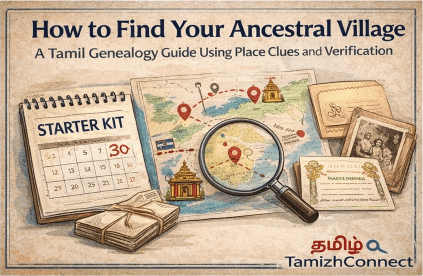
How to Find Your Tamil Ancestral Village
Tamil genealogy article
Step-by-step guide to identify and verify your Tamil ancestral village using temple circuits, address fragments, family networks & evidence triangulation.

Document Digitisation
Turn documents into verified Tamil lineage.
Choose the depth you need. One-time service, results stay in your account.
For many families, "Tamil ancestry" becomes real when you can answer one question confidently: Which village are we from?
This comprehensive guide provides a verification-first method to identify an ancestral village even when the remembered place name is incomplete or spelled differently in records.
Start with the hub: Tamil Ancestry Hub.
Step 1: Capture all place hints (even weak ones)
Ask for:
- temple name or deity name
- nearby town/market name
- school or employer location
- "route clues" (bus stand, railway station)
- festival circuit references
- relatives who still live nearby
Small hints compound quickly.
Step 2: Turn memory into a shortlist of candidate places
Do not jump to one village. Build a shortlist:
- village candidates (multiple spellings)
- district/taluk guesses
- nearby towns associated with the family story
Keep candidates in a list and eliminate them by evidence.
Step 3: Use documents as place detectors
High-yield sources:
- wedding invitations (native place often appears)
- electoral rolls (area and household clustering)
- school certificates (district or taluk references)
- property papers (village and boundary terms)
- letters and envelopes (post office references)
Look for repeated fragments across unrelated documents.
Step 4: Validate using temple circuits
If a candidate village has:
- the temple name you were told
- a nearby festival circuit that matches family memory
- a deity network consistent with the region
…then the candidate is strong.
If temple + place do not align, discard the candidate.
Step 5: Confirm using relationships, not only place names
Village name matches are common. Relationship matches are rare.
A village is "confirmed" when you can connect it to:
- spouse line evidence
- parent name evidence
- sibling marriage links
- household clustering at an address
The triangulation checklist (use this before you commit)
A village is confirmed when 3+ of the following align:
- repeated place mention across 2+ independent sources
- consistent household/address anchor
- relationship evidence matches (spouse/parent/sibling)
- timeline and migration story make sense
- temple/deity circuit aligns
If you only have 1–2, keep it as "probable" and continue searching.
Common pitfalls
Pitfall: Assuming the district is the village
Fix: districts are broad; you need taluk/village-level anchors.
Pitfall: Using Google Maps spelling as "truth"
Fix: village spellings vary; treat maps as one reference, not the authority.
Pitfall: Committing too early
Fix: keep candidates until you have triangulation.
Next steps
- If initials are confusing your place work, read: Tamil Naming System Explained
- If you're seeing duplicates, read: Avoid Duplicate Ancestors
- Return to the hub: Tamil Ancestry
Share this article
TamizhConnect Team
TamizhConnect helps Tamil families worldwide trace their ancestry using voter records, indenture archives, and origin village matching. Our research team combines genealogy expertise with digitised Tamil Nadu datasets to help you discover your roots.
Ready to start your Tamil family tree?
TamizhConnect helps you discover relatives, trace your origin village, and keep your family history alive for the next generation.
Create your free TamizhConnect accountGo to my family treeDocument Digitisation
Have old documents? Upload them and we'll verify, trace, and add them to your tree.
Was this article helpful?
Get new articles in your inbox
Tamil genealogy tips, research guides, and new feature updates.
You might also like
தமிழ் மூதாதையர் ஆய்வு நூலகம் (Tamil)
TamizhConnect-க்கு தேவையான தமிழ் வம்சாவளி முறைகள், பதிவுகள், இனவியல் மற்றும் பாரம்பரியச் சரிபார்ப்புக்கான அனைத்து ஆழமான வழிகாட்டிகளும் ஒரே இடத்தில்.
31T08:07:46.854Z May 2026
Tamil ancestry research: Complete guide for genealogical methods (English)
All our deep-dive guides on Tamil genealogical methods, records, ethnography, and heritage validation for TamizhConnect.
31T08:07:46.853Z May 2026
The Tamils of Dharavi: A Hundred Years from Tirunelveli to Mumbai (English)
From the droughts of Tirunelveli to the tanneries and textile mills of Mumbai, the Tamil community of Dharavi has built one of the largest Tamil cities outside Tamil Nadu. With redevelopment underway, here's how families can preserve their migration story for the next generation.
15 May 2026
The Tamils of Karachi: Tracing Roots from Madrasi Para Back to Tamil Nadu (English)
A century after they migrated from Madras Presidency, the Tamil community of Karachi's Madrasi Para still preserves South Indian traditions. Here's how their descendants can begin tracing their ancestral villages and family deities in Tamil Nadu.
15 May 2026
The Tamil Caribbean: Tracing Indenture Roots from Guadeloupe to Guyana (English)
From Pondicherry and Karaikal to the sugar plantations of Guadeloupe, Martinique, Trinidad, and Guyana — a guide to the Tamil indenture story in the Caribbean and how descendants can trace their roots back to Tamil Nadu today.
15 May 2026
Understanding Tamil Naming Conventions: Beyond 'Last Names' (English)
Tamil naming conventions traditionally do not feature fixed, inherited 'last names' in the Western sense, instead relying on a system of patronymics, village names, or caste indicators.
26 Apr 2026
Core topics
What is Tamil, really? Language, identity, and where it comes from
A clear, human explanation of what Tamil is-language, identity, people, and history-plus how to talk about it without stereotypes.
4 Feb 2026
What Defines Tamil Identity Beyond Borders and Sub-Groups? (English)
Tamil identity is primarily defined by shared language and cultural heritage, rather than by geographic borders or internal sub-group affiliations. This core identity persists across the diaspora and within Tamil Nadu.
17 Apr 2026