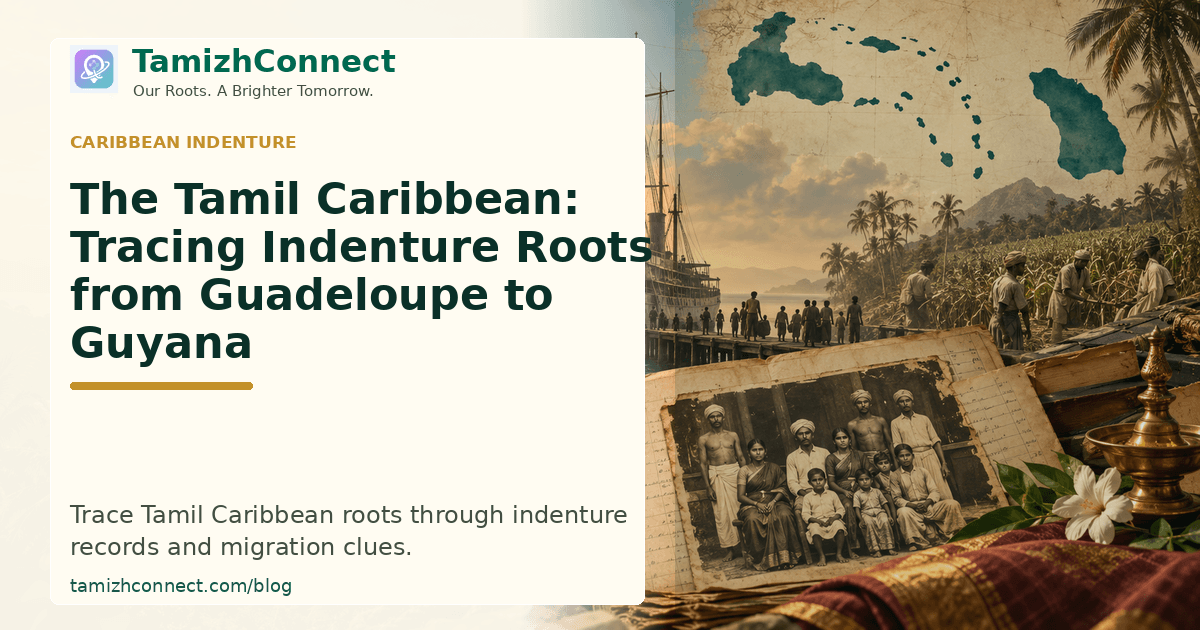
The Tamil Caribbean: Tracing Indenture Roots from Guadeloupe to Guyana
This week, Trinidad and Tobago Prime Minister Kamla Persad-Bissessar stood at Nelson Island — the first port of call for Indian indentured labourers in the Caribbean — and spoke a sentence that travelled around the world: "It took a little coolie girl from a place down in Siparia to become the Prime Minister of Trinidad and Tobago." Her speech reclaimed a slur that has clung to descendants of indentured Indians for nearly two centuries. Beside her stood India’s External Affairs Minister S. Jaishankar, in Trinidad as part of a three-nation Caribbean tour that also took him to Suriname and Jamaica.
On the same trip, two announcements were made that change the practical landscape for every Caribbean descendant of Indian indenture:
- An MOU was signed between India and Trinidad and Tobago to digitise the records of the National Archives of Trinidad and Tobago — specifically to help descendants of indentured labourers trace their ancestral lineage.
- Overseas Citizenship of India (OCI) eligibility has been extended to the sixth generation of Trinidad’s Indian diaspora — meaning sixth-generation descendants of the Fatel Razack and the ships that followed it now have a documented pathway back to India, if they can establish the lineage.
The Indian Caribbean is, finally, having its moment. But most coverage of this moment has focused on the North Indian — Bhojpuri, Bihari, eastern UP — story that makes up the majority of Trinidad’s Indian diaspora. There is another story inside that one, smaller but no less real, that has been waiting much longer to be told.
This is the story of the Tamils of the Caribbean.
How many Tamils came to the Caribbean?
The numbers are larger than most people realise. Between 1838 and 1917, the British and French shipped over half a million Indians to the Caribbean as indentured labourers. The British recruits came overwhelmingly from the Gangetic plains, but a meaningful minority — roughly 20% of indentured workers to the English-speaking Caribbean — were Tamils and Telugus from the Madras Presidency. The French Caribbean colonies were almost entirely staffed from South India.
The breakdown of Tamil-origin arrivals, approximately:
- Guadeloupe: Over 40,000 indentured workers arrived between 1854 and 1885, the overwhelming majority Tamil. Around 36,000 Indo-Guadeloupeans live there today. The Tamil community there is known as the Malabars.
- Martinique: 25,509 indentured arrivals, again overwhelmingly from Tamil Nadu and Andhra Pradesh. Around 15,000 Indo-Martinicans today.
- French Guiana: 8,500 indentured arrivals.
- Trinidad: 143,939 total indentured arrivals from 1845 to 1917. With roughly 20% from the south, this implies around 28,000 Tamil/Telugu-origin descendants in Trinidad today — including a historic Shiva temple known as the Madras Sivalayam (Caura Road temple) and active Tamil cultural preservation work.
- Guyana (formerly British Guiana): 238,909 indentured arrivals. With the same proportion, roughly 47,000 Tamil-origin descendants. Tamils have been in Guyana’s plantations since 1838 — in 1860 alone, 2,500 arrived from Madras. Former Prime Minister Moses Veerasammy Nagamootoo is of Tamil descent. There is a popular Mariamman temple. Hindu Tamil Indians make up the majority of the East Berbice-Corentyne region.
- Suriname: 34,304 indentured arrivals, primarily North Indian via Calcutta — but with a meaningful South Indian thread.
The total Tamil-origin Caribbean population today is well over 100,000 people — most of whom no longer speak Tamil, but who carry surnames, festival traditions, deity associations, and surviving Mariamman temples that point clearly back to Tamil Nadu.
The route most of them took: Pondicherry and Karaikal
While the British recruited from Calcutta and Madras for their Caribbean colonies, the French had their own Indian ports. Tamil migration to the French West Indies came almost entirely from Pondicherry and Karaikal, the two main French enclaves on the Tamil coast, between 1853 and 1883.
This is a critical genealogical clue. If your family came to Guadeloupe, Martinique, or French Guiana, your great-great-grandparents likely:
- Boarded ship at Pondicherry or Karaikal (not Madras or Calcutta)
- Came from villages in the Tamil-speaking districts surrounding those ports — modern-day Villupuram, Cuddalore, Karaikal, Nagapattinam, Thanjavur, Pondicherry’s hinterland
- Signed a five-year contract under French law (in contrast to the ten-year British contract)
- Often returned, or had the option to return, at the end of indenture — unlike many British contracts
For descendants in Guadeloupe and Martinique, this narrows the search for ancestral villages considerably. The records that survive are scattered between French colonial archives, the Pondicherry State Archives, and a handful of British and Dutch repositories — but they exist, and increasingly they are being digitised.
For descendants in Trinidad and Guyana whose families were Tamil, the route was different — they came through Madras port (after first being assembled at sub-depots across Tamil Nadu) and they sailed under British contracts. Their records were kept in different places, including the National Archives of Trinidad and Tobago, which holds emigration passes that record the immigrant’s name, age, caste, father’s name, district, and village in India for every ship that arrived between 1845 and 1917.
This last fact — that the village name in Tamil Nadu was recorded — is what makes ancestral tracing possible at all. The British colonial bureaucracy, for all its cruelty, kept paperwork.
What survives in the Caribbean today
The Tamil cultural footprint in the Caribbean is more visible than people often assume:
- Mariamman temples — present in Guyana, Trinidad, and elsewhere. Mariamman is a quintessentially Tamil village goddess; her presence in a Caribbean temple is a direct cultural fingerprint of South Indian migration.
- The Madras Sivalayam (Caura Road temple) in Trinidad — a historic Shiva temple founded by Tamil indentured workers.
- The Malabars of Guadeloupe — a distinct cultural community with surviving temple traditions, festivals, and food, though the Tamil language itself has nearly disappeared (an estimated 17 elderly speakers remained as of recent surveys).
- Tamil-derived surnames across the Caribbean diaspora — Naidoo, Nagamootoo, Pillai, Mootoo, Sammy, Maraj, Soobramaniam, and many others — often anglicised but recognisably Tamil in origin.
- Festival practices — kaavadi, fire-walking, Aadi Maasam observances, Pongal — surviving especially in Mauritius, but with parallels in the Caribbean.
- Caribbean Hindustani, a community organisation, runs a Madrasi Sangam programme dedicated to preserving Caribbean Tamil heritage.
The OCI sixth-generation extension: why it matters
Here is the practical headline most people missed in the news coverage. PM Modi’s decision to extend OCI eligibility to the sixth generation of Indian-origin Trinidadians means that a Trinidadian whose great-great-great-great-grandfather arrived on a ship in 1865 can now apply for an OCI card.
But to do so, they need to establish the lineage.
This is where Trinidad’s National Archives — and the new India-Trinidad MOU on digitisation — become genuinely consequential. The Ship Registers and Emigration Passes held at the National Archives contain the original Indian village name for almost every indentured worker who arrived. Cross-referencing this with surviving family knowledge in Trinidad (and Guyana, and Guadeloupe, and Martinique) allows the construction of a lineage chain that satisfies OCI documentation requirements.
For Tamil-origin Caribbean descendants specifically, the path is:
- Find the ancestor’s name on a ship register at the National Archives of Trinidad and Tobago (or equivalent archive for Guyana, French Caribbean records).
- Identify the village in Tamil Nadu recorded on the emigration pass.
- Establish the lineage chain from that ancestor down to you, generation by generation, through birth and marriage records.
- Apply for OCI with the lineage documentation.
The whole sequence is now becoming dramatically easier as records digitise. For Tamil descendants, there is one additional thread that opens up alongside this:
Tamil ancestry includes the Kula Deivam
For Tamil families, knowing the ancestral village isn’t just an OCI document. It is the gateway to something culturally deeper: the Kula Deivam (குல தெய்வம்), the family deity. Every Tamil family has a Kula Deivam — almost always tied to a specific village temple in Tamil Nadu, often a form of Mariamman, Murugan, Karuppasamy, Ayyanar, or one of the seven sister goddesses.
When a Caribbean Tamil descendant traces their family back to a specific Tamil Nadu village, they aren’t just finding a dot on a map. They are finding the specific temple their ancestors prayed at, the deity their family carried with them across the ocean, and the place that — even after six generations — is still spiritually theirs.
At TamizhConnect, the Kula Deivam Finder is one of the tools we are building specifically for this kind of reconnection. Combined with Tamil Nadu voter records (over 50 million entries, useful for finding distant relatives who never left), indenture ship records, and our family-tree builder, the platform exists to do exactly the kind of work this Caribbean moment now demands.
A practical starting point for Caribbean Tamil descendants
If you are reading this from Trinidad, Guyana, Guadeloupe, Martinique, Suriname, or anywhere in the Caribbean Tamil diaspora — or if your family is — here is how to begin:
1. Talk to your eldest relatives, now. Ask:
- Do you remember any names from India in our family — even partial ones?
- Which port did our ancestors arrive at? Which year?
- Do you know the ship’s name, or the year of arrival?
- What is our family deity? Which temple do we go to for important rituals?
- Were we Tamil-speaking originally? Telugu? Which caste or community?
2. Look at your surname. Tamil surnames carry information. Names ending in -samy, -swamy, -mootoo, -naidoo, -pillai, -maraj, -soobramaniam and similar all point to specific Tamil communities and regions.
3. Check the National Archives of Trinidad and Tobago (if your family is Trinidadian) at natt.gov.tt — they hold Ship Registers, General Registers, and Emigration Passes from 1845–1917, many of which name the original Indian village.
4. For Guadeloupe and Martinique: records are scattered between French colonial archives and Pondicherry. Begin with the Pondicherry State Archives and the Archives Nationales d’Outre-Mer (ANOM) in Aix-en-Provence.
5. Build your tree on TamizhConnect. Free to sign up. Add what you know, leave gaps where you don’t, and let the tools — voter records, indenture records, Kula Deivam Finder — help fill them in.
6. Connect with others doing the same work. The Caribbean Tamil community is small but globally distributed — there are descendants doing this work in Toronto, London, Paris, and increasingly in India itself. You are not alone in this search.
Why this matters now
For 180 years, Caribbean Indian descendants have carried fragments of an Indian identity without always knowing what to do with them. A Mariamman temple in a Guyana village. A Tamil-sounding surname with the original spelling lost. A grandmother’s prayers in a half-remembered language. An old photograph of an ancestor whose village no one can name.
The combination of three things has changed this in the last twelve months:
- Political will on both sides (Modi’s OCI extension, Persad-Bissessar’s record-digitisation push)
- Technology that makes record cross-referencing actually feasible
- A generation ready to do the work before the elders who remember are gone
The Tamil thread within this story has been quieter, but it is no less real. The Malabars of Guadeloupe, the Tamil descendants of Berbice, the Madras Sivalayam community in Trinidad — they are part of the same global Tamil family as the Mauritians and the Surinamese and the Singaporean Tamils and the Malaysian Tamils. The reconnection is not theoretical. It is starting now.
If your family is part of this story — or if you know a family that is — please reach out. The platform is free to begin. Every village name remembered, every ancestor traced, is a piece of a story that has been waiting nearly two centuries to be put back together.
Begin at tamizhconnect.com — free family tree building, Tamil Nadu voter records (50M+), indenture ship records, and our Kula Deivam Finder for tracing family deities back to ancestral villages in Tamil Nadu.
For researchers, archivists, journalists, and community organisations working on Caribbean Indian heritage — particularly the Tamil and Telugu threads — we’d welcome the chance to collaborate. We’re a small team, the platform is free for community use, and we believe this story deserves to be told properly.