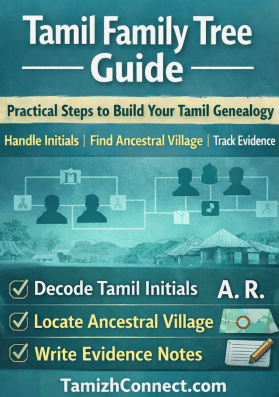
Tamil Family Tree: Practical Guide
Building a Tamil family tree means handling three things that make Tamil names unique: father’s-name initials instead of surnames (e.g., "R. Kumar"), spelling variants across English and Tamil ("Subramaniam / Subramanyam / Subramanian"), and the same name repeated across generations in the same village. Connecting the wrong people is a bigger risk than missing data, so every person in the tree needs at least two anchors: a place (household, village), a relationship (parent / spouse / child), and a time (age or DOB). TamizhConnect builds this workflow into a Tamil-first genealogy platform with 50 million voter records and indenture ship manifests for evidence.
This guide shows the safest, fastest method.
Start from the main hub: Tamil Ancestry & Genealogy Hub.
The 3 anchors that make a Tamil family tree credible
A person is “the same person” only when at least two of these anchors match:
- Place anchor (household/address/village network)
- Relationship anchor (spouse/parent/sibling proof)
- Timeline anchor (age + life events plausibility)
Never merge by name similarity alone.
Step-by-step: Build your Tamil family tree
Step 1: Start with one household (not generations)
Create:
- you → parents → siblings → spouse → children Then confirm links inside the household before extending upward.
Step 2: Collect 5 high-yield sources
Prioritize:
- wedding invitations
- school/employment records
- old letters/envelopes (post office clues)
- address proofs
- electoral rolls (if available)
Step 3: Normalize names safely
Store:
- raw name per source (do not overwrite)
- a canonical display name
- initials separately
- alias spellings
- confidence level
Read: Tamil Naming System Explained
Step 4: Handle Tamil initials correctly (patronymics)
Expand initials only after you have two anchors.
Read: Tamil Initials Decoder
Step 5: Find and verify the ancestral village
Use:
- temple/deity references
- nearby town clues
- post office fragments
- relatives’ villages (clusters)
Read: Find Your Ancestral Village
Step 6: Prevent duplicates using merge rules
Use strict merge discipline. If uncertain, keep as “Possible” until you find one more source.
Read: Avoid Duplicate Ancestors
Step 7: Add evidence notes for every important link
Evidence notes protect your tree from future confusion and help family members trust the results.
Read: Tamil Genealogy Evidence Notes
Practical checklist (copy/paste)
- [ ] I started with one household and confirmed relationships
- [ ] I stored raw names as written in sources
- [ ] I did not expand initials without two anchors
- [ ] I tracked village candidates before committing
- [ ] I used merge rules to avoid duplicates
- [ ] I wrote evidence notes for key claims
FAQ
Why is “Tamil family tree” hard compared to other trees?
Initials/patronymics and spelling drift across records create high duplicate risk. Place + relationships are more reliable than spelling.
Are Tamil surnames reliable for genealogy?
Often no. Many Tamil naming patterns do not use fixed hereditary surnames, and modern forms can force an initial into a “last name” field.
What if I don’t know my ancestral village?
Start with temple/deity + nearby town + post office clues, and build a shortlist until evidence confirms one.