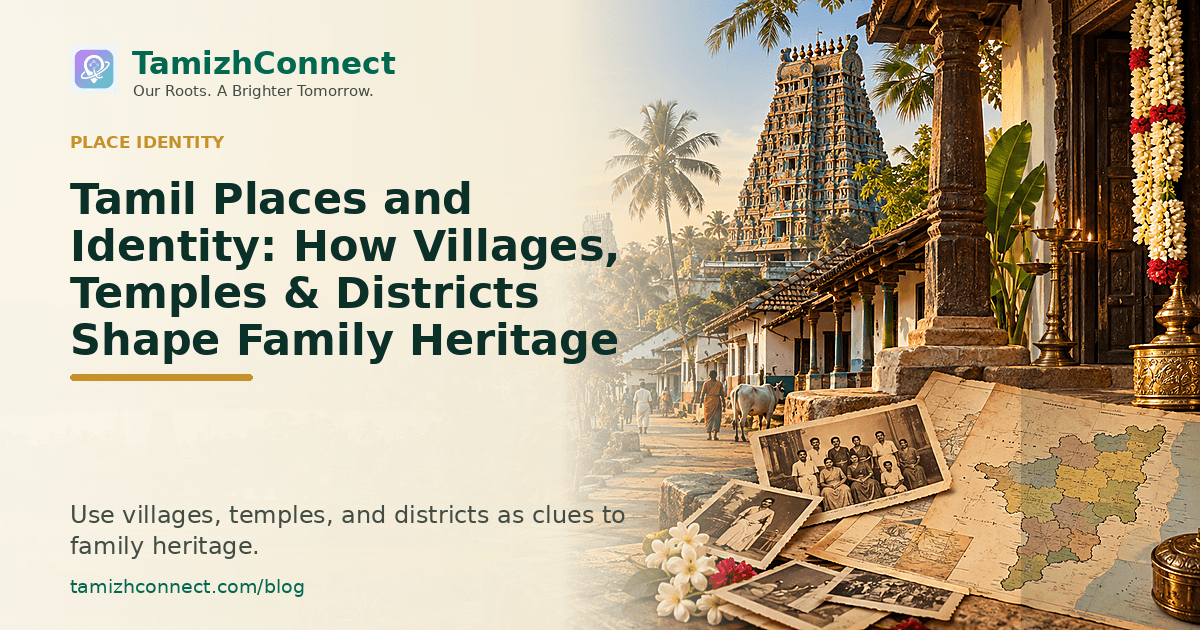
Tamil Places and Identity: How Villages, Temples & Districts Shape Family Heritage
In Tamil culture, where you come from is not just geography — it is identity. A Tamil family’s connection to a specific village, temple town, or district carries meaning that persists across generations, even when the family has lived elsewhere for decades.
For genealogy research, understanding this place-identity connection is one of the most powerful tools available. It can confirm family links, reveal migration paths, and connect you to relatives you did not know existed.
Related: Village Surnames: Jaffna, Trichy, Batticaloa | Tamil Migration Timelines
Why place matters more than surname in Tamil genealogy
In Western genealogy, the surname is the primary thread. You search for all people named "Smith" or "Johnson" and work outward.
In Tamil genealogy, the place is often a stronger thread than the name. Here is why:
- Tamil families traditionally did not use fixed surnames — but they always had a native place
- Multiple branches of the same family share the same ancestral village, even after migration
- Village identity is encoded in names, marriage records, temple donations, and oral history
- The kula deivam (family deity temple) anchors a family to a specific location
When you know the village, you can find relatives. When you only know the "surname," you often cannot.
The layers of place identity
Tamil place identity operates at multiple levels, and each level carries different information:
1. Ooru (ஊர்) — The ancestral village
The most fundamental unit. When a Tamil person says "Enga ooru Thanjavur" (our place is Thanjavur), they may mean:
- The family’s ancestral village in or near Thanjavur district
- Where the family deity temple is located
- Where the family’s agricultural land was historically
- The village listed on older generation’s documents
Genealogy value: The ooru connects you to temple records, land records, and other families from the same village.
2. Nadu (நாடு) — The micro-region
In older Tamil administrative geography, a nadu was a cluster of villages under a local chieftain. Some nandu names survive as identity markers:
- Tondaimandalam (northern Tamil Nadu)
- Cholamandalam (Cauvery delta)
- Pandya Nadu (southern Tamil Nadu)
- Kongu Nadu (western Tamil Nadu)
Genealogy value: Nadu identity helps narrow down which part of Tamil Nadu a family originates from, especially when the specific village name has been lost.
3. Kovil / Kula Deivam — The temple anchor
Many Tamil families identify with a specific temple rather than a specific village. The kula deivam (family deity) temple is:
- Inherited through the patrilineal line
- Shared by all branches of the extended family
- Often the site of annual gatherings where distant relatives meet
- Recorded in marriage invitations and community records
Genealogy value: If you know the kula deivam, you can connect with other families who share the same deity — they may be distant relatives.
Find your Kula Deivam on TamizhConnect →
4. District identity in modern context
For diaspora families and younger generations, identity often attaches to the district rather than the specific village:
- "We are from Madurai"
- "Our family is Thanjavur Brahmins"
- "We are Tirunelveli people"
Genealogy value: District identity is a starting point. From there, dig deeper into the specific taluk, village, and temple.
How places appear in Tamil names
Place names are woven into Tamil identity in several ways:
| Pattern | Example | What it means |
|---|---|---|
| Place as prefix | Madurai Shanmugam | Shanmugam from Madurai |
| Place as "surname" | Kumbakonam Srinivasan | Srinivasan whose family is from Kumbakonam |
| Street or area name | Agraharam Lakshmi | Lakshmi from the Brahmin quarter |
| Village suffix | Kallidaikurichi Murugan | Murugan from Kallidaikurichi village |
In official documents, these place references are often stripped out or forced into surname fields, losing the geographical context. Wedding invitations and temple records are more likely to preserve them.
Place identity across the Tamil diaspora
When Tamil families migrated — to Malaysia, Singapore, Sri Lanka, South Africa, Mauritius, Fiji, the Gulf, or Western countries — they carried their place identity with them:
Malaysia and Singapore
- Tamil communities in estates and towns often clustered by district of origin
- "Jaffna Tamils" and "Indian Tamils" maintained distinct place identities
- Temple committees in Kuala Lumpur and Singapore often trace back to specific Tamil Nadu villages
Sri Lanka (Jaffna and Eastern Province)
- Village identity is exceptionally strong in Jaffna — families identify with specific kovil zones
- Eastern Province (Batticaloa, Trincomalee) families maintain connections to lagoon and coastal villages
- The civil war scattered many families, making pre-war village records critical for reconnection
Gulf countries
- First-generation migrants maintain strong village ties and often return for temple festivals
- Second generation may know the district but not the specific village — a common research starting point
Western countries (UK, Canada, Australia, USA)
- Third-generation diaspora often knows "we are from Jaffna" or "from Thanjavur" but has lost the village specifics
- Family elders are the critical source — once they pass, the village connection may be lost permanently
Using place identity for genealogy research
Step 1: Establish the ancestral village
Ask elders these questions:
- "What is our native place?" / "நம்ம ஊர் எது?"
- "Where is our family temple?" / "நம்ம குலதெய்வம் கோயில் எங்கே?"
- "Which village did grandfather/grandmother come from?"
- "Do we have any land or property in the village?"
Step 2: Search records tied to that place
Once you have a village or district:
- Electoral rolls: Search for family names in that constituency using Voter Search
- Temple records: Contact the kula deivam temple for donation records and festival lists
- Land records: District land registries often have family names going back generations
- Marriage registers: Temple and civil marriage records in that area
Step 3: Map the migration path
Most Tamil families did not move once — they moved in stages:
- Village → nearest town (for education or employment)
- Town → city (Chennai, Madurai, Coimbatore)
- City → another state or country
Mapping this path reveals where different branches of the family settled and where records might exist.
Map your family’s migration on TamizhConnect →
Step 4: Connect with others from the same village
Other families from the same ancestral village may be distant relatives — or may have records and oral history about your family. TamizhConnect helps you discover these connections through shared village origins, temple associations, and surname patterns.
Why this matters now
Place-based identity is fading with each generation. Urban migration, globalisation, and the shift to nuclear families means that the village connection weakens over time. The elders who know the full story — the specific village, the temple, the migration path — are aging.
Recording this information now, while it is still accessible through living memory, is one of the most valuable things you can do for your family’s heritage.
Start tracing your place identity
TamizhConnect’s tools are built for this kind of research:
- Family Tree — Record ancestral villages, temple connections, and migration paths for each person
- Voter Search — Find relatives in Tamil Nadu electoral rolls by name and location
- Kula Deivam Finder — Connect with families who share your ancestral deity
- Surname Map — Explore the geographic distribution of Tamil surnames
Related reading: