Tamil Naming Conventions: How Names Appear on Documents, Forms & Records
If you have ever tried to match a relative across two official documents, you already know the problem: the same person can appear with completely different name formats depending on which form they filled out, which clerk transcribed it, and which decade it was recorded.
This guide focuses on the practical conventions — how Tamil names actually appear on real documents, and how to read them correctly for genealogy research.
For a deeper look at the naming system itself, see: Tamil Naming System Guide | Tamil Surnames History
The initial system: what the letters actually mean
The most common Tamil naming convention is the initial system. A name like S. Murugan or K. R. Lakshmi is not a Western-style first-and-last-name pair. Here is what the letters encode:
| Format | Meaning | Example |
|---|---|---|
X. PersonalName |
Father’s initial + personal name | S. Murugan = Murugan, child of someone whose name starts with S |
X. Y. PersonalName |
Grandfather + Father + personal name | K. R. Lakshmi = Lakshmi, father starts with R, grandfather starts with K |
PersonalName X. |
Initial placed after (South Indian convention) | Murugan S. = same person as S. Murugan |
The initial is almost always the father’s name (patronymic). In some families, particularly in certain communities, it may be the husband’s initial for married women.
How the same person appears on different documents
This is where genealogy research gets tricky. Here is a real-world example of how one person might appear across documents:
| Document | Name as written | What happened |
|---|---|---|
| Birth certificate (1965) | S/o Ramasamy, Baby Boy |
Father’s name recorded, child not yet named |
| School register (1970) | R. Senthil Kumar |
Initial R = Ramasamy (father) |
| Electoral roll (1990) | Senthilkumar R |
Initial moved to end, space removed |
| Passport (1995) | SENTHILKUMAR RAMASAMY |
Initial expanded to full father name, placed as "surname" |
| Marriage certificate | R. Senthil Kumar s/o Ramasamy |
Both initial and expanded form |
| Foreign HR system (2005) | Ramasamy Senthilkumar |
Father name treated as first name, personal name as last |
All six records refer to the same person. If you search only by exact match, you will miss most of them.
Electoral roll conventions
Tamil Nadu electoral rolls follow a specific format that genealogy researchers encounter constantly:
Standard format: Serial No. | Name | Relative's Name | Relationship | Age | Gender
Key conventions:
- Names are written in Tamil script on the official roll
- The relative listed is usually the father (for unmarried) or husband (for married women)
- Relationship is marked as தந்தை (father), கணவர் (husband), or தாய் (mother)
- Ages are approximate — they can drift by 2-5 years between rolls
- The same person may have slightly different spellings across different years
Common traps:
- A woman listed under her father in one roll and husband in the next — same person, different relative
- Transliteration changes between rolls: "Subramaniam" vs "Subramanian" vs "Subramania"
- Split households: family members in different booth numbers across election years
Use Voter Search on TamizhConnect to search across multiple rolls efficiently.
Passport and visa conventions
When Tamil names hit international systems, conventions shift dramatically:
The "surname" problem: Most Tamil families did not use hereditary surnames. But passport forms require a surname field. What happens:
- Father’s name becomes surname:
R. Senthil Kumar→ Surname:RAMASAMY, Given name:SENTHIL KUMAR - Caste/community title used:
Senthil Kumar→ Surname:PILLAIorMUDALIAR - Village name used: Surname:
THANJAVURorKUMBAKONAM - Initial expanded:
S. Murugan→ Surname:S, Given name:MURUGAN - Single name: Some people enter only one name and leave surname blank
For genealogy research: When you find a relative’s passport name, work backwards. The "surname" may be their father’s name, village, community title, or an arbitrary choice made at the passport office.
School and college records
Educational records are often the most consistent source because they were recorded early in life, before names got reformatted by foreign systems.
Typical format: R. Senthil Kumar S/o Ramasamy
What to look for:
- Transfer certificates (TC) usually have the most complete version of a name
- The "S/o" (son of) or "D/o" (daughter of) field confirms parentage
- Caste column (in older records) can help distinguish between same-named individuals
- Date of birth on school records is often more accurate than electoral rolls
Temple and marriage records
Older temple records and marriage invitations use a different convention entirely:
Temple donation records: Often use the format [Village] [Father's name] [Personal name] — three parts, no initials.
Marriage invitations: Traditionally list the full lineage context:
- Father’s name (and sometimes grandfather)
- Village or native place
- Kula deivam (family deity)
- Gothram (clan lineage)
These are gold for genealogy because they connect a person to their village, lineage, and temple — exactly the links that get lost in modern documents.
Transliteration variations you will encounter
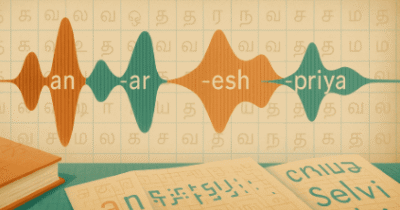
Tamil has sounds that do not map cleanly to English letters. The same Tamil name can be transliterated multiple ways:
| Tamil | Common variations |
|---|---|
| சுப்ரமணியம் | Subramaniam, Subramanian, Subramania, Subramanyam, Subrahmanyam |
| முருகன் | Murugan, Murukan, Muruken, Moorugan |
| லட்சுமி | Lakshmi, Laxmi, Latchumi, Luxmi |
| கணேசன் | Ganesan, Kanesan, Ganeshan, Ganaisan |
| இராமசாமி | Ramasamy, Ramasami, Ramaswamy, Ramaswami |
Rule of thumb: When searching for a relative, try at least 3 spelling variants. TamizhConnect’s search tools handle common transliteration variants automatically.
Practical tips for genealogy research
-
Never assume two records with different name formats are different people. Always cross-check age, father’s name, and location.
-
Record every variant you find. When you add a person to your family tree, note all the name formats you have encountered — it helps future searches.
-
Pay attention to the initial, not just the personal name. The initial tells you the father’s name, which is your link to the previous generation.
-
Check both Tamil and English versions of electoral rolls when available — transliteration differences can reveal clues.
-
Ask elders about the "full name." Older family members often know the expanded form of initials and the village or temple connections behind them.
Build your family tree with accurate names
TamizhConnect is designed for the complexity of Tamil naming conventions. The family tree builder supports multiple name formats, transliteration variants, and patronymic connections — so you can record names as they actually appear across documents without losing the relationships.
Start building your family tree →
Related reading: