Tamil Ancestry Research | Family Tree Guide
Let’s start with the blunt truth:
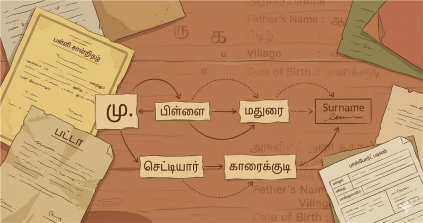
Traditional Tamil naming did not use fixed, hereditary surnames.
What you’re used to seeing now — FirstName LastName on social media, passports, HR systems — is mostly an adaptation to global bureaucracy, not a continuation of ancient Tamil practice.
If you’re serious about building a family tree, this matters. Because if you misread “surnames” in your Tamil family, you’ll:
- Merge unrelated branches
- Split real branches into fake lines
- Misinterpret caste, village, or house names as “family names” in the Western sense
This article walks through:
- How Tamil naming actually worked before Western forms
- How initials, village names, caste titles and house names were used
- How “surnames” appeared under British rule and in the diaspora
- What you should record now so future generations don’t have to guess
1. Traditional Tamil naming: initials, not surnames
The classic pattern:
R. Krishnamoorthy
S. K. Meenakshi
Where:
- The initials encode parent / ancestor / place
- The main word is the given name
1.1 Initials as compressed family history
Initials could represent:
- Father’s given name (most common)
- Grandfather’s name
- Village / house name
- Rarely, caste or title markers
Examples:
R. Krishnamoorthy– R = Ramasamy (father)T. N. Seshan– T = Thirunelveli (district), N = Narayanan (father)P. V. Narasimha Rao– P = Pamulaparti (village), V = Venkata (family line)
So the initials plus given name together formed a mini narrative:
“This is Krishnamoorthy, son of Ramasamy, from X region/family.”
There was no idea that Krishnamoorthy or Ramasamy was a hereditary family name to be carried unchanged across generations.
2. Caste titles, village names, and house names: not quite surnames
On top of initials, Tamils sometimes attached:
- Caste / community descriptors:
Pillai,Chettiar,Thevar,Mudaliar,Naidu,Gounder, etc. - Village / region-based identifiers:
Thanjavur,Kumbakonam,Jaffna,Trichy, etc. - House or clan names:
Vadakku Veedu,Thottam,Periya Veedu,Kottaiar, etc.
2.1 Caste / community labels
Names like:
Muthusamy PillaiRamanatha ChettiarSundara ThevarChidambaram Mudaliar
In many places these behaved like surnames socially, but:
- They weren’t always passed down consistently
- Some branches dropped or changed them
- Bureaucratic records sometimes truncated them
From a family-history angle, these labels are:
- Useful community signals
- Dangerous to treat as “fixed surnames” without context
2.2 Village and region markers
You’ll see people known as:
Kumbakonam SubramanianJaffna SivapalanMadurai Meenakshi
Sometimes this was:
- A way to distinguish two people with the same name
- A sign of migration (“the Subramanian from Kumbakonam” now living in Madras)
Again: helpful for locating origin, but not always stable across generations.
3. How “surnames” arrived for Tamils
Tamils did not wake up one day and decide Western-style surnames are cool.
They were forced into it by:
- Colonial registration forms
- School and college records
- Passports, visas, and modern HR systems
- Diaspora countries that refused to accept initials
3.1 British bureaucracy and the surname slot
Colonial administrators needed clean fields:
- Given name
- “Surname” or “family name”
Tamil names like R. Krishnamoorthy or K. R. Meenakshi did not fit neatly.
So local clerks improvised:
- Used the given name as surname in some cases
- Used the initial expansion (father’s name) as surname in others
- Sometimes jammed “given + caste title” into one field
This is why you see families where:
- The father is
R. Krishnamoorthy - The son becomes
K. RameshorRamesh Krishnamoorthy - The surname field flips around between generations
3.2 Diaspora pressure: Tamil meets immigration forms
In countries like the UK, US, Canada, Australia, Singapore, Malaysia, Gulf states, etc., Tamils had to:
- Provide a first name and last name
- Often avoid initials-only formats
- Accept that systems would auto-capitalise or truncate names
Common hacks:
- Father’s name as last name (
Ramasamy→Krishnamoorthy Ramasamy) - Created family surname (
Arunrajfamily, all childrenArunraj) - Origin village as surname (
Jaffna,Kandy,Madurai, etc.) - Shortened caste title as surname
From a genealogy perspective, these are new constructs, not ancient surnames. If you treat them as timeless, you’re lying to yourself.
4. Common surname patterns in modern Tamil families
If you want to decode surname history sensibly, recognise these patterns.
Pattern 1: Patronymic as surname
Child uses father’s name as surname:
Ramasamy→Krishnamoorthy Ramasamy(son)Krishnamoorthy→Anand Krishnamoorthy(grandson)
Implication:
- Surname changes each generation
- You cannot treat the surname as a stable family name
You must track:
- Person A:
Ramasamy(given) - Person B:
Krishnamoorthy, father = Ramasamy - Person C:
Anand, father = Krishnamoorthy
instead of pretending “Ramasamy family” is a fixed clan.
Pattern 2: Frozen patronymic = new hereditary surname
Sometimes a patronymic gets frozen as a stable surname:
- Ancestor:
R. Krishnamoorthy - Next generation in the West:
Meena Krishnamoorthy - All children:
Something Krishnamoorthy
Now Krishnamoorthy behaves like a Western hereditary surname. But its origin is still:
- One person’s given name, not an ancient clan label
Future generations should know that.
Pattern 3: Caste / community label becomes surname
Examples:
S. Ramachandran→Ramachandran Pillai- Children:
Naveen Pillai,Meera Pillai
Or:
R. Kandasamy Gounder→ children drop given name and keepGounder.
If you only see “Pillai” or “Gounder” as last names, you’ll miss:
- The real line of given names
- Internal sub-branch differences inside that community
Pattern 4: Village or town as surname
Examples:
Anand JaffnaMeera TrichyKavin Batticaloa
These are often diaspora coping mechanisms:
- A way to signal origin
- A neutral alternative to caste titles
- A compromise between Tamil identity and Western form
They’re not inherently wrong. Just document them honestly.
5. How to record surnames properly in a Tamil family tree
If you want to avoid future confusion, you need discipline.
5.1 Separate “full official name” from “structured components”
For each person, record:
-
Full official name as used in:
- Passport
- IC / Aadhaar / ID
- School certificates
-
Structured components:
- Given name(s)
- Father’s name
- Any initials and what they stand for
- Community / caste title (if you choose to store it)
- Village / region marker
-
Notes on naming rule:
- “Family uses father’s name as surname in passports.”
- “Surname is origin village, chosen during migration to Canada.”
- “Caste title dropped from official documents after 2000.”
That way, even if the display name is Westernised, the underlying Tamil structure is preserved.
5.2 Track name changes and variants
People will change names, especially in:
- Marriage
- Religious conversion
- Emigration / naturalisation
So you should:
- Record previous names with dates
- Note why the change happened
- Link all variants to the same person node
Example:
Meena Ramasamy→Meena Krishnamoorthy→Meena Anand(after marriage, after migration).
Store all three, don’t pretend only the latest exists.
6. Practical checklist: decoding your own family’s surname history
If you actually want to do something useful after reading this, walk through this list:
-
For each living ancestor up to grandparents / great-grandparents:
- Write their full name as they used it in their time
- Expand their initials, if any
- Note how they’re referred to in the village vs. official documents
-
For your current generation:
- List everyone’s legal full name
- Identify the pattern:
- Patronymic?
- Frozen patronymic?
- Caste title?
- Village-based?
- Brand-new family name?
-
For each household:
- Write one sentence explaining the rule:
- “We use
Arunrajas a fixed surname for all children, started by X.” - “We use father’s name as surname; it changes every generation.”
- “We use
- Write one sentence explaining the rule:
-
Store this in:
- TamizhConnect (ideal), or
- A shared document that doesn’t disappear with one phone
If you skip this, your grandchildren will be left staring at random combinations of Anand, Krishnamoorthy, Ramasamy, Pillai, Jaffna, and have no idea which part is lineage and which part is bureaucracy.
Tamil surnames are not sacred relics. They are a patchwork of:
- Initials
- Patronymics
- Caste labels
- Village names
- Anglo-Indian bureaucracy
- Diaspora hacks
If you want your family history to be more than a guessing game, stop pretending your current “LastName” is eternal truth. Document how it actually emerged, and let TamizhConnect or whatever system you use carry that reality forward.
That’s how you respect your ancestors and keep your data honest.
Not by forcing Tamil names into a Western mould and then forgetting how you did it.
Continue Your Tamil Heritage Journey
To further explore Tamil heritage and surname history, consider reading about Tamil language origins, understanding Tamil migration patterns, or collecting family history from elders. Our family tree builder includes specialized features designed to help Tamil families document their complex surname and naming patterns across generations.
For more information on Tamil genealogy, explore our guides on handling multiple name variants and understanding Tamil kinship terms.