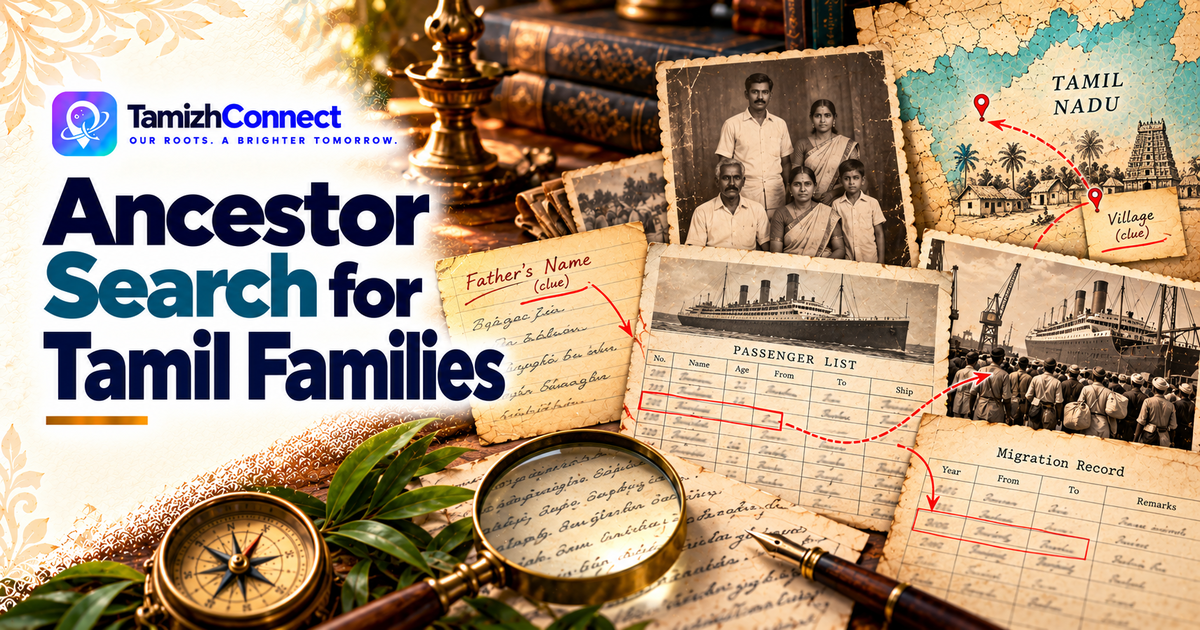
If you are searching for an ancestor online, do not rely on one spelling of one name. Tamil ancestry research works best when you combine a person’s name with father’s name, native village, district, migration route, and family memory.
Many people begin by typing an ancestor’s name into a search box. Sometimes that works. Often, for Tamil families, it does not.
The reason is simple: Tamil records were not always written for modern search engines. Names changed across languages, scripts, clerks, countries, and generations.
Why Tamil Ancestor Search Is Different
In many families, names are not fixed surnames passed unchanged for centuries. A person may be identified by:
- father’s initial
- village initial
- personal name
- caste/community context
- house name
- occupation
- temple connection
- migration record spelling
The same ancestor may appear differently in:
- family memory
- wedding invitations
- school records
- voter rolls
- ship registers
- colonial documents
- land records
- diaspora records
That is why a Tamil ancestor search must be flexible.
The Strongest Search Combination
A name alone is weak. A name plus father’s name is better. A name plus father’s name plus village is much stronger.
Try to collect:
Ancestor name + father name + village + district + approximate year
If the ancestor migrated, add:
Ship name + destination + arrival year + indenture number or estate/place clue
The more anchors you have, the less likely you are to confuse your ancestor with another person of the same name.
Search Spelling Variations
Tamil names are often written in different English forms.
For example, one name may vary because of:
- long and short vowels
- missing initials
- colonial spelling
- local pronunciation
- English clerk interpretation
- country-specific record systems
When searching, create a spelling list. Include every version you have seen in documents.
Do not assume the modern spelling is the only correct spelling.
Use Native Village as an Anchor
The native village can transform a broad search into a focused one.
Ask:
- What village did the family come from?
- Was there an older village name?
- Which district was used at the time?
- Did the district name change?
- Was the village recorded under a colonial spelling?
- Did the family remember only “Madras,” when the real village was elsewhere?
For diaspora families, “Madras” may refer to a port or presidency, not the exact ancestral village. You may need to look deeper into records.
Migration Records Can Preserve Lost Clues
For Tamil diaspora families, migration records are often crucial.
Indenture and migration records may preserve:
- ancestor name
- father’s name
- old village
- old district
- ship name
- arrival year
- indenture number
- destination country
These records can be the bridge between a family story abroad and a native village in Tamil Nadu.
Avoid False Matches
When searching online, it is tempting to accept the first matching name. Be careful.
A record is stronger when multiple clues match:
- name
- father’s name
- age or approximate year
- village
- district
- spouse or kin name
- migration destination
- oral history
If only one clue matches, treat it as a possibility, not proof.
How TamizhConnect Helps
TamizhConnect focuses on Tamil family-history patterns that generic systems may miss.
It supports research using:
- Tamil naming patterns
- father-name clues
- native villages
- Kula Deivam notes
- migration records
- family-tree collaboration
- archival clues
Start your ancestor search here: TamizhConnect
Final Thought
Finding a Tamil ancestor online is not about one perfect search.
It is a process of gathering clues, testing variations, comparing records, and confirming with family evidence.
One name can start the search. One village can focus it. One record can reconnect a family line.
Where to go next
- Tamil Ancestry: A Complete Guide — the master research method for Tamil family history.
- Tamil Nadu voter search — 50 million+ current voters indexed by village and district.
- Indenture registers — for South African, Fijian, Mauritian and Malayan diaspora branches.