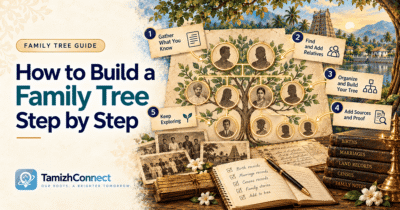
An ancestor family tree is built backwards, not forwards. You start with people you know — yourself, your parents, your grandparents — and work backwards one generation at a time until the record trail runs out. This is the opposite of how most beginners think family history works, and mistaking the direction is the main reason first-time trees fail.
This guide walks the reverse-generational method: how to work backwards from known relatives to unknown ancestors, how to time the transition from oral history to archive records, and how to know when to stop pushing further back and consolidate what you have. Written for Tamil families where the backward trail runs from destination-country records through indenture-era migration to pre-emigration Tamil Nadu village records.
Why backwards is the only workable direction
The alternative — starting with an old ancestor and working forward — sounds intuitive but fails in practice. You don’t know your ancient ancestor’s name reliably, so you can’t search for them without guessing. Any guess creates a false anchor; every generation of “descendants” built on that anchor is also mis-identified.
Working backwards, you start with what you know (yourself, your parents) and only add ancestors when evidence supports the specific parent-child link. You never guess an ancestor’s identity — you follow the record trail one link at a time. If the trail breaks, the tree stops there honestly, without pushing further back on speculation.
Step 1: Anchor at Generation 0 (yourself and siblings)
Generation 0 is you and your siblings — the “living present” of the family. Record:
- Every full name (with Tamil naming variants)
- Birth dates and places
- Current locations
- Sources: your own birth certificate, siblings’ birth certificates, personal knowledge
This anchor is the strongest evidence you’ll ever have — direct personal knowledge plus civil documents. Every other generation is verified relative to this anchor.
Step 2: Move to Generation -1 (your parents)
Your parents and their siblings. For each parent:
- Their birth certificate (or your own birth certificate, which names them)
- Their marriage certificate (which names both spouses and often both sets of parents — jumping you one generation further back)
- Their siblings’ names (from your parents’ memory or family records)
A marriage certificate is one of the highest-value documents for going backwards. It names four generation +1 people (both spouses’ parents) in a single document. If both parents’ marriage certificates are accessible, you’ve jumped to generation -2 in one step.
Step 3: Move to Generation -2 (grandparents)
Four grandparents. For each, the reverse-tracing questions:
- What was their full name (including Tamil second-name / father’s-name)?
- Where were they born? — narrow to specific village + district
- When were they born and when did they die?
- What was their occupation? — occupation clues unlock occupation-specific records
- Who was their spouse’s family? — this is your other grandmother/grandfather’s identifier
Interview your parents (or their siblings if parents deceased). Record verbatim. See our living memory guide for the interview technique.
After the interviews, cross-check with civil records:
- Grandparents’ birth certificates (post-1890 India)
- Grandparents’ marriage certificates (this is where great-grandparents get named)
- Grandparents’ death certificates (which often name parents and spouse)
Every civil record you find for a grandparent typically names 3-5 other family members (parents, siblings, spouse, children). Extract every name.
Step 4: Move to Generation -3 (great-grandparents)
Eight great-grandparents (four maternal, four paternal). This generation is where memory starts thinning and archive records become essential.
Sources typically available:
- Grandparents’ birth certificates (they named their own parents on the birth certificate)
- Grandparents’ marriage certificates (also naming both sets of great-grandparents)
- Oldest living relative’s memory (great-aunts / uncles who remembered their own grandparents)
- Family Bibles, kula deivam registers, and other family-preserved records
For diaspora families, this is often the generation where migration happened. Great-grandparents may be the emigrating ancestors — the ones on the ship manifest. That transition matters because it means you switch from post-emigration records (destination country) to pre-emigration records (India).
Step 5: Move to Generation -4 (great-great-grandparents)
For diaspora families, this is the generation that stayed in India when the emigrating ancestor left. Their records are in Tamil Nadu, not the destination country.
Where to look:
- Historical patta records at the district Collector’s office (for landholding families)
- Settlement registers from the 1880s (deepest publicly-accessible ancestor documentation for many villages)
- Temple records for the specific village (via HR&CE if state-managed)
- Church registers (CSI, RC, TELC diocesan archives) for Christian families
- Oral history from the oldest surviving family members who may remember stories about their grandparents’ parents
Many ancestor family tree projects stall at generation -4 because the paperwork requires physical archive visits. Plan accordingly — a trip to Chennai, or hiring a proxy researcher, may be the only way to get generation -4 confirmed.
Step 6: Attempt Generation -5 and beyond
Beyond generation -4, records get sparse. For most Tamil families, the deepest reachable generation is somewhere around -5 to -7, depending on:
- Whether the family had continuous land ownership (patta records reach back further for landholding families)
- Whether the family belonged to a community that kept genealogy records (some Chettiar families kept detailed lineage records for merchant purposes)
- Whether the family had temple donation records preserved (some families donated across generations and the records preserved the lineage)
Getting beyond generation -5 usually requires:
- A specific archive visit to the district Collector’s office for pre-1880s land records
- A visit to the family’s kula deivam temple to consult the temple’s own family register
- Interviews with extended-family members you haven’t yet reached (they may hold the family Bible or oral tradition that extends further back)
Knowing when to stop pushing back
Every backward-traced family tree hits a stopping point. The rule: when generation N’s evidence gets thin and generation N+1 would require pure speculation, stop.
Signs you should stop pushing:
- The most recent generation added is supported by only ONE source (thin evidence)
- The next generation would require guessing which of several same-named candidates is the ancestor
- The archive records for the next generation don’t exist for your family’s specific village
- Oral history has run out and no elders remember further back
Stopping honestly at generation -5 with a well-verified tree is better than pushing to generation -10 on unverified speculation. Descendants inheriting the verified tree can extend it further as new records surface; descendants inheriting the speculative tree have to demolish the speculation first.
The reverse-search technique for specific ancestors
When you’re stuck on identifying a specific ancestor (say a great-great-grandfather whose name is uncertain), the reverse-search method:
- Start with the confirmed ancestor one generation forward (their child, your great-grandfather)
- Extract every clue about the parent from the child’s records — parent’s name if mentioned, parent’s occupation, parent’s village, siblings’ names
- Search records that specifically capture parent-child relationships — marriage certificates, death certificates (often name parents), land inheritance records
- Cluster-search the community — who were the parent generation of the confirmed ancestor’s cohort?
Reverse-search is slower than forward-search but more disciplined. Every generation you add is supported by evidence linking it to the confirmed generation below.
Working backwards without getting lost
The temptation with a partially-built tree is to jump to a compelling but under-verified deep ancestor and try to work backwards from THEM to unknown further ancestors. Don’t. Work backwards only from confirmed anchors, one generation at a time, and only add the next generation when the evidence supports it.
An ancestor family tree built this way is smaller, slower to grow, and much more reliable than the alternative. Every ancestor on it belongs there. Future descendants can extend it in either direction (forward with new descendants, backward with new archive finds) without demolishing what’s already been built.
Backwards is the only workable direction for building a family tree. Every experienced genealogist learned this the hard way — usually after wasting months on a forward-built tree that turned out to be someone else’s family. Start with what you know, extend one generation at a time, and stop when the evidence stops.