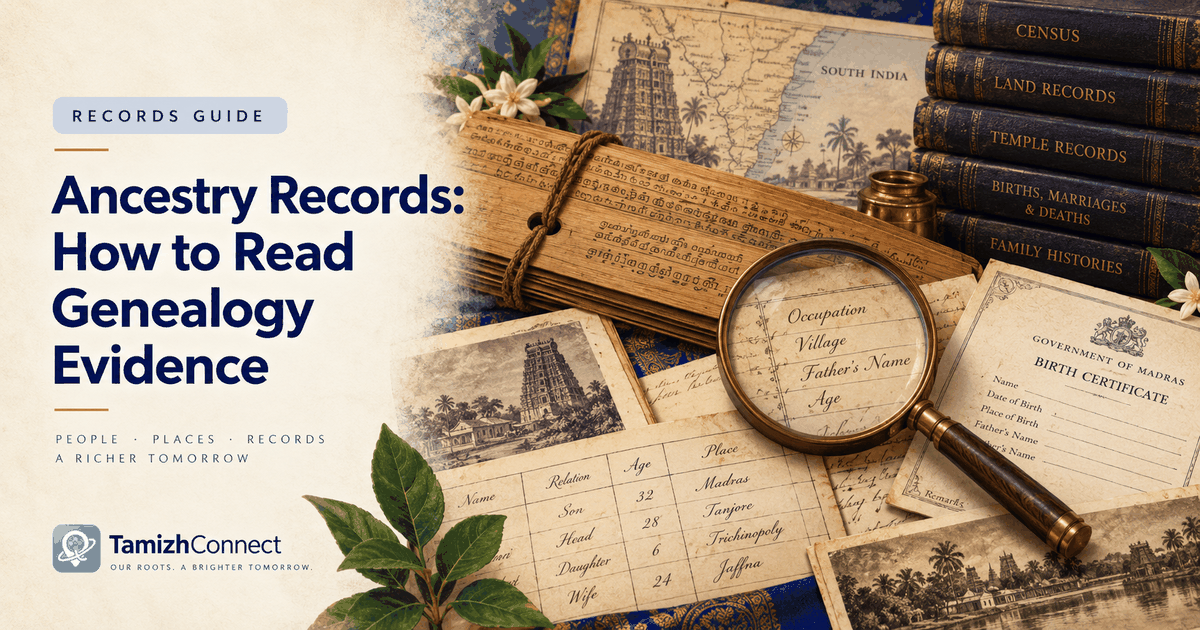
People searching for ancestry records are looking for proof. Records can be powerful, but they must be read carefully because similar names, spelling changes and missing context can easily create false matches.
What records can prove
Records may confirm a name, relationship, village, date, address, migration route or family event. Their value increases when several independent clues point to the same person.
Watch for false matches
Two people can share the same name. Clerks can misspell names. Ages may be rounded. Villages may be written using older spellings. Never rely on one field alone.
Evidence checklist
Look for name, father or spouse name, village, district, date, occupation, religion or community clue, and migration context. The more anchors match, the stronger the case.
TamizhConnect approach
Use TamizhConnect to attach records to people and explain why each source supports the family connection.
Where to go next
- Tamil Ancestry: A Complete Guide — the master research method for Tamil family history.
- Tamil Nadu voter search — 50 million+ current voters indexed by village and district.
- Indenture registers — for South African, Fijian, Mauritian and Malayan diaspora branches.