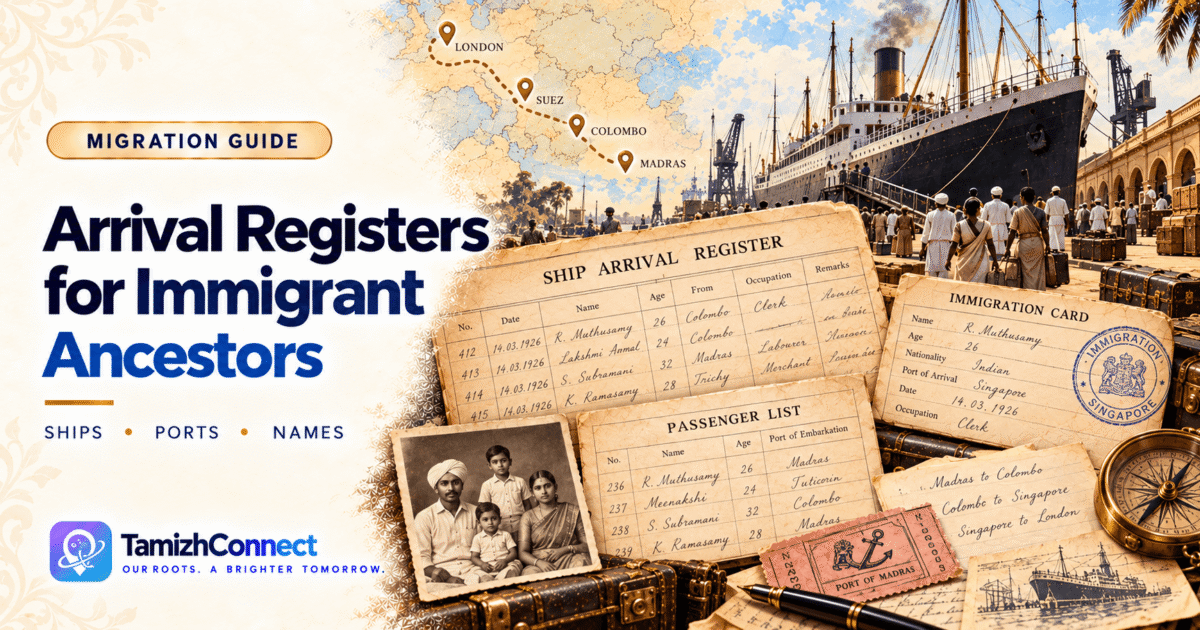
The arrival register is the single most useful piece of paper for anyone tracing an indentured labour ancestor. It was written on the day the ship docked, by a clerk sitting at a table at the depot, and it carries five or six pieces of information nothing else in the archive combines: the labourer’s name, their father’s name, native village, ship they came on, arrival date, and the estate they were assigned to. Get one of these for your family and the tree pushes back to a Tamil Nadu village in a single leap.
This guide walks the arrival registers that reach the deepest for the four largest Tamil indenture destinations — Natal, Mauritius, Fiji, and the Caribbean — and the specific pieces of information each register holds. It also names the two things that trip most people up on the first try: the spelling drift between the paper name and the family name today, and the fact that “arrival register” refers to at least three different documents held in three different archives.
What an arrival register actually looks like
Physically, most arrival registers are large bound volumes — think ledger books, roughly 40 cm tall, held together by leather spines that have often failed. Each labourer got a two-page spread. The first page carried the personal details (name, father’s name, age at emigration, height, distinguishing marks, native village and district). The second page carried the contractual details (ship name, arrival date, immigration number, estate of first assignment, contract length, five-year re-indenture option if taken).
The immigration number is the key piece of numerical data. Every labourer got one on arrival — think of it as a passport number for the indenture system. All subsequent administrative papers (estate transfers, marriage registrations, births of children on the estate, insurance claims, death notices) reference this number. If you find the immigration number, you can pull every other record in the archive that touches your ancestor.
The number scheme differed by destination. Natal’s immigration numbers ran from 1 (Vencatasawmy, arrived 1860 aboard the Truro) to about 152,000 (the last cohort in 1911). Mauritius numbers ran into the several hundred thousands because the Mauritian scheme started earlier (1834) and ran longer (until 1910). Fiji’s girmit numbers were shorter — about 60,000 across the whole 1879 to 1916 period. Trinidad, Guyana, and Suriname each had their own numbering starting from 1.
Natal (South Africa): the GLDC master registers
The Natal arrival registers are held today at the Gandhi-Luthuli Documentation Centre (GLDC) at the University of KwaZulu-Natal in Durban. They cover the full 1860 to 1911 period and are the master copy — a duplicate set was made for the Colonial Office in London and lives at the National Archives at Kew (record class CO 179 and CO 291) but the Durban copy is the one that survived best.
The Natal registers list one labourer per double-page spread with these columns: name, father’s name, age, sex, native district and village, caste (recorded as “caste” through 1870 and increasingly as “sub-caste” from the 1880s), height in feet and inches, distinguishing marks (scars, moles, tattoos), ship name, arrival date, and the immigration number. The estate of first assignment was recorded on a separate register at the Coolie Commission office and cross-referenced by immigration number.
Natal is the destination TamizhConnect indexes most deeply. If your family is South African Tamil, start at tamizhconnectblog.kinsta.cloud/indenture-search?country=south-africa and search by your surname or one of the phonetic variants. The GLDC records reach every one of the ~152,000 Natal arrivals, so if your ancestor was among them there is almost certainly a match if you spell the name right.
Mauritius: the Mahatma Gandhi Institute archive
Mauritius has the oldest, longest-running, and largest indenture archive of any destination. The arrival registers for the 1834 to 1910 period are held at the Mahatma Gandhi Institute (MGI) in Moka. Approximately 450,000 labourers passed through the Aapravasi Ghat depot at Port Louis over that seventy-six-year span.
The Mauritius registers are especially rich because the Aapravasi Ghat was designed as a scientific experiment in “free” labour immigration and the colonial administration recorded more per-person data than anywhere else. Alongside the standard name, father’s name, and native village, Mauritian arrival records often include a photograph (from about 1885 onward), fingerprint impression, medical certificate, and detailed physical description running to a full paragraph.
The MGI has digitised a substantial portion of the earliest registers and made them searchable through the Aapravasi Ghat Trust Fund’s online portal. TamizhConnect indexes the Mauritius records through the theiii.in project — search under the III provider on the indenture search page for the Madras-recruited slice (approximately 241,000 of the total).
Fiji: Suva and the girmit pass number
Fiji’s girmit contract ran from 1879 to 1916 and moved about 60,000 labourers under the CSR (Colonial Sugar Refining Company) contract. The arrival registers are held at the National Archives of Fiji in Suva, with a partial duplicate set at the Auckland War Memorial Museum library in New Zealand.
The Fiji records use a “pass number” instead of an immigration number. The pass was a paper strip carried by the labourer showing name, father’s name, native village, ship, and pass number. Many survived and are the primary evidence Indo-Fijian families have of their ancestor’s arrival. TamizhConnect’s GIRMITIYA_MADRAS provider covers the Madras-recruited slice, roughly 12,000 arrivals.
Two Fiji-specific gaps are worth naming. The 1884 Syria wrecked on Nasilai Reef and lost 59 lives; passenger list survived but many personal papers travelling with the voyage did not. Second, the CSR kept its own plantation registers separately from the government arrival records. Some CSR papers were destroyed when the mills closed in the 1970s; the survivors are split between the National Archives of Fiji and the Noel Butlin Archives Centre at the Australian National University.
The Caribbean: Guyana, Trinidad, Suriname
The Caribbean indenture destinations (British Guiana, Trinidad and Tobago, Suriname, Jamaica, Grenada, and the smaller Windward Islands) share a common pattern: arrival registers were kept at the port depot on arrival (Georgetown, Port of Spain, Paramaribo respectively) and duplicated to the Colonial Office in London.
British Guiana (now Guyana) received the largest Caribbean stream — about 239,000 Indian arrivals between 1838 and 1917, though Tamil-origin labourers were a minority (roughly 15%) compared to the Bhojpuri majority from Calcutta. The main archive is the Walter Rodney National Archives in Georgetown. The UK duplicates at The National Archives at Kew are in the CO 111 record class. TamizhConnect indexes the Kew-side records for Guyana under TNA_GUYANA.
Trinidad received roughly 143,000 Indian arrivals between 1845 and 1917. The Trinidad and Tobago National Archives (NALIS) in Port of Spain holds the arrival ledgers; Kew has duplicates in CO 295. TamizhConnect’s TNA_TRINIDAD covers the Kew-indexed subset.
Suriname is unique in this list because it was Dutch-administered. Records are in Dutch and held at the Nationaal Archief in The Hague and its Paramaribo branch. About 34,000 Indians arrived between 1873 and 1916. TamizhConnect indexes the surviving passenger lists under SURINAME_BS and SURINAME_SLAVEN (the older Dutch slave-emancipation registers that overlap with the earliest indenture period).
Reading the fields: what actually matters
Given a filled-in arrival register entry for your ancestor, the fields to weigh most heavily are these:
Native village. This is the highest-value single piece of data in the whole record because it anchors the Tamil Nadu side of the search. If the village is “Chingleput” or “Vellore” without a specific place, treat that as a district-level lead only. If it names a specific village (“Chetput”, “Wandiwash”, “Tiruvellore”), that is the anchor you can use for voter-roll lookups and modern residual-family searches today.
Father’s name. Second most valuable. Combined with the village, father’s name gives you enough to search the Tamil Nadu Electoral Commission voter rolls for present-day families of the same surname at the same village. A match doesn’t prove a shared line but it usually surfaces a living contact who knows the family history the paper archive cannot reach.
Ship name and year. These identify the specific voyage, which lets you find co-passengers. Same-voyage co-passengers were often relatives or same-village neighbours — the “cluster” of people who left together. If your ancestor’s own record is thin but their same-village same-ship co-passengers have richer records, those cousins-of-cousins records fill in the blanks.
Age at emigration. Colonial clerks were reasonably accurate about adult ages (within two or three years) but wildly inaccurate about children’s ages. Take an adult age at emigration and subtract from the arrival year to get the ancestor’s birth year within a plausible window; take a child’s age with a grain of salt.
Distinguishing marks. Rarely useful for lineage confirmation, but occasionally decisive. Family memory of a scar, tattoo, or missing finger can match a paper record and confirm the identity when name spellings otherwise diverge.
The spelling problem
The single hardest thing about using arrival registers is that the paper spelling is rarely how the family spells the name today. “Muthusamy” appears as Mutu Sami, Muddoosami, Moottoosami, Mootoosamy and a dozen other forms depending on which clerk wrote the page. “Naidoo” is the South African spelling of what was written as Naidu in India and appears in colonial records as anything from Naidoo to Naidu to Naydoo. “Ramasamy” turns up as Ramassami with a doubled S if the record went through a French-speaking clerk at Karaikal.
The practical rule for search: try three or four phonetic variants before dismissing a null result. Vowel doubling (oo for u, ee for i), aspirated-consonant drops (Th→T, Ch→C, Dh→D), and French-influenced spellings (double consonants, terminal S kept) cover most of the drift. TamizhConnect’s search internally expands your query into phonetic variants automatically, but if you’re searching a foreign archive directly you have to run the variants yourself.
What to bring to the archive
If you’re planning an in-person visit to any of the destination archives, three pieces of preparation dramatically increase your hit rate:
Bring a list of every name spelling variant your family has ever used or that you’ve come across in colonial records. Bring your best guess at the ancestor’s arrival year and ship if you have one, or an arrival decade if you don’t. Bring the district-level origin if you have it (Chingleput, North Arcot, South Arcot, Tanjore etc.) — most archives index by ship+year, not by name, so a district-level filter narrows the search enormously.
What you do not need to bring: proof of relationship, family photos, or any pre-existing tree. The archives care about the paper record they have, not your existing evidence. Any additional context you carry is useful for interpretation but is not a prerequisite to see the record.
Next step
If the ancestor is from the Natal, Mauritius, or Fiji streams, the fastest first step is a name search on the TamizhConnect indenture search. Even a partial match with the right village and a plausible ship year is usually enough to identify the correct record. If the match is on the Caribbean streams, TamizhConnect covers the Kew-side duplicates but you’ll get the deepest reading by then following up with the destination archive directly.
The village anchor point is what makes the whole exercise worth the effort. Once you have it, the search flips from “find the paper record” to “reach the living family in Tamil Nadu” — and that second search is where most descendants find the human stories that the paper never captured.