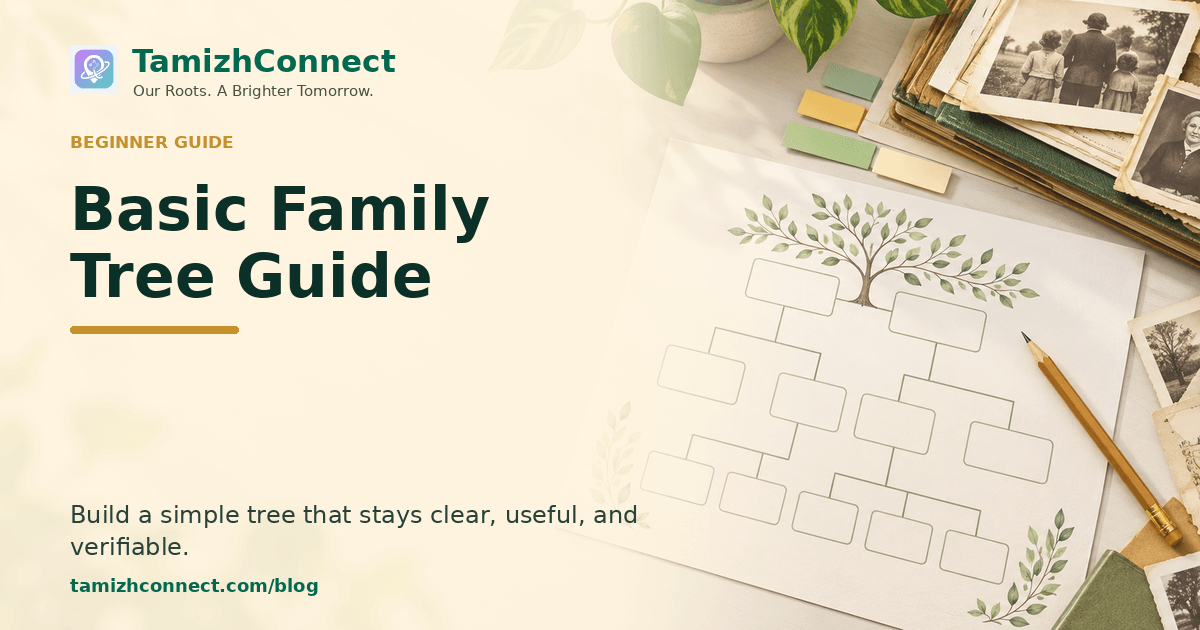
A basic family tree should be exactly what its name suggests: basic. Not comprehensive, not exhaustive, not everything-you-might-eventually-know. Basic. The point of a first family tree is to have a working structure that captures the essential facts about each person; you extend, deepen, and verify later.
Most first-time genealogists get this wrong. They start with elaborate templates asking for 20+ fields per person and stall at the second name because they don’t have most of the answers. This guide walks the specific minimum viable structure — what every Tamil family should add first — and the discipline of leaving fields blank rather than guessing.
The five essential fields per person
Every person on your basic family tree should have these five fields, and only these five to start:
- Full name — including caste title and father’s name in Tamil naming convention (Muthusamy Perumal Pillai)
- Relationship to you — grandfather, great-aunt, second cousin once removed, etc.
- Birth year or year range — exact if known, ±5 years if approximate
- Origin village / place — the more specific the better (village + taluk + district)
- Source — how you know this person exists in your family (interview with grandmother, arrival register, land document, etc.)
That’s it. Not five hundred fields. Five. If you have all five for every ancestor on the tree, you have a working Tamil family tree that can be verified, extended, and passed down.
Why blank fields are better than guessed fields
The temptation on any family tree is to fill every field, even when the answer isn’t known. Don’t. A guessed field:
- Becomes fact to future descendants who inherit the tree
- Compounds errors when used to search for related records
- Damages the credibility of correctly-filled fields
The discipline: if you don’t know, write “unknown” or leave blank. A tree with 40% of fields marked “unknown” is more useful than a tree with 100% of fields filled but 50% of them guessed. Future descendants inheriting the honest tree know exactly what to research; inheriting the guessed tree, they have to re-verify everything before they can trust any of it.
The starting point: your own generation and out
Build the tree from you outward, not from unknown ancestors backward. The order:
- You: full name, birth year, birth village, source (birth certificate).
- Your siblings: same detail.
- Your parents: same detail. Birth certificates or marriage certificates are the source.
- Your parents’ siblings (your aunts and uncles): names, rough birth years, current locations. Sources: family memory of your parents’ siblings.
- Your grandparents (all four): full names, birth year ranges, origin villages, death dates if known. Sources: family Bibles, death certificates, oral history from your parents.
- Your great-grandparents (all eight): as much as you can find. Sources: oldest living relatives, family papers.
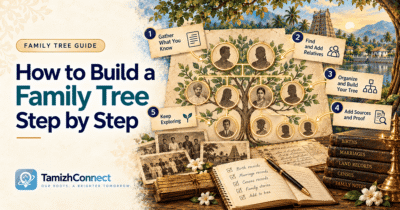
Getting through steps 1-6 with the five essential fields for each person gives you a 4-generation basic starter family tree. That’s your foundation. Everything beyond generation 4 (great-great-grandparents and earlier) comes from archive research and gets added later.
Tamil-specific naming conventions
Because Tamil names carry generational information built in (father’s name as second element), the naming field on your tree needs to capture more than just given name. For each person, record:
- Given name — what they were called in daily life (Muthusamy)
- Father’s name — the “second name” in Tamil pattern (Perumal, if father was Perumal)
- Caste title — Pillai, Chettiar, Naidu, etc. (if the family uses one)
- Christian name — for converted families, the baptismal name alongside the Tamil name (Peter Muthusamy)
- Village-plus-name form — sometimes used (Wandiwash Muthusamy)
- Nicknames or informal names — for reference (elders may know a person only by nickname)
Capturing all name variants matters because different records use different variants. If your tree only records “Muthusamy” but the arrival register indexed the ancestor as “P. Muthusamy” (initial for Perumal), searches on your tree’s name won’t find the record.
Relationships that matter for the basic tree
A basic tree captures direct-descent lines. Every person on it is your ancestor, your descendant, or one of the “collateral” relatives worth noting (siblings of ancestors, spouses of ancestors, spouses of siblings). What NOT to include in the basic tree:
- Second cousins twice removed you’ve never met
- In-laws’ extended families beyond your parents-in-law
- People from oral history whose relationship isn’t clear
- Speculative ancestors from before the earliest verified generation
You can add these later. Starting with them clutters the tree and dilutes the essential-fields-per-person discipline.
Village and place-of-origin: the field that unlocks everything
Of the five essential fields, the origin village field does the most work for Tamil family research. A specific village name unlocks:
- Voter rolls for the village (Electoral Commission)
- Land records for the village (patta.tn.gov.in and district Collector)
- Temple records (if the family had a kula deivam / village deity connection)
- Church records (if Christian, at the parish serving that village)
- Census manuscripts (Tamil Nadu Archives, where they survive)
Get the specific village name for every ancestor if possible. “Somewhere in South India” is not enough. “Wandiwash village, Vandavasi taluk, Tiruvannamalai district” is a searchable anchor for the whole family lineage.
Recording sources with each entry
Every person on your basic family tree gets a “source” field. The rule: without a source, the person is a hypothesis, not a fact. Sources fall into categories:
- Personal knowledge: “I know my parents personally” (highest confidence for immediate family only)
- Family memory: interview with grandmother, uncle’s recollection, family Bible entry
- Civil records: birth certificate, death certificate, marriage certificate, land deed
- Community records: temple donation register, church baptism register, community organisation records
- Archive records: arrival register, depot manifest, voter roll entry
- Photographic evidence: photograph with dated caption
A tree entry with two independent source types is well-verified. A tree entry with one source type is provisional. A tree entry with no source is a lead, not a person, and should be marked as such.
Software for the basic tree
You don’t need specialised software to start a basic family tree. Options in order of increasing complexity:
- Spreadsheet (Excel / Google Sheets): works for the first 20-40 people. Every row is a person; columns are the five essential fields plus any extras.
- Free tree tool (Gramps, WikiTree, MyHeritage free tier): proper family-tree visualisation and relationship links. Good for the first 100 people.
- Paid tree software (RootsMagic, Family Historian, Legacy): comprehensive research management. Overkill for a basic tree; useful when you’re past ~200 people.
- TamizhConnect’s roots-tracing tool: Tamil-specific, integrates with the indenture and voter-roll datasets so you can attach source records directly.
Start with the simplest tool that works. Upgrade only when you outgrow it.
The one-page tree test
Your basic family tree passes the “one-page” test if:
- Every person has the five essential fields filled or marked unknown
- Every relationship line is traceable to a source
- The tree fits on one A3 page or one large monitor screen at readable size
- Someone unfamiliar with your family can read the tree and understand it
If it passes, you have a foundation. Extend from there — one generation deeper, one branch wider — but only after each new person gets the same five essential fields and a source.
Basic doesn’t mean incomplete. Basic means disciplined. A basic family tree with essential fields and honest sources is more valuable than a sprawling elaborate tree with unverified guesses. Descendants inheriting the disciplined tree can build on it forever. Descendants inheriting the guessed tree have to start over.