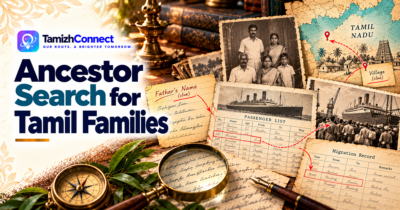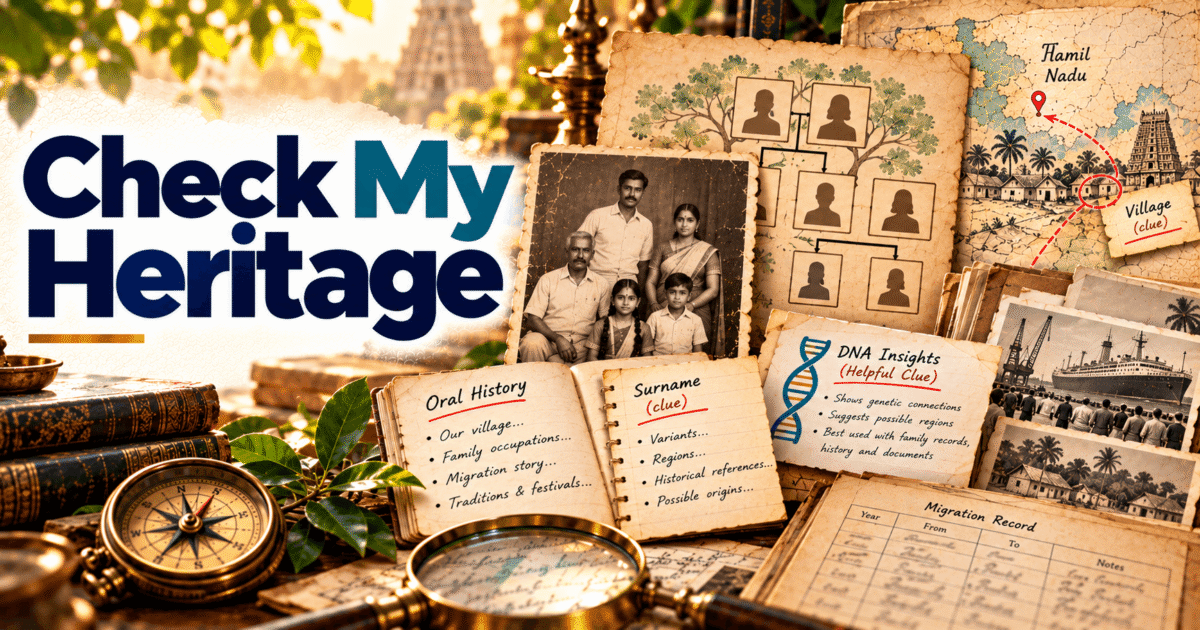
If you are searching “check my heritage,” the best place to begin is not a DNA percentage or a surname search. For Tamil families, heritage is usually anchored in names, native villages, family relationships, Kula Deivam traditions, migration stories, and documents preserved across generations.
Many people start family-history research by asking broad questions: Where did my family come from? What is my heritage? Can I trace my grandparents or great-grandparents? For Tamil families, these questions often need a different method from generic genealogy searches. Tamil identity is frequently carried through place, kinship, oral history, temple connections, and migration routes, not only through fixed surnames.
This guide explains how to check your Tamil heritage in a practical, evidence-based way.
Heritage Is More Than a Surname
In many Western genealogy systems, a surname is the main anchor. You search a surname, find a census record, and follow the line backwards. Tamil genealogy does not always work like that.
Traditional Tamil names may include:
- a father’s initial
- a village initial
- a personal name
- a patronymic pattern
- spelling variations in English records
- names written differently in migration or colonial documents
That means two people from the same family may appear with different initials, spellings, or formats across records. A family may also be known locally by a house name, a village street, a temple connection, a caste/community label, or a remembered ancestor.
So when you check your heritage, do not start with only one spelling of one name. Start with a cluster of clues.
The Four Strongest Tamil Heritage Clues
A good Tamil ancestry search usually starts with four anchors.
1. Native Village
The native village is often the strongest clue. Even when family names change, the village may remain in wedding invitations, old school records, land documents, temple receipts, or elder memory.
Ask your family:
- Which village did our grandparents come from?
- Was there an older village before the current town?
- Did the family move after marriage, work, or migration?
- Which district or taluk was mentioned by elders?
A village clue can help connect family branches that a name-only search would miss.
2. Father’s Name and Initials
Tamil records often depend heavily on father’s names. If you only know an ancestor’s personal name, the search may be too broad. If you know the father’s name, the search becomes much stronger.
Write down:
- ancestor name
- father’s name
- initials used
- possible spelling variations
- nicknames or shortened names
For example, a name that appears one way in a family memory may appear differently in voter rolls, school certificates, ship records, or migration documents.
3. Kula Deivam and Temple Clues
For many Tamil families, Kula Deivam can point to a temple, village, region, or old kinship network. It should not be treated as a magical shortcut, but it can be a powerful cultural clue.
Record:
- Kula Deivam name
- temple village
- festival or annual visit memory
- which family branch maintained the tradition
- marriage links connected to that temple
This may help identify whether two family branches share the same deeper origin.
4. Migration Route
If your family migrated, the route matters. Tamil families moved for work, marriage, colonial labour systems, education, business, and political events.
Migration clues may include:
- South Africa / Natal indenture records
- Mauritius, Fiji, Guyana, Trinidad, Suriname or Malaysia records
- Sri Lanka or Singapore family memories
- old passports, ship names, or plantation/estate names
- place names remembered as “Madras,” which may have been a port rather than the exact village
A migration record may preserve a village name that the family later forgot.
Documents That Can Help You Check Heritage
Do not wait until you find an official archive. Many families already have useful evidence at home.
Look for:
- wedding invitations
- death notices
- old school certificates
- ration cards
- voter IDs or voter roll entries
- land documents
- temple receipts
- old photographs with names written behind them
- letters from relatives abroad
- passports or travel documents
- family WhatsApp messages containing elder memories
Wedding invitations are especially useful because they often mention parents, native places, titles, family branches, and marriage alliances.
Why DNA Is Not Enough
DNA tests may tell you broad ancestry regions, but they usually cannot tell you your exact Tamil Nadu village, your great-grandfather’s name, or which family line connects to a particular temple.
For Tamil heritage, the better first step is:
Names + villages + documents + elder memory + archival records
DNA can sometimes support research, but documentary and family evidence should carry the main work.
How TamizhConnect Helps
TamizhConnect is built specifically around Tamil family history. It helps families preserve names, relationships, villages, migration clues, and family stories in a way that understands Tamil naming and kinship patterns.
You can use TamizhConnect to:
- start a private family tree
- record Tamil relationships accurately
- add native village and Kula Deivam clues
- search relevant ancestry records where available
- preserve family evidence and memories
- connect migration clues back to Tamil Nadu villages
Start here: TamizhConnect
A Simple Beginner Plan
If you want to check your heritage this week, do this:
- Write down your parents and grandparents.
- Add every village name you know.
- Ask one elder about the oldest remembered ancestor.
- Search for wedding invitations and old certificates.
- Record Kula Deivam and temple clues.
- Keep every spelling variation.
- Build a private tree before searching public records.
Do not try to jump straight to ancient history. Build from the known to the unknown.
Final Thought
Checking your heritage is not about proving a grand claim. It is about preserving the chain of memory before it breaks.
Start with one name. Ask one elder. Find one village. Save one document.
That may be enough to begin your Tamil family-history journey.
Where to go next
- Tamil Ancestry: A Complete Guide — the master research method for Tamil family history.
- Tamil Nadu voter search — 50 million+ current voters indexed by village and district.
- Indenture registers — for South African, Fijian, Mauritian and Malayan diaspora branches.