Most amateur genealogy stalls at the same point: the direct-ancestor search runs out of records. You’ve found your great-great-grandfather in the indenture arrival register, you’ve read his father’s name off the ship manifest, and now the trail ends. Every subsequent search for the pre-emigration generation returns nothing. The temptation is to conclude that the record just doesn’t exist.
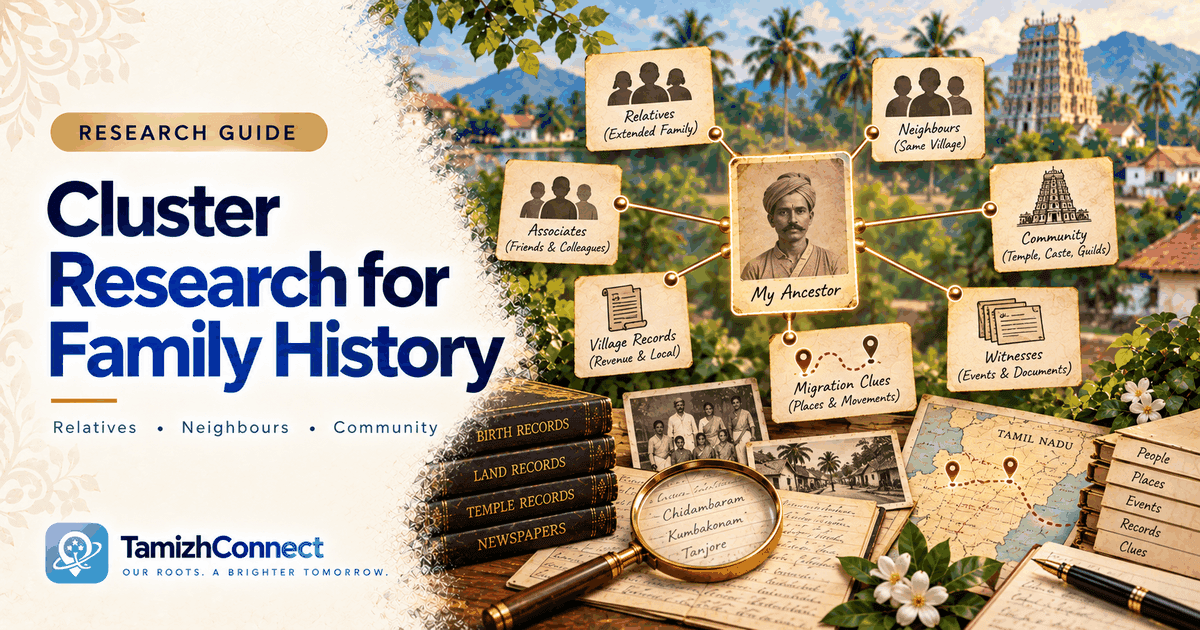
Cluster research is the professional-genealogist technique that gets past this wall. Instead of searching only for the direct ancestor, you study the community of people who surrounded them — the co-passengers on their ship, the same-village emigrants who arrived nearby, the estate-assignment cohort they worked with, the witnesses who signed their marriage certificate. These “cluster members” often have richer paper trails than the direct ancestor, and their records name your ancestor as a related party.
This guide walks the cluster research technique specifically for Tamil indenture ancestry — where the natural cluster structures (ship, village, estate) map onto record classes that make cluster identification tractable.
Why direct-ancestor search hits a wall
Colonial-era record-keeping was asymmetric. The colonial administrator cared about the labourer’s contract, arrival, and legal status; the labourer’s personal biography (parents, siblings, birth village) was recorded only at the moment of registration and often only partially. Once the labourer was on-estate, the paper trail became about employment, health, and death — not about family structure back home.
This means direct-ancestor search reaches a hard limit at the arrival register in most cases. To go earlier — to identify parents’ generation, siblings, home village context — requires records that were created for someone else and happen to name your ancestor as a family member or associate.
Cluster research identifies those “someone elses” systematically. The key insight: colonial emigration was overwhelmingly a group phenomenon. Labourers who ended up on the same ship, at the same estate, and eventually married into the same community usually came from an overlapping set of villages and social networks. Reconstruct the cluster and the group biography fills in details no single record captured.
The four cluster types for Tamil indenture research
1. Same-ship cluster. Everyone who sailed with your ancestor on a specific voyage. Ships carried 400-700 labourers each, and colonial-era ship manifests list every passenger. Same-ship co-passengers were often related, from the same village, or from the same recruitment sweep by the same depot agent.
2. Same-village cluster. Every labourer whose native-village field in the arrival register matches your ancestor’s. Same-village emigrants across multiple ships and years frequently share extended-family relationships (uncles, cousins, in-laws) that no single arrival register makes explicit.
3. Same-estate cluster. Every labourer assigned to your ancestor’s estate of first work. Estate assignment was somewhat random — the estate needed X labourers for the season and took the next X off the depot list — but same-estate cohorts often married into each other’s families and their descendants’ records reference each other frequently.
4. Ritual-community cluster. The people who witnessed your ancestor’s marriage, appeared as sponsors at their children’s baptisms, or co-founded temples/mosques with them in the destination community. Ritual-community bonds crossed ship and village lines and often reflected pre-emigration extended-family or caste ties.
Building the cluster: the practical workflow
The workflow that produces reliable clusters:
Step 1: Anchor on the ancestor. Confirm the direct-ancestor arrival record from the destination archive. Extract the ship, arrival year, immigration number, native district, and native village.
Step 2: List all co-passengers on the same voyage. Most arrival registers list arrivals in immigration-number order, with each voyage’s cohort contiguous. Pull the fifty to a hundred entries immediately before and after your ancestor’s — those are the same-voyage co-passengers. TamizhConnect’s indenture search lets you filter by ship + year to see the full voyage manifest.
Step 3: Filter co-passengers by native village. From the same-voyage list, isolate the passengers whose native village matches your ancestor’s. This subset is your highest-value cluster — same voyage AND same village strongly suggests either family or immediate-neighbour relationship.
Step 4: Widen to same-village across all voyages. Search the arrival register for every labourer with the same native village, regardless of ship. Same village + different ship = same extended family or same village at different points in a recruitment cycle. These are your extended-cousin network at various removes.
Step 5: Cross-reference destination-side records. For each cluster member, check whether they appear in destination-country marriage certificates, estate registers, or naturalisation records. Read those records for mentions of your direct ancestor.
What clusters actually reveal
A well-built cluster typically surfaces three classes of information the direct-ancestor search missed:
Sibling identification. Direct ancestors’ siblings are rarely named on the ancestor’s own record. But a cluster member arriving two years later on a different ship, from the same village, with the same father’s name, is almost certainly a sibling. Building the sibling set at the emigrant generation opens up the pre-emigration search — because the parents’ name(s) are now confirmed by multiple independent records.
Extended-family confirmation. If three same-village emigrants over ten years all name variations of “Muthusamy” as their father, that name is confirmed as a village-common patriarch — likely a shared grandfather rather than three unrelated Muthusamys. Extended-family confirmation lets you draw generation-level lineage inferences the direct ancestor’s record alone can’t support.
Marriage-network reconstruction. Same-village AND same-estate clusters often intermarried in the destination community. Marriage certificates from Natal, Fiji, and Mauritius often name the bride’s and groom’s fathers — reconstructing which cluster members married each other’s daughters reveals the pre-emigration social structure that clerks never wrote down.
The specific power for Tamil indenture research
Tamil indenture ancestry is exceptionally amenable to cluster research because of two structural features:
Village-of-origin field. Every Natal and Fiji arrival register has a “native village” column that most other Indian emigration records don’t have. This means you can build a same-village cluster with high confidence — the paper record explicitly ties emigrants to a specific origin village.
Recruitment-agent clustering. The Madras depot recruited through a network of agents (called arkatis), each of whom worked a specific set of villages. Same-village emigrants who arrived within a few months of each other were almost certainly recruited by the same agent’s sweep. Recruitment records at the Madras depot (partially surviving at the Tamil Nadu Archives) name the agents; matching the agent to the emigrants’ village + year identifies the recruitment moment and gives you cluster membership beyond just the arrival record.
Two failure modes worth naming
Confusing common names for lineage. “Muthusamy son of Ramasamy” appears dozens of times in a large village’s records. Not every Ramasamy who fathered a Muthusamy is your ancestor’s grandfather. Cluster research must use multiple confirmation signals (same village + same generation + same ship cohort + same religious community) before treating two records as the same lineage. A single-signal match on a common name is not enough.
Reading the modern surname back into the colonial record. A modern family named “Naidoo” may have descended from a colonial-era arrival named “Naidu” — but not every “Naidu” in the arrival register is a Naidoo family in South Africa today. Cluster research must be careful to distinguish “shares a surname” from “shares a lineage”. The surname is one signal; village + generation + community are the confirming signals.
The tools cluster research needs
Cluster research at scale is impractical on pencil and paper. Two categories of tools help:
Cluster-search interfaces. TamizhConnect’s indenture search filters by ship + year, village, and provider simultaneously — the exact combination cluster research needs. Search results also link to individual arrival trees at tamizhconnectblog.kinsta.cloud/roots where each ancestor page names their estate-cluster kin and same-village kin explicitly. The same-village-others and same-ship-others panels on those pages are cluster-research shortcuts.
Spreadsheet tracking. As the cluster grows past ten members, spreadsheet tracking becomes essential. Columns: name (as written on the arrival register), name (modern spelling), immigration number, ship, arrival year, native village, native district, father’s name (as written), estate of first assignment, and a notes column for observed cross-references. A cluster of 30-50 people with this data captured is enough to reconstruct significant generational structure.
How long does it take?
Cluster research pays off on a slower timeline than direct-ancestor search — expect weeks or months of accumulated work rather than days. But it’s the only technique that reliably breaks through the pre-emigration wall for Tamil families. Amateur genealogists who try cluster research usually find that after two months of consistent work on a single village-of-origin cluster, they’ve identified two or three generations of extended family that direct-search alone would never have surfaced.
The technique is genuinely additive: every cluster member added to the reconstruction increases the confidence and depth of the whole. Twenty confirmed same-village emigrants gives you a village-scale social history no single arrival record could sketch. Forty gives you the beginning of a genealogical map of the extended family the emigrants left behind.
For families whose direct ancestor search has already stalled, cluster research is the highest-leverage next step. It replaces the “find one more record about my great-grandfather” search — which has a 20% hit rate at best after the arrival register is exhausted — with a “find one more record about anyone in my great-grandfather’s village-and-voyage cluster” search, which has a much higher hit rate and yields the same lineage information via a different route.
The paper trail was written for the coloniser’s purposes, not the researcher’s. Cluster research works with the grain of that paper trail rather than against it, and unlocks the family history the direct-ancestor search alone cannot reach.