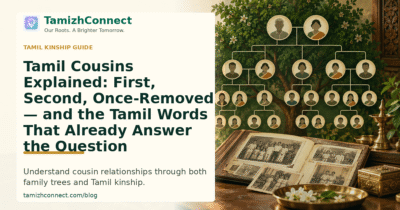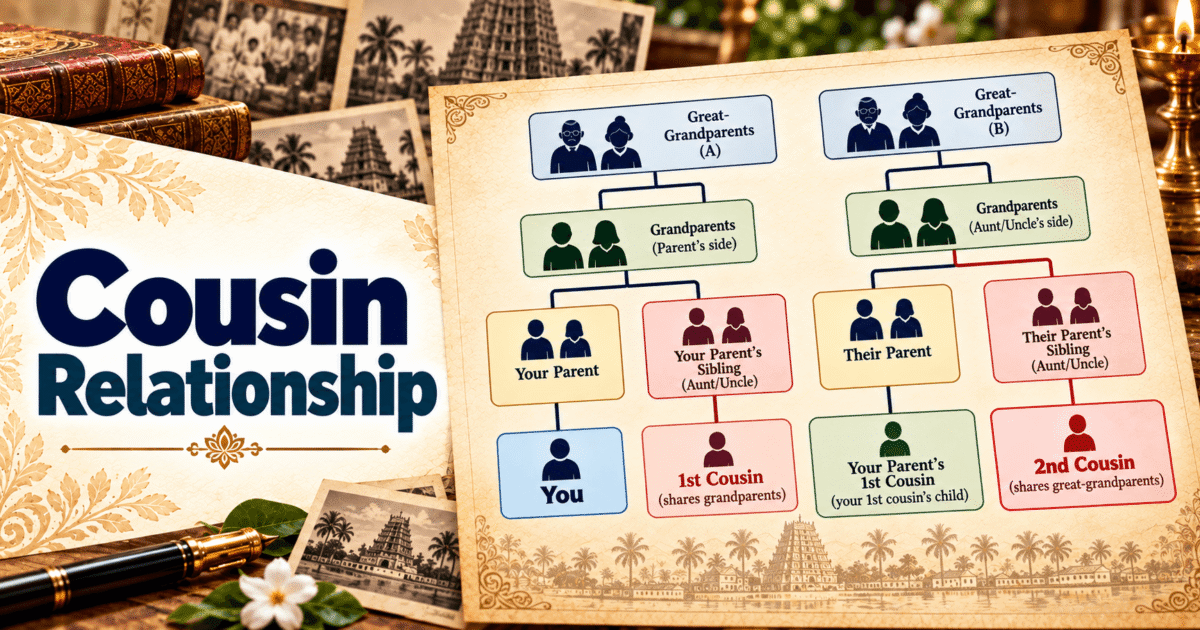
Cousin Relationship: How to Understand Family Tree Connections is one of the questions people ask when a family tree starts to grow beyond parents, grandparents and direct ancestors. The term can feel simple in English, but Tamil families often describe relationships with more precision than generic genealogy charts.
In Tamil families, a cousin may be remembered through the parental side, elder/younger distinction, marriage route, or household relationship. That is why it is useful to understand the English genealogy term, but also record the Tamil relationship term your family actually uses.
The basic rule
A cousin relationship depends on two things:
- the nearest common ancestor you both share
- how many generations each person is from that ancestor
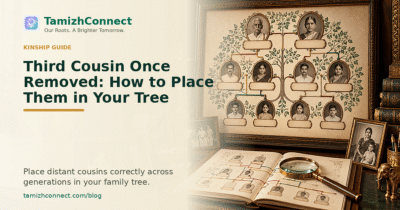
A second cousin usually means you and the other person share the same great-grandparents, but not the same grandparents. A cousin once removed means there is a one-generation difference between the two people.
Why this matters for Tamil genealogy
Tamil family history often includes many relatives described as annan, akka, mama, athai, periyappa, chithappa, chithi or periyamma. These words may describe both affection and structure. When you convert everything into English, important detail can disappear.
A good Tamil family tree should keep both layers:
- the formal genealogy relationship
- the Tamil relationship term used inside the family
Practical method
When adding a cousin to your tree, write down:
- their full name as remembered
- their parents’ names
- which grandparent or great-grandparent connects both sides
- the Tamil relationship term used at home
- whether the connection is by birth, marriage or adoption
- the village, street or family house connected to that branch
Common mistake
Do not assume that every person called cousin is the same kind of cousin. In many Tamil families, close community relatives and marriage relatives may be spoken of like family even when the biological link is distant.
TamizhConnect angle
TamizhConnect is useful because Tamil family trees need more than Western relationship labels. A tree should preserve the structure of the relationship and the cultural term used by the family. That makes the tree easier for elders to verify and easier for younger generations to understand.
Where to go next
- Tamil Naming System Explained — the initials + patronymic convention that changes how Tamil cousin relationships get recorded.
- Build your Tamil family tree — preserve Tamil relationship terms (periyappa, chithappa, athai, mama) alongside genealogy labels.
- Tamil Ancestry: A Complete Guide — the master research method.