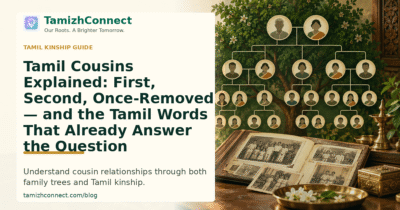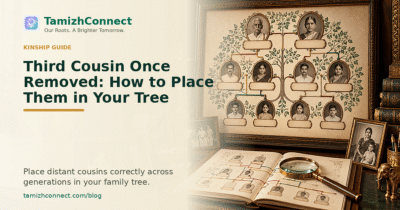
Understand cousin twice removed relationships and how to record them without confusion in a family tree. Cousin relationships confuse many people because the words sound simple but the generations matter. A clear family tree makes the relationship easy to understand.
What this search usually means
When someone searches for "What Does Cousin Twice Removed Mean? A Clear Family Tree Guide", they are usually trying to answer a personal question: where did my family come from, who belongs in my tree, and which records can prove the connection?
For Tamil families, the answer is rarely found from one field alone. A name, surname or record match becomes meaningful only when it is connected to the right person, village, generation and family context.
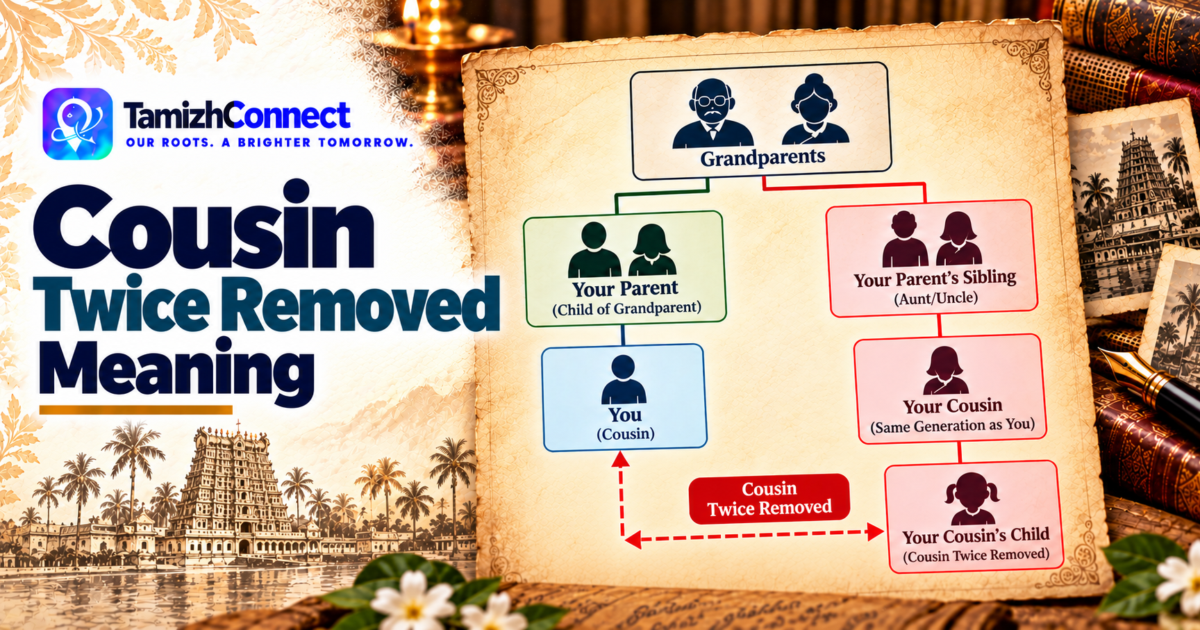
What "twice removed" actually means
"Removed" describes the number of generations separating two people within a cousin relationship. Not the closeness of the connection — just the generational gap.
- Once removed = one generation apart
- Twice removed = two generations apart
- Three times removed = three generations apart
"Twice removed" can attach to any cousin degree: first cousin twice removed, second cousin twice removed, third cousin twice removed. The degree tells you which shared ancestor the relationship traces back to; "twice removed" only says the two people are two generations apart within that line.
Concrete examples of "twice removed"
- First cousin twice removed: your grandparent’s first cousin (or your first cousin’s grandchild). Shared ancestor is a great-great-grandparent on one side, grandparent on the other.
- Second cousin twice removed: your grandparent’s second cousin (or your second cousin’s grandchild). Shared ancestor is a great-great-great-grandparent on one side, great-grandparent on the other.
Practical way to figure it out
- Find the shared ancestor — the closest person both of you descend from.
- Count how many generations from the shared ancestor down to you (your grandparent = 2, great-grandparent = 3, etc.).
- Count how many generations from the shared ancestor down to the other person.
- The smaller number tells you the cousin degree (2 = first cousin, 3 = second cousin, 4 = third cousin).
- The difference between the two counts tells you how many times "removed" (0 = same generation, 1 = once, 2 = twice).
Tamil family trees need both systems
Tamil relationship terms are culturally rich, but formal genealogy terms help when comparing records or sharing trees internationally. Keep both where possible.
How TamizhConnect fits in
TamizhConnect is designed for Tamil family history rather than generic surname-only genealogy. It helps families keep private trees, preserve Tamil relationships, record native villages, track family notes and search Tamil-specific clues.
Use it as a workspace, not as a shortcut. Add what your family knows first, then compare records carefully.
Privacy note
Do not publish living relatives’ phone numbers, exact addresses, ID details or private family disputes in public places. Keep sensitive information inside a private tree or submit it only where there is a clear reason and consent.
Family history should reconnect people without exposing them.
Final thought
Tamil family history should be built carefully. Start with what your family knows, keep private information protected, and treat every record as a clue until the wider evidence supports it.
One name can lead to one village. One village can lead to one family line. One family line can help preserve a story that might otherwise disappear.
Where to go next
- Tamil Naming System Explained — the initials + patronymic convention that changes how Tamil cousin relationships get recorded.
- Build your Tamil family tree — preserve Tamil relationship terms (periyappa, chithappa, athai, mama) alongside genealogy labels.
- Tamil Ancestry: A Complete Guide — the master research method.