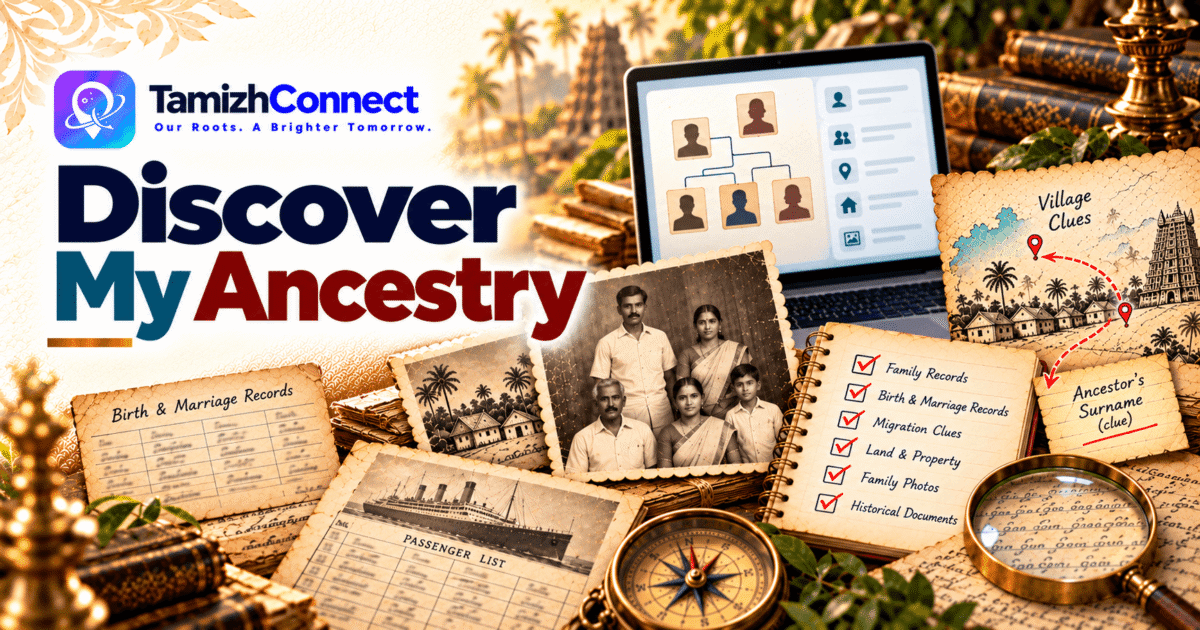
“How do I discover my ancestry?” is one of the most common family history search queries. The most-clicked answers usually recommend a DNA test as the first step. DNA is useful eventually, but as a starting point it’s the wrong order — DNA tells you about deep-ancestry ratios (percentage regional breakdowns) but very little about specific ancestors, their names, or where they lived. To discover ancestry meaningfully, you need records.
This guide walks the records-first approach to ancestry discovery: what record types exist, which to consult in which order, what each type can and can’t prove, and how to build a working ancestry search records workflow that actually surfaces named people rather than statistical ratios. Written for Tamil family history, where the record trail runs across India + one or more diaspora destination countries.
Why records-first beats DNA-first
A DNA test result telling you “34% South Indian, 22% Sinhalese, 18% British Isles” is genuinely interesting but doesn’t help you name your great-grandfather. Named-ancestor discovery needs written records — birth registers, arrival lists, temple donations, voter rolls, and so on — that connect a specific person to a specific place at a specific date.
The right sequencing:
- Start with living-memory records (family papers, photographs, letters, oral history)
- Move to civil registration and community records (birth/marriage/death certificates, church/temple registers, school records)
- Extend into public archive records (voter rolls, arrival registers, land records)
- Add DNA later to verify hypotheses or find distant cousins whose family history intersects yours
DNA works well as a verification layer once you have a hypothesis. As a first step it just gives numbers, and numbers alone don’t populate a family tree.
The Tamil-family record classes worth searching
Vital records (birth, marriage, death)
Civil registration for Indian subjects in the Madras Presidency became consistent in the 1890s. Post-1890 births, marriages and deaths for Tamil families were increasingly registered at district or municipal offices. Pre-1890 vital records mostly survive through community registers rather than civil ones — church baptism / marriage / burial registers for Christians, temple records for Hindus, community organisation records for specific caste groups.
Where to look: district Registrar of Births and Deaths offices in Tamil Nadu (holding physical registers), the Tamil Nadu State Archives at Egmore for older/consolidated records, and CSI / Roman Catholic / TELC diocesan archives for Christian-community vital records. Destination-country civil registration for post-emigration life events is at the equivalent national registry.
Migration records
For Tamil families with a diaspora connection, migration records are usually the highest-density record class. The classes to consult, ranked by information depth:
- Depot manifests — Madras Emigration Depot at Royapuram (records at Tamil Nadu Archives + India Office Records at British Library), Karaikal Depot (Archives Nationales d’Outre-Mer, France). The most detailed pre-departure record: name, father’s name, village, district, caste, age, next-of-kin, ship of departure.
- Arrival landing lists — held at each destination country’s national archive (NARSSA/GLDC for South Africa, MGI/Aapravasi Ghat for Mauritius, NAFI for Fiji, NALIS for Trinidad, Walter Rodney Archives for Guyana, Nationaal Archief for Suriname). Names, estate assignments, health status.
- Naturalisation records — for descendants who later became citizens of destination countries. Contain rich biographical narratives, references, and family details.
- Passport applications — for post-1917 migration between countries.
Census records
Tamil Nadu was covered by the British Indian censuses of 1871, 1881, 1891, 1901, 1911, 1921, 1931 (partly), and the post-independence censuses from 1951 onward. Pre-1971 censuses did not systematically publish named-individual data — mostly aggregate community statistics. But surviving village-level census manuscripts (where they exist at Tamil Nadu Archives) can name households.
Destination-country censuses (South Africa, UK, Australia, Canada, US) publish named-individual data from ~30-100 years ago depending on the country’s release rules. UK census 1841-1921 covers Tamil ayahs, seamen, and servants of British-Indian families who came to Britain.
Community records
Under-searched but often more detailed than civil records for pre-1890 Tamil ancestors:
- Temple records — kula deivam (family deity) registers, donation deeds, festival contribution lists. Held at the temple itself; sometimes at Hindu Religious & Charitable Endowments (HR&CE) if the temple is state-managed.
- Church registers — baptism, confirmation, communion, marriage, burial for Christian families. CSI, RC, TELC, Basel Mission diocesan archives.
- Caste organisation records — some communities kept genealogy registers (e.g. Nadar Mahajana Sangam records for the Nadar community). Access varies.
Land records
Tamil Nadu keeps some of the deepest land-ownership records in South Asia. Patta (ownership documents), chitta (individual land summary), adangal (village land register), and settlement registers (1880s baseline). Publicly accessible at patta.tn.gov.in for current records; historical records at district Collector’s offices and Tamil Nadu Archives.
Land records document the pre-emigration family in a way arrival records can’t — they name the ancestor’s parent, grandparent, sometimes great-grandparent, all as owners of the same plot across generations.
Employment / plantation records
For Tamil ancestors employed by British-era companies, plantation employers, or the colonial civil service, employment records survive at company / employer archives. Notable: the CSR (Colonial Sugar Refining Company) records for Fiji at the Noel Butlin Archives Centre, Canberra; the East India Company records at British Library; various Kew records for colonial civil-service employees.
Building the records-first workflow
The systematic approach:
- Interview living relatives. Names, villages, migration stories, family papers. This is the free, high-density first step most searchers skip.
- Scan and inventory family papers. Any funeral card, letter, land deed, photograph with writing on the back, official certificate, or old passport is potentially the missing link.
- Search the destination-country arrival record. For diaspora families, this typically surfaces first — Google-searchable through many national archive portals.
- Cross-reference to the departure record. Depot manifest at Chennai or Karaikal for the same voyage.
- Extend to the pre-emigration village record. Voter roll, patta, temple record for the origin village.
- Add community/religious records for pre-1890s ancestors that vital records can’t reach.
- Verify with a second independent source for each ancestor claim (see the three-source rule).
Each step builds on the previous. Skipping steps creates gaps that harder-to-verify records (or DNA) can’t reliably fill.
Common ancestry-discovery mistakes
Five patterns that stall records-first ancestry searches:
- Starting with DNA. Get a % breakdown but no names, and lose motivation.
- Accepting the first match. A common Tamil name returns three candidates; the researcher picks the first plausible one and builds their tree on it. Verification later fails.
- Ignoring living family. The details that unlock 200 years of records are often in a great-aunt’s memory that no online record captures.
- Trusting a modern spelling. Colonial records used phonetic transliterations; searching only the modern spelling misses most of the trail.
- Never leaving the internet. The majority of Tamil ancestry records are physical, held at Chennai / London / Aix-en-Provence / Kew / Canberra archives. A research visit (or a paid proxy researcher) is often the final step.
What each record can and can’t prove
Records vary in evidentiary weight. A birth certificate proves birth. A death certificate proves death. A ship’s manifest proves the voyage. A photograph proves nothing without context but suggests a lot. A DNA test proves biological relationship without proving specific ancestors.
The verified family tree treats records honestly: each ancestor claim is annotated with the specific source(s) that support it, and how confident the researcher is in the identification. A tree that mixes proven, probable, and speculative ancestors without noting the difference misleads future descendants.
Records-first ancestry discovery is slower than DNA-first. It’s also more informative. For descendants who want to actually meet their ancestors — see their names, know where they lived, understand what they did — records are the only path.