The emigration depot is the missing link in most indenture-era genealogy. Descendants know the ancestor arrived — the destination archive holds the arrival record. Descendants sometimes know the ancestor’s origin village — from oral history or from the arrival record’s origin field. But the two to six weeks the ancestor spent between leaving their village and boarding the ship are usually a research blank. That blank is where the emigration depot sits, and the records generated there are among the most informationally dense documents in the whole system.
This guide walks the depot as institution, the specific records depots generated, and how to work with the surviving deposits. It focuses on the Madras and Karaikal depots that processed most Tamil emigrants, with notes on the Calcutta depot (which handled a smaller but significant Tamil flow) and the smaller regional depots that fed into the main ports.
What the depot was and did
The emigration depot was a purpose-built compound near the port of embarkation. It served three institutional functions: assembling labourers into ship-sized cohorts, medically screening them before boarding, and generating the administrative paperwork the colonial state required for indentured labour movement.
The Madras Emigration Depot at Royapuram (near modern Chennai’s harbour) processed the largest volume — over five hundred thousand Tamil emigrants across the seventy-year indenture era. Karaikal, the French Tamil port, processed a smaller but distinctive stream to French destinations. Nagapattinam had a smaller Madras-Presidency depot for South Arcot recruits.
Time at the depot varied. A labourer arriving in late September for a ship departing mid-October might spend two to three weeks in the depot. One arriving early after a slow recruiting season might wait six weeks or more for the next ship. During this time the depot held them in dormitory accommodation, fed them at government expense, gave them a first medical inspection, and generated the documents that would follow them across the ocean and into the plantation system.
The specific records the depot generated
Depots produced several distinct record classes, each surviving in different archives today:
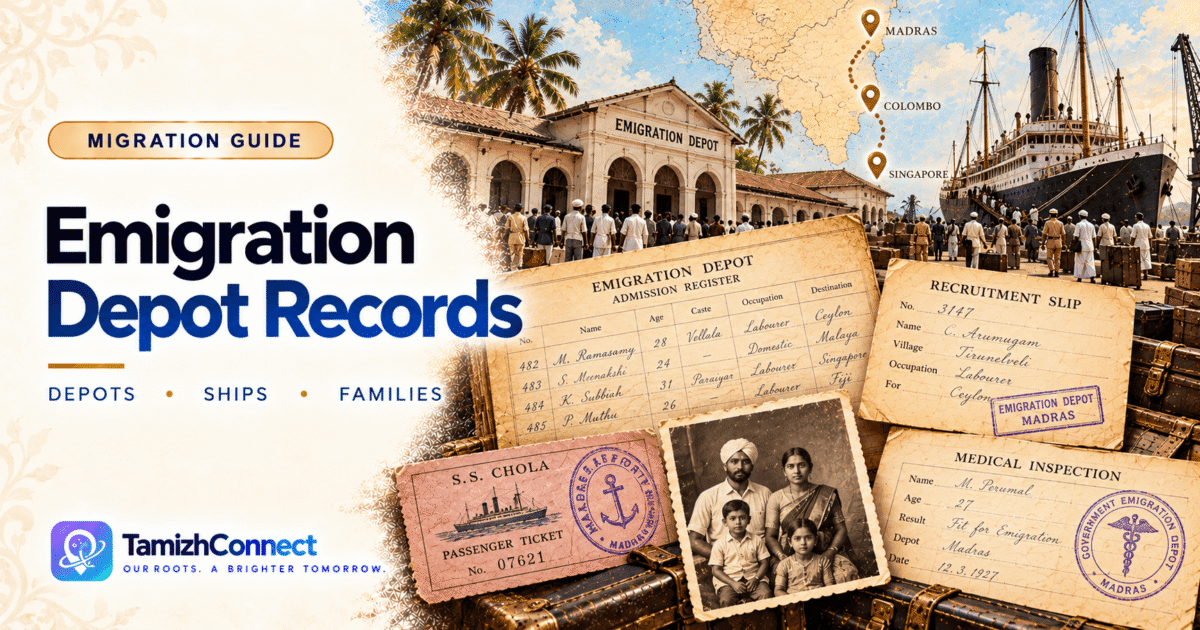
Emigration Pass (individual document, issued to labourer). The single most important pre-embarkation document. A physical paper pass carrying the labourer’s name, immigration number, physical description, next-of-kin, destination, and ship. The labourer carried this pass onto the ship and, in some destinations, retained it as their identity document for years after arrival. Very few original passes survive (they were paper, held by illiterate labourers, in tropical conditions) but the pass’s information was duplicated in every subsequent record.
Depot Register (bound register, kept by depot). The depot’s own log of every labourer who passed through. Chronologically organised by admission date. Records the labourer’s arrival at depot, medical inspection, ship assignment, and departure. Duplicates the pass information plus records the labourer’s location within the depot’s dormitory system.
Medical Inspection Register (bound register). Medical officer’s assessment at admission and again pre-embarkation. Records height, weight, vaccination status, apparent age, general fitness verdict, and any noted conditions (bad teeth, healed scars, minor skin conditions). Rejections at this stage — for tuberculosis, advanced age, or apparent frailty — were documented and the labourer sent home.
Ship Manifest Preparation Sheets. The document that becomes the depot ship manifest once departures are finalised. Compiled from the depot register in the week before ship departure.
Recruit Origin Registers. Some depots kept a separate log of where each labourer came from and which recruiter delivered them. This log is administratively valuable because it identifies specific recruiters (individual named men who worked as sub-agents in villages) and shows which villages produced clusters of labourers together.
Depot Correspondence Files. The depot’s outgoing and incoming correspondence with recruiters, ship captains, the Emigration Agent’s office, and the government. Contains complaints, disputes, refunds for rejected labourers, and inspection reports.
Where depot records survive
Madras Depot at Royapuram. The primary deposit is at the Tamil Nadu State Archives at Egmore, Chennai. Coverage runs from about 1855 through the end of indenture in 1917, with the strongest holdings for 1875-1910. Records are catalogued under “Emigration” and “Public Works” record classes. Requires an in-person visit or a proxy researcher.
The India Office Records at the British Library hold duplicates of the depot’s outgoing correspondence to London, some ship manifest preparation sheets, and the Emigration Agent’s summary reports. These are digitised through the British Library’s Endangered Archives Programme for parts of the period. IOR class L/PJ (Public and Judicial) and L/AG (Accountant General) are the relevant classes.
The National Archives of India in Delhi hold administrative summaries and inspection reports at the government-wide level. Less useful for individual labourer research but valuable for understanding the depot’s operations in a given year.
Karaikal Depot. The primary deposit is at the Archives Nationales d’Outre-Mer (ANOM) in Aix-en-Provence, France. French-language records, well-catalogued, some digitised through the ANOM online portal. Coverage runs from 1859 to about 1885. Requires French-language capacity.
Calcutta Depot (Bhawanipore). Records at the West Bengal State Archives in Kolkata. Handled predominantly Bihari and Bengali labourers but also processed Tamil recruits who travelled north to Calcutta for northern-route destinations (Fiji particularly).
Nagapattinam depot. Smaller regional records at the Tamil Nadu Archives, largely under Madras Presidency administrative files.
Using depot records for family research
Depot records answer specific questions that no other record class answers well:
Who exactly recruited my ancestor? The depot’s recruit origin register names the specific sub-agent who brought the labourer to the depot. If that sub-agent recruited from a specific village or district, your ancestor was likely from that area. This can narrow “somewhere in Madras Presidency” (the vague field on many arrival records) to a specific village cluster.
Did my ancestor arrive with others? Sequential depot admission numbers (labourers assigned consecutive numbers on the same day) usually mean people who came to the depot together. These are often kinsmen, neighbours, or same-village co-recruits. Cross-referencing sequential numbers in the arrival landing list (see passenger lists guide) identifies the shipmate cohort that formed at the depot.
What was my ancestor’s health like on departure? The medical inspection register records vaccination status (many labourers were vaccinated at the depot for smallpox, and the vaccination scar remained visible for decades), noted conditions, and general fitness. This is the last record of the ancestor’s physical state in India.
Who was named as next-of-kin? The depot pass named the person in India to notify if the labourer died en route. This is often the ancestor’s parent, spouse, or elder sibling — the person the labourer expected to eventually return to. The name and village of this next-of-kin are direct genealogical leads back into the Tamil Nadu village of origin.
The specific value of Karaikal depot records
Karaikal depot records deserve a specific mention because they are systematically under-searched by anglophone descendants. Tamil families whose ancestors emigrated to French destinations (Réunion, Guadeloupe, French Guiana, and briefly Cochin China) went through Karaikal, not Madras. Their descendants often assume all depot records are at Madras and don’t know Karaikal’s separate archive exists.
The ANOM records for Karaikal are French-language, well-catalogued, and often more complete than Madras equivalents because French archival practice preserved more of the routine paperwork. A descendant of a Réunion-Tamil family who has looked in vain at the Tamil Nadu Archives should shift the search to ANOM — the record is likely there.
The medical inspection as time capsule
The pre-embarkation medical inspection was performed the day before the ship sailed. It captured the ancestor at their moment of greatest departure — physically and geographically — from the village of origin.
The records are terse (typically one line per labourer, a two-word health verdict, and any physical marks). But collectively they preserve information no other source has: the general health of the Tamil emigrant cohort, the specific labourers rejected and why, and the physical state of your specific ancestor on the day before the voyage. If your ancestor was noted with a specific mark — a large scar on the left forearm, a missing digit, a distinctive tattoo — that mark may be visible in surviving photographs decades later or remembered in family oral history.
The paper trail that connects two countries
Depot records are the specific paper trail that connects the destination-country archive to the Tamil Nadu village of origin. Without depot records, the destination arrival list tells you your ancestor came from “Madras Presidency” — a colonial administrative unit covering most of South India. With depot records, that vague origin becomes a specific village, a named recruiter, a specific health verdict, a specific next-of-kin.
For descendants trying to close the loop back to India, depot records are the missing document that turns “somewhere in South India” into a specific place with specific people. They are worth the extra research effort — a visit to Chennai, a request to the India Office at the British Library, a proxy researcher at ANOM — because they hold information that will not become clearer or more accessible with time.