“Explain second cousin” is the search phrase people use when they’ve heard the term, roughly understand it’s about distant family, but can’t quite pin down what makes someone a “second” cousin rather than a first cousin or a “cousin removed.” This guide takes the definitional walkthrough further than a short glossary answer — it explains the underlying kinship math, how second-cousin relationships appear in DNA testing, and how Tamil families have historically navigated the same relationships without using the “second cousin” label at all.
The five-second explanation
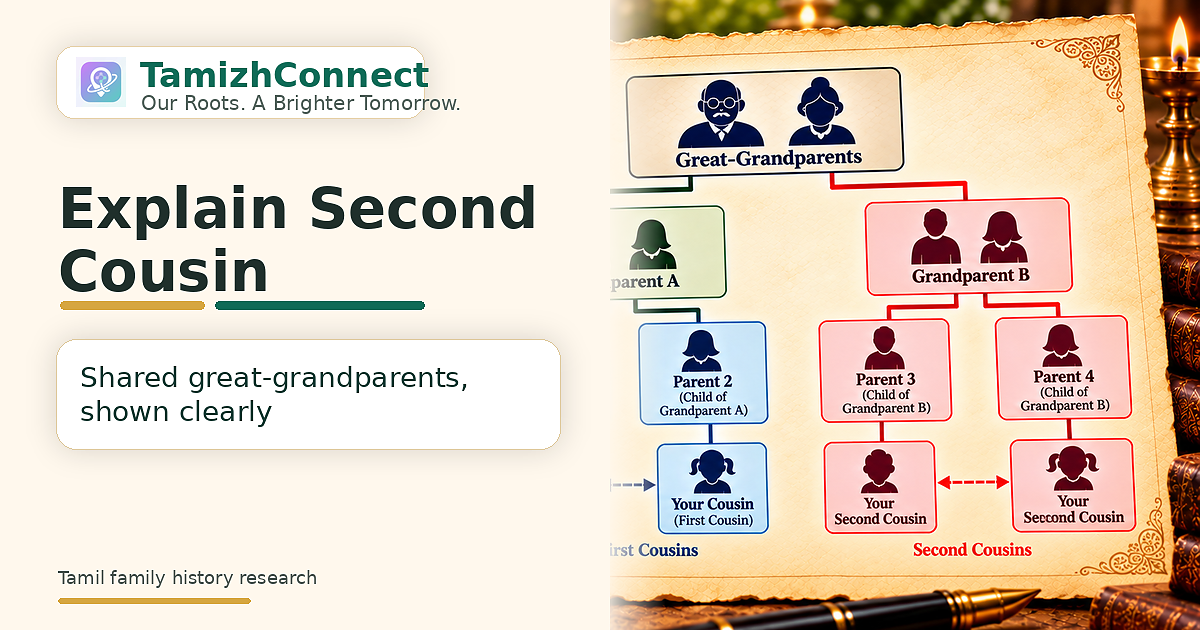
Second cousins are people whose grandparents were siblings. Or equivalently: people who share great-grandparents but not grandparents. That’s the definition.
What this looks like on a family tree:
- Level 0: your great-grandfather Muthusamy and his wife
- Level 1: their children — say, your grandfather Perumal AND his brother Kannan
- Level 2: their grandchildren — you (Perumal’s grandchild via your parent) AND Kannan’s grandchild Ravi
You and Ravi are second cousins. You share Level 0 ancestors (Muthusamy and his wife) but Level 1 ancestors are different (Perumal for you, Kannan for Ravi).
The kinship math that generalises the definition
To go from first cousin to second cousin to third cousin, the pattern is:
- First cousin: shared grandparents; NOT shared parents
- Second cousin: shared great-grandparents; NOT shared grandparents
- Third cousin: shared great-great-grandparents; NOT shared great-grandparents
- Nth cousin: shared (N+1)th ancestors; NOT shared Nth ancestors
Each step increases the shared-ancestor generation by one. Second cousins go one generation further back than first cousins for the connection point.
The counting rule that produces this pattern: count generations from each person to the closest shared ancestor. If both counts are equal to K, they are (K-1)th cousins. So:
- 2 generations back to shared ancestor (both) → 1st cousins
- 3 generations back to shared ancestor (both) → 2nd cousins
- 4 generations back to shared ancestor (both) → 3rd cousins
DNA sharing between second cousins
Second cousins share approximately 3.1% of their DNA on average, or about 230 centiMorgans (cM). The range is wide though — 75 to 360 cM is normal for second-cousin pairs. This variance comes from how DNA recombines each generation.
What this means for genealogy testing:
- A DNA match at 230 cM is likely a second cousin — but it could also be a first cousin twice removed, a half first cousin, or a second cousin once removed. Numeric DNA alone doesn’t distinguish these.
- Confirming the specific relationship requires cross-referencing the DNA match’s family tree against your own.
- DNA testing is more useful for finding second cousins than for identifying the specific relationship. Ancestry and MyHeritage will surface second-cousin matches; the researcher then verifies which specific second cousin by comparing shared ancestors.
Tamil kinship terminology for second cousins
Tamil kinship vocabulary doesn’t have a single word equivalent to “second cousin.” Instead, Tamil families describe the relationship by naming the intermediate ancestors:
- “My periyappa’s grandchild” — my father’s elder brother’s grandchild (a specific second cousin type)
- “My mama’s grandchild” — my mother’s brother’s grandchild (another specific second cousin type)
- “My athai’s grandchild” — my father’s sister’s grandchild (cross-lineage second cousin)
The Tamil constructions are more precise than the English “second cousin” — they carry information about which specific line of the family (patrilineal vs. matrilineal, cross vs. parallel) the relationship runs through. English “second cousin” is agnostic to that lineage information.
Historically the distinction between cross-cousin (opposite-sex sibling connection) and parallel-cousin (same-sex sibling connection) mattered because Tamil communities had marriage rules that permitted cross-cousin unions in the parents’ generation and their children’s generation. English “second cousin” flattens these distinctions.
What second cousins share culturally
Beyond DNA and family tree position, second cousins often share:
- Cultural memory of the shared ancestors — even if you never met your great-grandparents personally, second cousins on either side often carry stories, photographs, or artifacts from that generation. Reaching out to a second cousin can double the family history you know about your great-grandparents.
- Village origin — for Tamil families with a specific ancestral village, second cousins are often from that same village or its immediate diaspora. This is high-value for village-of-origin research.
- Migration story — if the great-grandparents emigrated, second cousins are usually descended from the same emigration cohort. Cross-referencing your family story with a second cousin’s often fills gaps.
- Community affiliation — same caste, same religion, same specific temple or church, same community organisation. Second cousins are usually within the same community boundaries as you.
- Family artifacts — one branch of the family may have inherited the family Bible or kula deivam register; another branch may have the land documents. Second cousins together often hold complementary artifact sets.
Legal and inheritance status
Second cousins typically have no automatic legal relationship in most jurisdictions:
- No inheritance rights by default (unless named in a will)
- No consanguinity restrictions on marriage in most modern jurisdictions (though some communities and religions retain traditional restrictions)
- Not typically considered “family” for legal purposes like immigration sponsorship, medical decision-making, etc.
Traditional Tamil family conventions may extend more social recognition to second cousins than legal frameworks do — they’re often invited to weddings, funerals, and family functions, addressed by kinship terms, and expected to maintain ongoing relationship. The cultural framing is stronger than the legal framing.
Finding second cousins you didn’t know existed
For most people, the first-cousin network is well-known but the second-cousin network is partly unknown. The typical Tamil family has 20-60 second cousins scattered across:
- The ancestral village (branches that stayed)
- Nearby Tamil Nadu cities (branches that moved for work)
- Diaspora destinations (branches that emigrated to different countries)
Methods for finding unknown second cousins:
- Great-aunt / great-uncle interviews — they usually know the whole cousin network at their generation, which includes your first cousins once removed (whose children are your second cousins).
- DNA testing on major platforms — Ancestry, MyHeritage, 23andMe surface DNA matches at the second-cousin range with reasonable accuracy.
- Ancestral village visits — for families with continuous village ties, the local temple or village community often knows the extended family across branches.
- Community organisation records — caste associations, alumni groups, and religious organisations sometimes maintain member registers that reveal family branches.
- Migration cohort research — for diaspora families, indenture arrival records often show the same great-grandparent’s children arriving together; their descendants are second cousins.
Extending from second cousins to further cousins
Once second cousins are well-mapped, the same logic extends outwards:
- Third cousins (shared great-great-grandparents) — usually harder to reach; often unknown until DNA tests surface them
- Fourth cousins (shared 3rd-great-grandparents) — DNA sharing drops to ~0.2%; typically only visible via DNA testing
- Fifth cousins and beyond — mostly identifiable only through documented genealogy (temple records, community registers, land inheritance chains)
For most family history projects, mapping to third cousin is achievable with a combination of oral history + DNA + civil records. Beyond that requires either exceptional documentation or extensive DNA network work.
The “second cousin” definition — shared great-grandparents but not grandparents — anchors the whole cousin-vocabulary. Once you can identify who your second cousins are, extending to more distant relationships follows the same counting rule. Getting the definition solid opens up two or three generations of extended family that most people never realise they have.