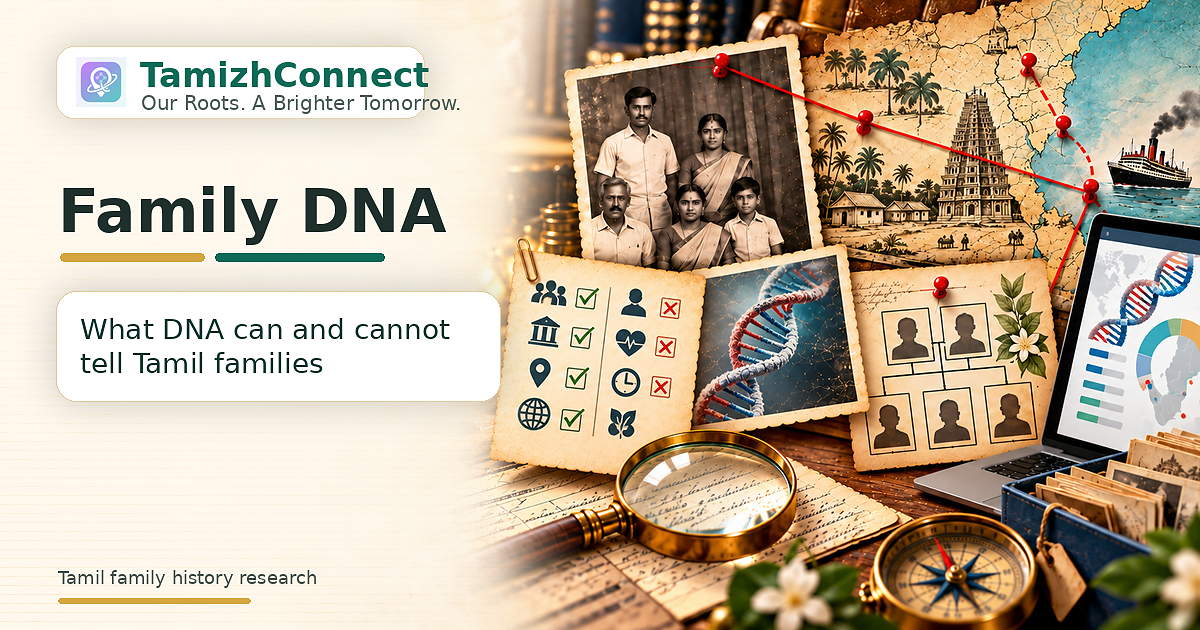
Deciding on family DNA testing for Tamil ancestry research involves specific decisions that most generic “DNA testing guide” articles skip: which family members to test, which company to test with, what the test can and cannot deliver, and how much to spend. This guide walks the specific decision framework for Tamil families considering DNA testing as part of their family history research.
Should your family test DNA at all?
DNA testing is a paid step. Before spending, be clear on what you’re hoping to learn:
- Unknown-cousin discovery: yes, DNA is uniquely useful for this — finding cousins you don’t know exist
- Identifying specific ancestors by name: no, DNA doesn’t do this — records do
- Confirming family stories about specific ancestry: partly — DNA can support or challenge broad direction; specific ancestor claims need records
- Deep-ancestry / haplogroup interest: yes, for those interested in thousands-of-years-ago migration patterns via Y-DNA / mtDNA
- Adoption / unknown-parent search: yes, DNA is often the primary tool for this
- Quick answer to “what am I?”: reset expectations — see our DNA heritage guide on why percentages don’t answer identity questions well
If none of these applies to your research questions, DNA testing may not be worth the cost. Records-based research is often more informative for standard Tamil family history projects.
Which family members to test
Priority order for maximum DNA-research value:
Priority 1: Oldest living relatives
Grandparents and great-aunts / uncles in their 80s and 90s. Their DNA carries information one generation closer to unknown ancestors than yours does. When they’re gone, that specific DNA source is gone forever.
Priority 2: Both parents
Testing both parents provides more precise inheritance information than testing only you. Parents’ DNA can be phased to identify which DNA came from which line, resolving many ambiguities.
Priority 3: Cousins from unknown-history branches
Extended-family cousins from family lines you know less about. Their DNA may reveal connections you can’t see in the branches you already know.
Priority 4: Yourself
Sufficient for most research questions if you can’t get earlier-generation samples. Not always necessary if better-positioned relatives have already tested.
Priority 5: Children / younger generation
Rarely necessary for family-history research (they inherit less unique information than parents). Useful only for specific research questions like confirming a specific parent identification.
Which company to test with
Ancestry.com
- Match pool: largest in the world (~20 million testers)
- Best for: finding unknown cousins; ethnicity estimates with broad regional categories
- Weakness: no chromosome browser (limits advanced triangulation work)
- Price: ~£80-100 for autosomal DNA
- Tamil-family fit: reasonable for cousin matching; ethnicity estimates lump Tamil under broad “South Asian” or “South Indian”
MyHeritage
- Match pool: large, with strong European / international presence
- Best for: European ancestry investigation; free-tier match visibility
- Chromosome browser: yes (supports triangulation)
- Price: ~£70-90 for autosomal DNA
- Tamil-family fit: moderate; free-tier features useful for initial exploration
23andMe
- Match pool: mid-sized
- Best for: Southeast Asian ancestry granularity; combined DNA + health-genetic reports
- Chromosome browser: yes
- Price: ~£90-130 (ancestry-only vs ancestry+health)
- Tamil-family fit: reasonable; ethnicity estimates often more granular for Southeast Asian than competitors
FamilyTreeDNA
- Match pool: smaller than Ancestry / MyHeritage but growing
- Best for: Y-DNA testing (paternal line) and mtDNA testing (maternal line); deep-ancestry haplogroup work
- Chromosome browser: yes
- Price: ~£80 for autosomal; ~£150-200 for Y-DNA; ~£150 for mtDNA
- Tamil-family fit: essential for those interested in haplogroup analysis
Third-party option: GEDmatch
Free platform where you upload raw DNA data from any tester and get cross-platform match visibility. Not itself a testing company, but essential for comparing matches across platforms.
The testing strategy for a Tamil family
For most Tamil family research budgets, the productive strategy:
- Test the oldest living relative on Ancestry (largest match pool)
- Download raw DNA data and upload to GEDmatch and MyHeritage (free)
- Consider testing yourself if the relative’s results reveal unexplored branches
- Consider Y-DNA on FamilyTreeDNA if paternal-line deep-ancestry is a research interest
- Skip 23andMe unless health-genetic reports are also wanted
Total spend for this workflow: ~£100-200 for the initial testing + potentially £150-200 for optional Y-DNA extension. GEDmatch and MyHeritage transfers are free.
Data privacy considerations
DNA data is genuinely sensitive. Before testing, understand:
- Testing companies store your DNA data indefinitely by default (though most allow deletion on request)
- DNA data can identify you and your close relatives with high specificity
- Some companies share DNA data with research partners (opt-in / opt-out varies by company)
- Law enforcement has used DNA databases (including GEDmatch) to identify criminal suspects via their relatives; this may or may not be a concern for your family
- Once uploaded to a shared database, DNA information cannot be fully retracted from copies others may have accessed
Read the specific privacy policy of any platform before testing. If privacy concerns are significant, some platforms have stronger opt-out protections than others.
What Tamil family DNA testing typically reveals
Realistic expectations for a Tamil family DNA test:
Ethnicity percentages
Broad regional estimates (mostly “South Indian” or “South Asian” at 60-90%; smaller percentages from adjacent regions). Interesting but limited in specific-ancestor value. See DNA heritage guide.
Cousin matches
The most valuable output. Typically 50-500 matches at moderate confidence levels; a handful of high-confidence matches (2nd cousin or closer). Unknown cousins may reveal new family branches.
Haplogroup assignment
Ancient-ancestry migration patterns. Tamil families commonly show Y-DNA haplogroups H1, L1, R1a, R2 and mtDNA haplogroups M2, M4, M5, U2, W. Interpretable but not directly usable for recent family history.
Health-genetic information (some platforms)
Not family-history relevant but sometimes included. Read carefully before ordering — health information can be emotionally impactful.
Common Tamil family DNA testing mistakes
- Testing yourself when a grandparent is still alive: prioritise the older relative’s DNA before it’s gone
- Testing only one company: missing match visibility on other platforms; upload to GEDmatch / MyHeritage for cross-platform coverage
- Ignoring privacy implications: understand the data-handling policies before testing
- Over-reliance on ethnicity percentages: percentages are approximate; cousin matches are more useful for family history
- Not integrating DNA with records: DNA in isolation produces less value than DNA + records combined
DNA testing as one component, not the whole strategy
Family DNA testing is a genuinely useful addition to Tamil family history research when applied appropriately. It’s not a magic answer to “who are we?” — that question requires records, family interviews, and community history. But for cousin discovery, deep-ancestry haplogroups, and verifying / challenging specific hypotheses, DNA does things no other research method can.
For a Tamil family with ~£100-200 to spend on family history annually, DNA testing is a defensible allocation IF you have specific research questions it can address. If not, that budget is better spent on paid research subscriptions, archive proxy services, or genealogy-software licenses that produce more direct family-history value.
Test with clear intent. Combine with records-based research. Manage privacy carefully. That’s how family DNA testing delivers what it can genuinely deliver without creating disappointment about what it can’t.