Comparing family genealogy sites for Tamil ancestry research usually goes badly because the comparison rubrics are wrong. Generic “best genealogy sites” articles rank platforms on Western-family criteria: US civil registration coverage, UK census depth, European emigration records. None of these are what a Tamil family needs to evaluate.
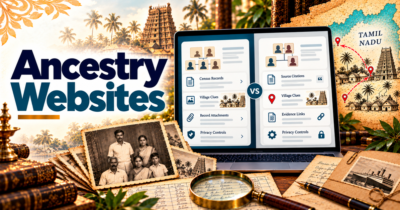
This guide walks a Tamil-specific feature-comparison framework and applies it to the major platforms (Ancestry, MyHeritage, FindMyPast, FamilySearch, TamizhConnect). The point isn’t to declare a winner — the productive answer is usually a combination of 2-3 platforms, and this comparison helps you pick which combination.
The Tamil-specific comparison rubric
Rate each candidate platform on 8 dimensions:
- Indenture arrival records — how many destination-country arrival registers are indexed? For which countries?
- Pre-emigration Tamil Nadu records — voter rolls, patta, temple registers, community organisations?
- Naming-convention handling — patronymic support, phonetic matching, community-title vs surname distinction?
- Kinship-vocabulary support — can you record traditional Tamil kinship terms alongside English relationships?
- Multi-country migration — can you track an ancestor across India → destination country → subsequent migration?
- Community-record integration — kula deivam, caste-organisation records, mission archives?
- Free-tier depth — what can you do without paying? How much of the tool is behind a paywall?
- Data-portability — GEDCOM export, image download, tree backup?
Platform-by-platform assessment
Ancestry.com
- Indenture records: thin (some India Office Records; minimal destination-country arrival indexing)
- Pre-emigration Tamil Nadu: minimal
- Naming conventions: Western surname-first; limited phonetic Tamil matching
- Kinship vocabulary: standard English only
- Multi-country migration: strong for US / UK / Commonwealth; weak for India-side
- Community records: weak
- Free tier: browse-only; most features paid
- Data portability: GEDCOM export supported
Best for: destination-country civil registration + DNA testing / matching. Weak as a Tamil-primary platform.
MyHeritage
- Indenture records: similar to Ancestry — thin
- Pre-emigration Tamil Nadu: minimal
- Naming conventions: standard Western
- Kinship: standard English
- Multi-country: good coverage; less US-centric than Ancestry
- Community records: weak
- Free tier: better free tree than Ancestry (up to 250 people); records mostly paid
- Data portability: GEDCOM supported
Best for: European civil records, free tree hosting, DNA matching with international reach. Weak for Tamil-primary work.
FindMyPast
- Indenture records: some India Office Records digitised; better than Ancestry for UK-side India connections
- Pre-emigration Tamil Nadu: minimal
- Naming conventions: standard Western
- Kinship: standard English
- Multi-country: strong UK/Commonwealth; India records via British Library partnerships
- Community records: some UK-side Indian community records
- Free tier: limited browse-only
- Data portability: GEDCOM supported
Best for: Tamil ancestors who spent time in Britain (ayahs, lascars, sepoys, students) and British-India administrative records. Weak for direct Tamil-village research.
FamilySearch (free)
- Indenture records: some indexed India Office Records; growing coverage
- Pre-emigration Tamil Nadu: some civil registration collections; district-level records
- Naming conventions: standard Western; limited phonetic Indian-name matching
- Kinship: standard English
- Multi-country: broad but shallow in some regions
- Community records: some CSI / SPG / CMS records via mission society partnerships
- Free tier: the whole platform is free
- Data portability: GEDCOM supported
Best for: free comprehensive supplement to any other platform. Cannot replace specialist Tamil tools but adds meaningful coverage at zero cost.
TamizhConnect
- Indenture records: 400,000+ arrival records indexed across South Africa, Mauritius, Fiji, Trinidad, Guyana, Suriname, Réunion
- Pre-emigration Tamil Nadu: village directory, voter roll integration, kula deivam directory
- Naming conventions: Tamil naming convention native support; phonetic matching for Tamil names
- Kinship: Tamil kinship terms supported
- Multi-country: focused on India ↔ diaspora migration
- Community records: kula deivam directory; village-level community affiliation tracking
- Free tier: substantial (search + basic tree); paid tier for advanced features
- Data portability: GEDCOM export supported
Best for: primary platform for Tamil family history. Should be combined with a destination-country generalist for post-emigration life records.
Comparison matrix summary
Rating each platform on Tamil-family fitness (out of 10):
- Ancestry: 4/10 — good for destination-country civil registration; weak for Tamil-specific
- MyHeritage: 4/10 — similar to Ancestry with better free tree
- FindMyPast: 5/10 — better UK / India Office coverage; still Western-primary
- FamilySearch: 7/10 — free + broad; supplements everything else
- TamizhConnect: 9/10 — designed for Tamil-primary research; needs destination-country supplement
None of these is 10/10 alone. The productive answer is usually TamizhConnect + one generalist + FamilySearch as free supplement.
Cost-effectiveness comparison
Annual cost for meaningful Tamil-family research:
- Ancestry (destination-country access): £150-250/year for UK/US/Commonwealth
- MyHeritage (equivalent): £120-200/year
- FindMyPast: £130-180/year
- FamilySearch: £0/year (free)
- TamizhConnect: pricing at tamizhconnect.com/pricing
A minimum-viable annual subscription for Tamil-family research: TamizhConnect + one destination-country platform (Ancestry, MyHeritage, or FindMyPast depending on which country your diaspora branch is in) + FamilySearch (free). This typically comes to £150-300/year and covers most research questions.
Choosing the combination for your specific family
Match the platforms to your family’s specific research questions:
- Tamil family with no diaspora migration: TamizhConnect + FamilySearch + patta.tn.gov.in. No generalist needed.
- Tamil family with UK-side history (Britain-based branch): TamizhConnect + FindMyPast + FamilySearch. FindMyPast for the UK archives.
- Tamil family with South Africa / Mauritius / Fiji / Caribbean indenture history: TamizhConnect + FamilySearch + selective Ancestry for destination civil registration.
- Tamil family with US / Canada / Australia post-1970 migration: TamizhConnect + Ancestry (largest DNA match pool for new-diaspora contexts).
- Tamil family with mixed history (multiple destinations): TamizhConnect + Ancestry + FamilySearch. Multi-destination coverage.
The subscription-management discipline
Given that platforms use monthly subscriptions, avoiding overspending requires discipline:
- Start free-only (FamilySearch + TamizhConnect free tier + patta.tn.gov.in)
- Add paid subscriptions when you hit specific research walls the free tools can’t clear
- Use trial periods to test before committing to annual subscriptions
- Cancel subscriptions when you enter research-pause phases
- Rotate paid subscriptions (subscribe intensively to one platform for a month, then switch)
Research-pace-matching subscription management saves ~£100-200/year vs. maintaining all subscriptions year-round.
Beyond the major platforms
Some Tamil-family research questions need niche resources beyond the major genealogy sites:
- British Library India Office Records — direct catalog access; some records digitised
- Archives Nationales d’Outre-Mer (Aix-en-Provence, France) — Karaikal / Réunion / French colonial records
- CSI diocesan archives — direct correspondence for Christian family records
- HR&CE (Hindu Religious & Charitable Endowments) — state temple records
- Community organisation archives — caste-specific historical societies
These aren’t “sites” in the genealogy-website sense but are essential for deep Tamil-family research. The major platforms don’t cover them.
Comparing family genealogy sites for Tamil ancestry isn’t a single-winner question. It’s a combination question: which 2-3 platforms best cover YOUR specific family’s research needs. The Tamil-specific rubric above turns platform-selection into a defensible decision rather than a guess based on advertising or generic reviews.