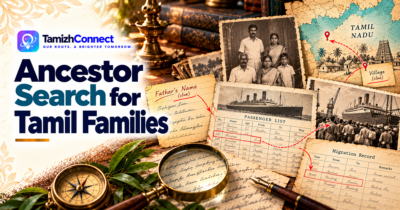
You can begin tracing your family lineage for free. For Tamil families, the first valuable records are often not behind a paywall — they are in elder memory, wedding invitations, old documents, village names, and family stories.
Many people think genealogy must begin with a paid subscription. That is not true. A paid record service may help later, but the first stage of Tamil family-history research should usually be free and private.
Start With What Your Family Already Knows
Before paying for anything, collect the known information.
Write down:
- your parents
- grandparents
- great-grandparents
- siblings and marriage links
- native villages
- districts
- Kula Deivam clues
- migration stories
- old addresses
- family documents
This creates the base of your lineage.
Ask Elders Before Records Disappear
Elder memory is time-sensitive. Once a generation passes, names and village links may disappear permanently.
Ask elders:
- What was the oldest ancestor’s name you remember?
- What was their father’s name?
- Which village did the family come from?
- Was there a Kula Deivam temple?
- Did anyone migrate to another country?
- Are there relatives we lost contact with?
- Which old documents still exist?
This costs nothing, but it may be the most valuable part of your research.
Build a Free Private Tree First
A family tree helps you organise information before searching deeper records.
Your first tree does not need to be perfect. It should capture:
- names
- relationships
- approximate years
- villages
- notes
- evidence sources
- uncertain links
Mark uncertain information clearly. Do not present guesses as facts.
Use Home Documents
Many Tamil families already have genealogy evidence at home.
Search for:
- wedding invitations
- school certificates
- land records
- temple receipts
- old passports
- letters
- ration cards
- photographs
- community notices
- funeral notices
These documents may reveal parent names, village names, marriage links, and spelling variations.
Record Every Spelling
Tamil names often change across documents. A free lineage search becomes much stronger when you preserve every spelling variation.
Keep a list for each ancestor:
- family pronunciation
- spelling in school records
- spelling in old certificates
- spelling in migration records
- initials used
- expanded father’s name
This helps you search later without missing records.
Search Free Public Clues Carefully
Depending on the region and record type, you may find useful clues from public or free sources.
Possible starting points include:
- family documents
- community pages
- village histories
- cemetery or memorial records
- old association records
- public voter or locality clues where legally available
- migration record indexes where available
Always verify before adding a record to your confirmed lineage.
What Should You Pay For Later?
Consider paying only when you know what you are looking for.
You may later pay for:
- document copies
- archive access
- field research in a village
- professional transcription
- translation
- local verification
- travel or temple record checking
Do not pay someone to “find your roots” if you have not yet collected your own basic family clues.
How TamizhConnect Helps
TamizhConnect lets Tamil families begin with a private tree and gradually add records, villages, and heritage clues.
You can start with:
- known family members
- Tamil relationships
- village names
- notes from elders
- Kula Deivam clues
- migration clues
Start here: TamizhConnect
Final Thought
Family lineage research does not need to start with money.
Start free. Start at home. Start with elders.
The strongest lineage is built from evidence, not from rushing into paid searches.
Where to go next
- Tamil Ancestry: A Complete Guide — the master research method for Tamil family history.
- Tamil Nadu voter search — 50 million+ current voters indexed by village and district.
- Indenture registers — for South African, Fijian, Mauritian and Malayan diaspora branches.