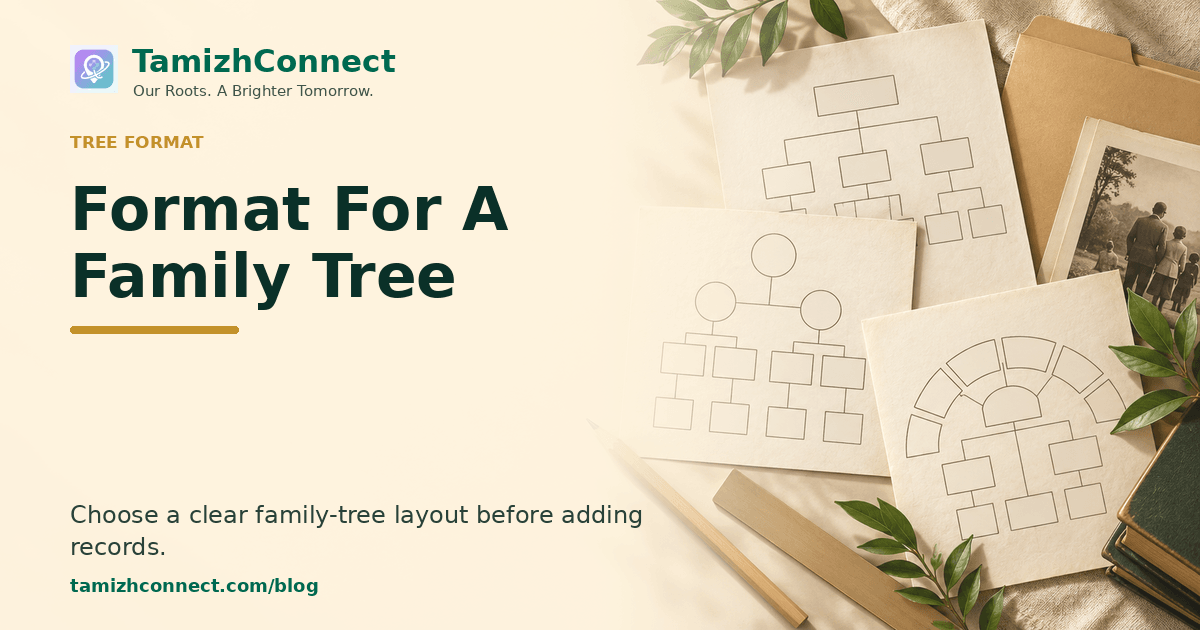
Format for a Family Tree: A Tamil-Friendly Structure should begin with living memory, not with a random record search. A strong family tree starts from what your family can still confirm, then moves backwards step by step.
For Tamil families, the best tree is not just a chart of names. It should preserve relationships, villages, Kula Deivam clues, migration stories, photos, documents and oral history.
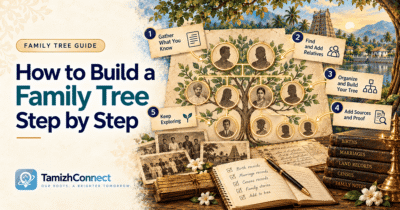
Start with three generations
Begin with:
- yourself
- parents
- grandparents
- great-grandparents where known
- siblings of each generation
- spouses and marriage links
Ask elders to verify each connection before you move further back.
Record Tamil relationship terms
Do not flatten every relationship into uncle, aunt and cousin. Record the Tamil term used in the family, such as periyappa, chithappa, athai, mama, chithi or periyamma. These terms help future generations understand which side of the family the person belongs to.
Add village anchors
For each person, add:
- native village
- district
- old street or house name if known
- temple or Kula Deivam clue
- migration place
- document source
A name without a village may produce too many false matches.
Keep uncertainty visible
Every family tree has uncertain branches. Mark them clearly. Use words such as possible, likely, family memory, unverified or needs evidence. This prevents future users from treating guesses as facts.
TamizhConnect angle
TamizhConnect is built for Tamil family trees, where names, villages and relationships all matter. A good tree should help both elders and younger generations understand the family story.
Where to go next
- Build your Tamil family tree — the TamizhConnect workspace built for Tamil naming, relationships, villages and records.
- Tamil Naming System Explained — how initials, patronymics and village anchors work in a Tamil tree.
- Tamil Ancestry: A Complete Guide — the master research method behind every strong Tamil family tree.