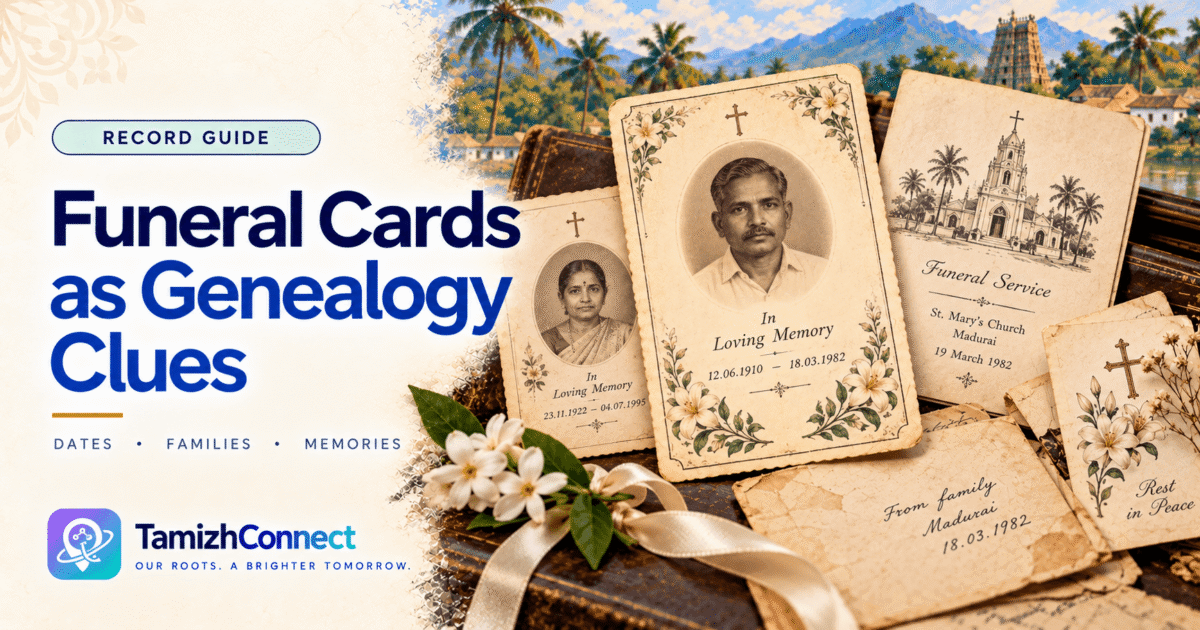
Almost every Tamil Christian family archive contains a small stack of funeral cards. These are the printed cards distributed at the funeral service, typically 5 x 7 inches, printed on cream-coloured card stock, with the deceased’s photograph on one side and biographical text on the other. Nobody knows why families keep them; families just do. And they’ve been keeping them, generation after generation, for over a hundred years.
For genealogy, funeral cards preserve information that no formal record class captures — the deceased’s specific parents and grandparents (often named on the card even when civil death records omit them), their exact village of origin, their specific dates and places (birth, marriage, death, burial), and often a brief biographical narrative that names siblings, children, and extended family. A well-preserved funeral card from 1950 can document a family more fully than the entire civil-registration record for the same person.
This guide walks the specific structure of Tamil Christian funeral cards, the information they typically contain, and the specific techniques for extracting genealogical value from them.
What a funeral card contains
The typical Tamil Christian funeral card, following the format that emerged from the 1900s onward:
Front side. The deceased’s photograph (formal portrait, sometimes from years before death), full name in large type, dates of birth and death, and often a brief scriptural quote or hymn line.
Interior / back side. Biographical narrative typically 100-500 words, covering:
Full name including any Tamil name variants and the family surname pattern. Parents’ names — including maiden name of mother if from a different family. Village of origin — often in more specific terms than civil records use (“Nazareth Village, Tirunelveli District” rather than just “South India”). Marriage details — date, spouse’s name and family, place of marriage. Children’s names — usually with each child’s name and current residence noted. Career or occupation — a few lines about what the deceased did in life. Church membership — the specific parish, date of joining, any parish role held. Circumstances of death — often gently phrased but including the date and place of death, sometimes cause. Funeral arrangements — the officiating minister, the church, the burial place.
Family message. A closing paragraph naming the surviving family (spouse, children with specific names, sometimes grandchildren) and expressing thanks to those who attended or supported.
Compare this to a typical civil death certificate: name, date of death, cause, informant. The funeral card carries three to ten times as much genealogically-useful information as the death certificate for the same person.
Why funeral cards preserve so much
Funeral cards are family-produced documents, not government-required ones. The family (usually the eldest child or the spouse) commissioned the printing, wrote the narrative, and distributed the cards at the funeral service. The purpose was memorial and biographical — to give attendees a written keepsake honouring the deceased’s life.
Because the family wrote the biography, it includes information the family knew: parents, siblings, marriage, specific village. Government records only contain what the informant was asked to provide by the form. Funeral cards contain what the family chose to include.
The distribution pattern also matters. A funeral card was given to every attendee, meaning 50-200 physical copies of the same biographical record entered circulation. Many of those attendees kept their copy in their own family archive, so the same biographical information exists in multiple places — increasing survival odds compared to a single centralised record.
Where surviving funeral cards live
Funeral cards live in family archives — the shoeboxes, filing cabinets, and photo albums that families accumulate over generations:
Own family archive. The deceased’s own family always kept copies. Descendants who inherit family papers usually have access to a stack of family funeral cards spanning several generations.
Extended family archives. Siblings, cousins, and community members who attended the funeral kept their own copies. Reaching out to extended family often surfaces funeral cards the direct-descent family didn’t have.
Church parish archives. Some parishes retained a small archive of funeral cards from services held at the church. Access via the parish office.
Community organisation archives. Tamil community organisations (associations, alumni societies) sometimes retained funeral cards for prominent community members. Access via community organisation records.
Local Tamil newspaper obituary archives. When a prominent Tamil person died and their funeral card was distributed at a well-attended service, the local Tamil newspaper often reproduced or referenced the funeral card content in the obituary. Newspaper obituary archives (see obituaries guide) thus overlap with funeral card content.
Reading a funeral card systematically
Amateur genealogy often glances at a funeral card without extracting all the information. The systematic reading:
Front side extraction: Full name (compare to name in other records — spellings, sequence). Dates of birth and death (compare to other sources). Photograph (visual evidence, dateable by clothing/style).
Biographical narrative extraction: Parents’ full names including mother’s maiden name (often the ONLY source of maternal-grandfather’s name). Village of origin (compare to family memory / arrival records). Marriage date + spouse’s full name and family (compare to marriage registers). Every child named — this often documents siblings never mentioned in other records. Occupation and church role (adds biographical texture and often points to further records).
Family closing message extraction: Every surviving relative named. Their residences. Cross-check for anyone unfamiliar — they may be extended kin worth investigating.
Officiating minister and church: Cross-references to parish records; the officiating minister’s own records may include the funeral in their sermon-notes archive.
The specific value for diaspora research
For Tamil Christian diaspora families, funeral cards are especially valuable because:
Post-emigration civil records often lost the specific pre-emigration village information. The funeral card typically reasserts it explicitly — a South African Tamil Christian’s funeral card from 1955 will often name the pre-emigration Tirunelveli village that no civil record for the same person captures.
Diaspora family archives had strong preservation cultures around funeral cards specifically. The material objects survived immigration better than paper records (bound registers, correspondence) because families intentionally curated them.
Cross-generational funeral card collections in a single diaspora family archive can document family membership back to pre-emigration India — with each successive funeral card naming the deceased’s parents and grandparents, four to five generations of documentation accumulate in a single collection.
The distinctive death-date accuracy
Funeral cards typically have more accurate death dates than family memory for the same person. Because the card was printed within days of the death, the date was still fresh. Family memory decades later often blurs death dates by a year or two. When a family memory disagrees with a funeral card, the funeral card almost always wins.
Similarly for birth dates. The family calculated the deceased’s age at death (or looked at their baptism certificate) when preparing the card. This calculated birth date is typically more accurate than descendants’ memory generations later.
What to do with an inherited stack of funeral cards
If you’ve inherited a stack of family funeral cards, the systematic processing:
Step 1: Digitise every card, both sides. High-resolution scans preserve the material record. Store in multiple locations (cloud + local backup).
Step 2: Transcribe every biographical narrative. Convert to searchable text so future researchers can cross-reference without re-reading each physical card.
Step 3: Extract every named person into a shared family database. Every parent, child, sibling, cousin mentioned across the collection becomes a potential family tree entry. Use the collection as source material for family tree construction.
Step 4: Cross-reference across cards. A person mentioned as a child on one card and as a parent on another later card documents that person’s own life stages across the family’s death record collection. Build the timeline.
Step 5: Share with extended family. Family cards are family history. Digitising and sharing extends preservation and often prompts extended relatives to share their own inherited cards, expanding the collection.
The unusually high genealogy value per document
For the physical size (a small printed card) and the family effort involved (typically an hour or two of writing and a few hundred rupees / dollars printing), funeral cards produce more genealogically-useful information per document than almost any other family archive item. A stack of ten inherited funeral cards from four generations can single-handedly reconstruct much of a family’s history from 1900 to now.
Every Tamil Christian family with any historical continuity has these cards somewhere. Systematically extracting the information from them is one of the highest-value first-steps in family history research — often more productive than any archive request, and definitely more productive than searching civil registration for the same information.
See our oral history guide and family archive organisation guide for the general approach to systematising inherited family papers.