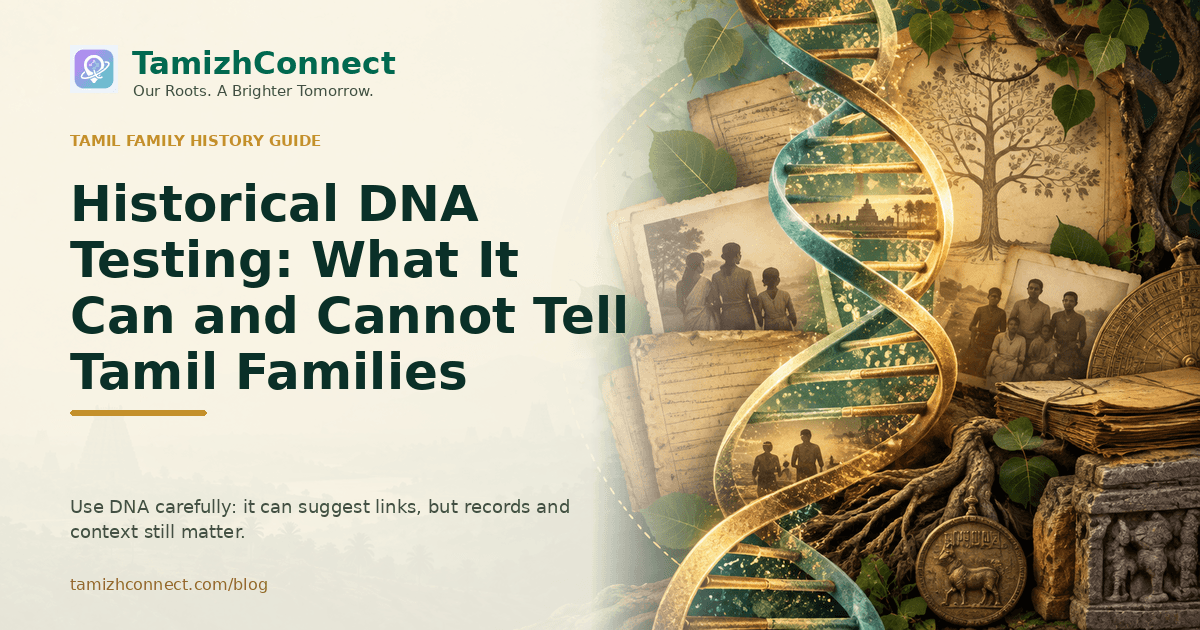
Historical DNA testing — the specialized use of DNA to investigate deep-past ancestry rather than recent genealogy — is a different discipline from finding your first cousin via Ancestry. It uses Y-DNA and mtDNA haplogroups, ancient-DNA comparison, and population-genetics analysis to trace ancestry back thousands of years. For Tamil families interested in deep history — Chola-era ancestry, ancient migration patterns, connections to broader Dravidian populations — historical DNA testing is the specific tool.
This guide walks what historical DNA testing can and cannot reveal about Tamil ancestry, the specific tests and analyses involved, and the interpretation caveats that separate meaningful historical-DNA conclusions from over-interpreted haplogroup narratives.
Deep-ancestry vs recent genealogy DNA
Two fundamentally different scales:
Recent genealogy DNA (last ~5-6 generations)
- Uses autosomal DNA (inherited from all ancestors)
- Tests: Ancestry, MyHeritage, 23andMe, FamilyTreeDNA Family Finder
- Identifies: cousins, ethnicity percentages at broad regional level
- Best for: reconnecting with unknown recent relatives, filling in the last few generations
Historical / deep-ancestry DNA (thousands of years)
- Uses Y-DNA (father-to-son line only) and mtDNA (mother-to-child line only)
- Tests: FamilyTreeDNA Y-DNA and Full Sequence mtDNA (primary provider); YSEQ / Full Genomes for advanced Y-DNA
- Identifies: haplogroups reflecting ancient population membership and migration routes
- Best for: investigating deep history, connecting to population-genetics scholarship, understanding ancient ancestry
These two scales answer different questions and require different tests. Buying an autosomal DNA test hoping for deep-ancestry information will disappoint; buying a Y-DNA / mtDNA test hoping for recent genealogy will also disappoint.
Y-DNA haplogroups common in Tamil families
Y-DNA haplogroups reflect deep paternal-line ancestry. Common Tamil-family Y-DNA haplogroups include:
- Haplogroup H (especially H1 and its subclades) — the most common Y-DNA haplogroup in South India; associated with Dravidian-speaking populations and dated to Palaeolithic South Asian ancestry
- Haplogroup L (L1 subclades common) — associated with South Asian and Middle Eastern populations; some evidence for pre-Aryan Indus civilization origins
- Haplogroup R1a — associated with Indo-European speakers; higher frequency in North India but present in Tamil populations too
- Haplogroup R2 — South Asian haplogroup with ancient South Indian origins
- Haplogroup J2 — Neolithic Middle Eastern origins; present in Tamil populations at moderate frequency
Each haplogroup traces to a specific “most recent common ancestor” thousands of years ago. Interpreting your haplogroup means understanding which ancient population your paternal line descends from.
mtDNA haplogroups in Tamil families
Maternal-line haplogroups tell a different story. Common Tamil-family mtDNA haplogroups:
- M (especially M2, M4, M5, M6) — the dominant maternal-line lineage in South India; among the oldest human mtDNA outside Africa; strongly associated with early South Asian settlement
- U (especially U2) — associated with ancient West Eurasian and South Asian populations
- W — West Eurasian origins; present in Tamil populations at low frequency
- R — broad Eurasian macrogroup; various subclades in South Asia
The dominance of M-haplogroup mtDNA in Tamil populations reflects the ~50,000-year history of South Asian human settlement — a much deeper timescale than any recorded family history.
What historical DNA can tell Tamil families
Population membership
Your haplogroups place your deep ancestors in specific ancient population groups. This connects you to the broader story of South Asian human genetics — the Palaeolithic settlement, the Neolithic transitions, the Iron Age Dravidian expansions.
Migration path evidence
Haplogroup distributions across modern populations reveal ancient migration paths. Your haplogroup places your paternal / maternal line’s ancient migration story — where the population came from, when, and where it spread.
Connections to ancient civilizations
Some haplogroups have proposed connections to specific ancient civilizations (Indus Valley, ancient Tamil kingdoms). These connections are actively researched; academic conclusions evolve as more ancient-DNA data becomes available.
Community-genetics context
Your haplogroup places your family in the broader Tamil / South Indian genetic landscape. Understanding your haplogroup’s distribution across Tamil communities can hint at your family’s ancient community affiliation.
What historical DNA cannot tell Tamil families
Recent ancestors’ names
DNA never provides names. Your Y-DNA haplogroup tells you your paternal line traces back thousands of years to a specific ancient population; it doesn’t tell you your great-great-grandfather’s name.
Specific villages of origin
Haplogroups distribute across large geographic regions. They don’t identify specific villages or districts.
Specific caste / sub-caste identity
Modern caste identity is a recent (last few thousand years) social phenomenon that doesn’t map cleanly onto ancient population structures. Haplogroups may correlate loosely with caste distribution but don’t identify caste directly.
Recent historical events
Colonial-era migration, indenture-era emigration, Chola-era expansions — these are too recent to change population haplogroup frequencies. Historical DNA is silent on the last ~1,000 years of Tamil history.
The interpretation caveats
Common ways historical DNA gets over-interpreted:
- “My haplogroup proves I’m descended from [SPECIFIC HISTORICAL FIGURE]”: haplogroups are shared by millions of people; they don’t identify specific descent lines.
- “My haplogroup proves my caste identity”: haplogroups don’t map cleanly to caste; caste is social identity, haplogroup is deep genetic ancestry.
- “My haplogroup shows my family originated in [SPECIFIC ANCIENT REGION]”: haplogroups distribute across broad regions; specific origin claims usually overreach.
- “My haplogroup dates to exactly [X] years ago”: haplogroup dating is estimated with wide uncertainty (thousands of years on either side).
- “Y-DNA haplogroup R1a means my family was Aryan”: the “Aryan invasion” narrative is contested in modern scholarship; haplogroup R1a’s presence in Tamil populations is nuanced and doesn’t support simplistic identity claims.
How to interpret your Y-DNA / mtDNA results carefully
Once you have haplogroup results:
- Note the specific haplogroup and subclade (e.g., not just “H” but “H1a1a”)
- Read the peer-reviewed literature on that specific haplogroup’s history
- Understand the dating uncertainty (often thousands of years wide)
- Understand the geographic distribution across modern populations
- Avoid single-source “haplogroup meaning” websites; consult multiple academic sources
- Recognise that haplogroup narratives evolve as more ancient DNA is sequenced
Historical DNA + records-based Tamil family history
Historical DNA occupies a specific niche in Tamil family history — the ancient-past layer that records-based research can’t reach. For most Tamil families:
- Family history: last 100-200 years, via records + interviews + arrival registers
- Community history: last 500-2,000 years, via community records + academic scholarship
- Deep ancestry: last 5,000-50,000 years, via Y-DNA / mtDNA haplogroups
Each layer answers different questions. Historical DNA testing is the right tool for the deepest layer — but not a replacement for records-based work on the more recent layers.
Cost and effort considerations
Historical DNA testing costs and effort:
- Basic haplogroup identification: ~£100-150 for entry-level Y-DNA or mtDNA test
- Full-sequence mtDNA: ~£150-200 for maximum resolution
- Advanced Y-DNA (Big-Y or equivalent): ~£350-500 for detailed subclade identification
- Population-genetics analysis: mostly self-directed via academic literature; no paid interpretation service specific to Tamil ancestry
The specific tests are worth the cost for those genuinely interested in deep ancestry; overkill for those primarily interested in recent family history.
Historical DNA testing reveals ancient ancestry patterns that records can’t reach. Combined with records-based research (for the last 100-200 years) and community-history scholarship (for the last few centuries), it produces a complete ancestry picture spanning tens of thousands of years. But it needs to be interpreted with the caveats: broad-brush conclusions, wide uncertainty, evolving academic understanding. Applied that way, it’s a genuine tool. Over-applied, it produces confident-sounding claims that don’t survive scrutiny.